30
Checking, adjusting and synchronizing V-brakes and
cantilever brakes
Common cantilever and V-brake designs have two brake arms mounted separately
on either side of the rim. When pulling the brake lever, both arms are connected by
the cable, the pads touch the rim.
V-brakes are mounted on MTBs and BMX bikes.
Cantilever brakes are mounted on cyclocross bikes. They are compatible with the
Shimano Dual Control/STI gear-brake-levers.
Functional check
Check whether the brake pads are accurately aligned with the rims and are still
sufficiently thick. You can judge the wear of the brake pads by the appearance of
the grooves. If the pads are worn down to the bottom of the grooves, it is time to
replace them.
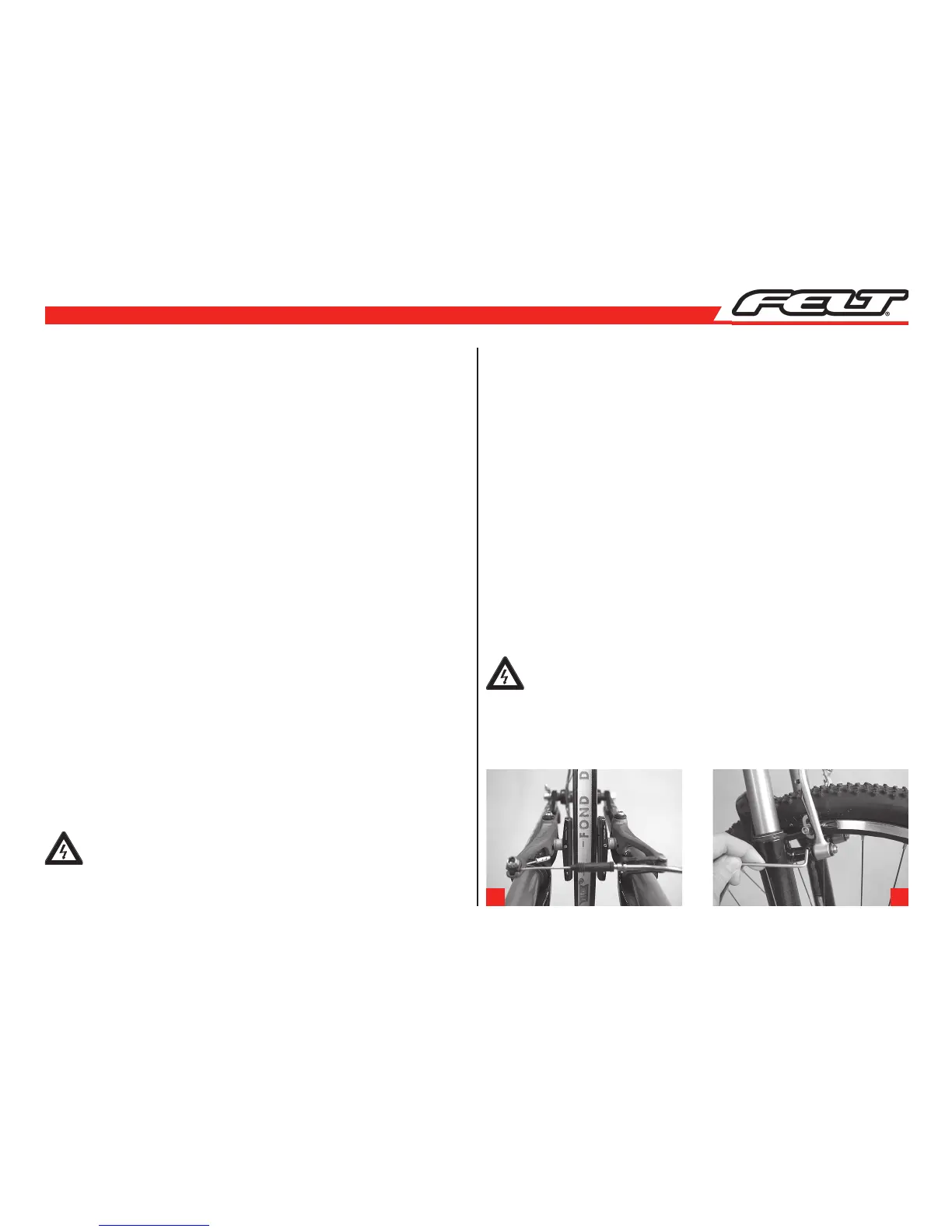
The brake pads must hit the rim simultaneously, first touching it with the front
portion of their surface. At the moment of first contact the rear portion of the pads
should be a millimetre away from the rim. Viewed from above, the brake pads form
a “V” with the trough pointing to the front (a). This V-shaped setting prevents the
brakes from screeching when applied. To align the brake pads, release the fixing
screw, realign the pad and retighten the fixing screw.
The brake lever must always remain clear of the handlebars. You should not be able
to pull it all the way to the handlebars even in the event of an emergency stop.
A correctly adjusted brake will match all these points.
Adjusting the position of the brake pads relative to the rims requires a
considerable degree of skill. Replacing and adjusting the brake pads is a
job best left to your FELT dealer.
Synchronizing and adjusting the brakes
Almost all brake designs have a bolt located next to one or both brake pads for
adjusting the initial spring tension (b). Adjust this bolt until the distance between
brake pads and rim is the same on either side.
To adjust the brakes, unscrew the knurled lock ring located at the point where the
brake cable enters the brake lever on the handlebars.
Unscrew the knurled, slotted adjusting bolt by a few turns. In this way you are
reducing the free travel of the brake lever.
Keeping the adjusting bolt fixed, tighten the lock ring against the brake lever mount.
This prevents the adjusting bolt from coming loose by itself.
((a) page 31)
Ensure that the slot of the bolt faces neither forward nor upward, as this would
permit water or dirt to enter.
Always test the brakes’ function when stationary after adjusting them,
making sure that the brake pads engage fully with the rim when you pull
them hard.
Following the stationary test, check the brakes in a place clear of traffic.
a b



 To Next Page