44
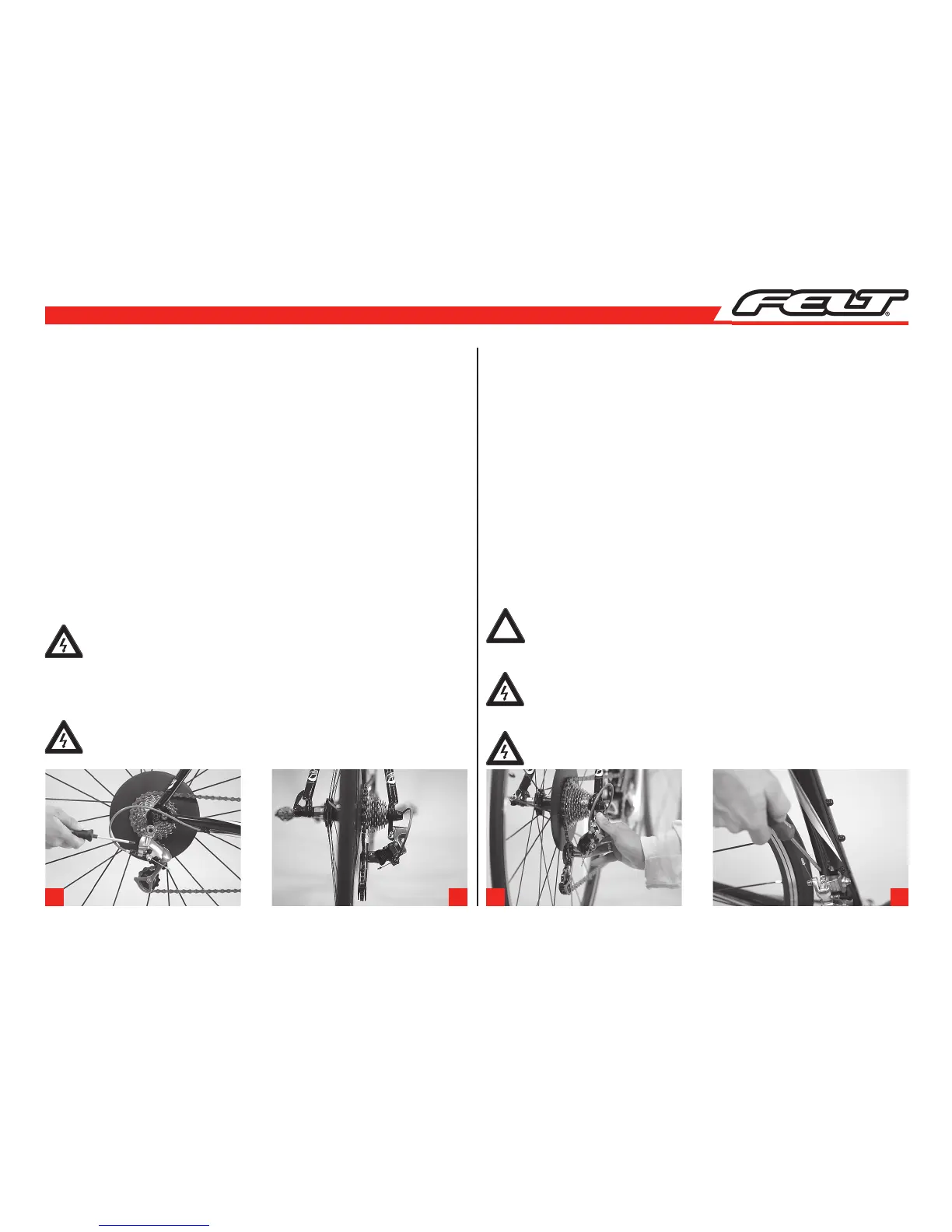
If the screws are not marked, you will have to find out by trial and error. Turn one
of the screws, counting the number of turns, and watch the derailleur (a). If it does
not move, you are turning the wrong one. Turn back the counted rotations to find
its original position.
Then try the same procedure with the derailleur shifted to the lowest gear (largest
sprocket). Turn the “L” limit screw clockwise to shift the derailleur away from the
wheel and anticlockwise to shift it towards the wheel.
Once the limit screws are checked and set, change up and down through the gears
(b). When the chain runs on the largest sprocket see whether you can shift the gear
changer even further by moving the gear lever to the end of its travel. Then press
the gear changer further towards the spokes by hand (c). Spin the wheel. If the
derailleur cage moves towards the spokes or if the chain begins to move beyond
the largest sprocket, the limit screw marked “L“ requires further adjustment until
the gear changer is clear of the spokes.
Adjusting the front and rear deraileurs is a job which must be carried out
by an experienced mechanic unless you are entirely comfortable in doing
so. If you want to do this yourself, be sure to read the operating instruc-
tions of the gear manufacturer. If your gears give you any trouble, please
ask your FELT dealer for advice.
Always go on a test ride in a place free of traffic, after adjusting the gears
of your bike.
Front gear changer (front derailleur)
Adjusting the swivelling range of the front derailleur requires a great deal of experi-
ence. The range within which the front derailleur keeps the chain on the chainring
without itself touching the chain is very small. It is often better to let the chain drag
slightly on the derailleur than to risk having the chain fall off the chainring, which
would interrupt the power train. If the chain tends to jump off the chainring, you will
need to reduce the swivelling range in the same way as with the rear derailleur, i.e.
by turning the limit screws marked “H“ and “L“ (d). It is advisable to let your FELT
dealer do that job.
As with the rear derailleur, the cable of the front derailleur is subject to stretching
during initial usage and hence to reduced precision in gear changing. If necessary,
shift to the small chainring and increase the tension of the bowden cable by turning
the adjusting bolt through which it passes at the entry to the gear shifter or at the
frame in the down tube area on a road bike.
Always check after an accident whether the front derailleur is still parallel
to the chainring, and the rear derailleur is parallel to the sprockets of the
cassette.
Adjusting the front gear changer is a delicate job. Improper adjustment
can cause the chain to jump off, thus interrupting the power train. This
can cause an accident!
Always go on a test ride in a place free of traffic, after adjusting the gears
of your bike.
!!
a b c d



 To Next Page