75
Adjustment
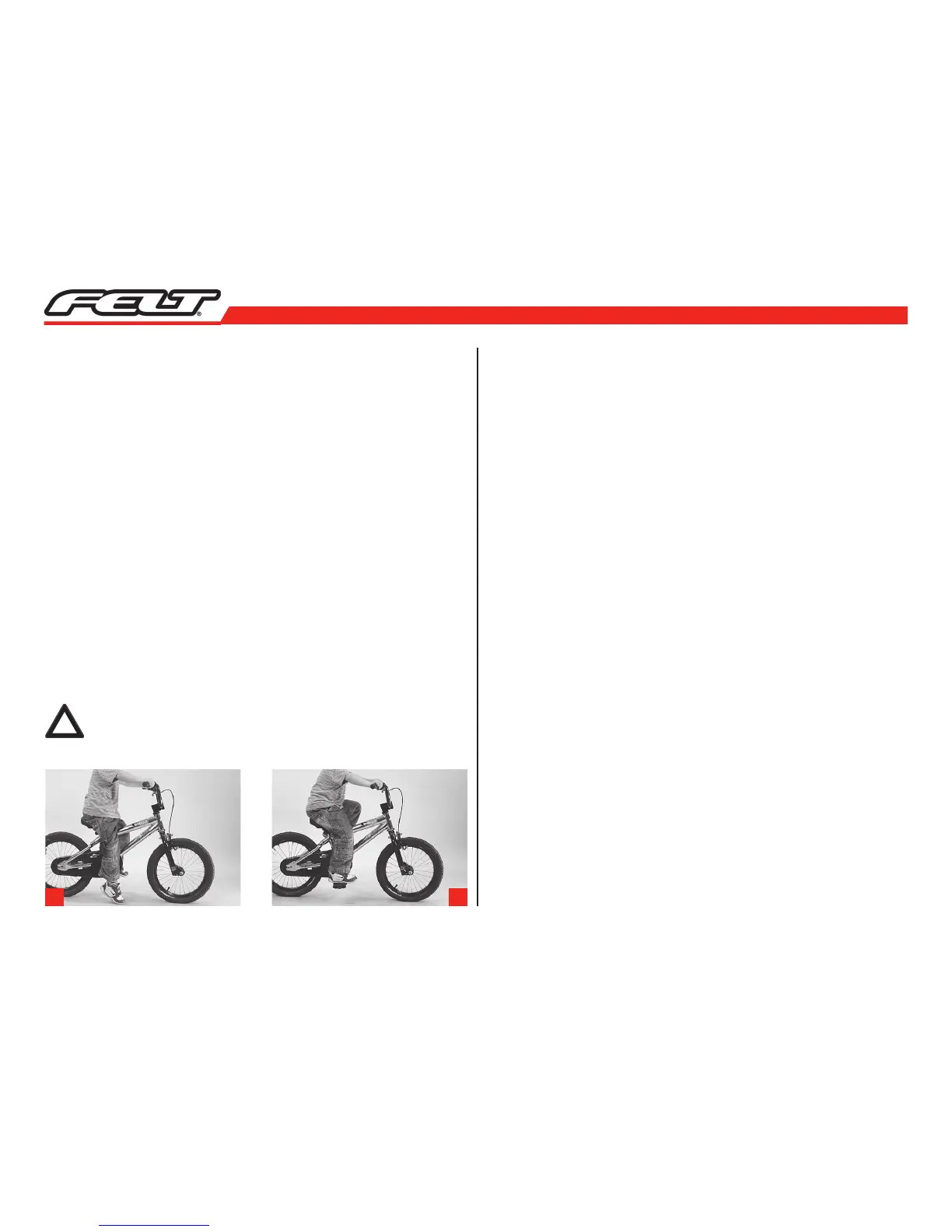
Adjusting the bicycle to the bodily proportions of a child is even more important
than in the case of an adult. In determining the height of the saddle you will need
to find a compromise that allows the child to reach the ground with both feet when
sitting on the saddle while at the same time giving them enough space for pedal-
ling (a).
Set the saddle to a height where the child’s leg is fully stretched when the heel rests
on the pedal at its lowest point (b).
As a second test, Make sure the child’s knee is slightly bent when the ball of the
foot rests on the pedal in this position.
During both tests the child’s pelvis should rest horizontally on the saddle (when
viewed from behind the seated rider). As a final check, see whether the child can
still reach the ground with both feet at the same time when sitting on the saddle. If
this is not the case, lower the saddle a little.
Look up the chapter titled ”Adjusting the bike to the rider” on how to adjust the
height of the saddle.
With children and teenagers check the height of the saddle at least every
three months!
!!
Another condition that can impair the child’s riding comfort, is when the handlebars
are too far away from the saddle. For this reason, the saddle has been designed to
allow fore-to-aft adjustment. Using a spanner or Allen key, unscrew the bolt or nut
of the saddle clamp at the top of the seat post by one to two turns.
Do not unscrew the nut all the way, otherwise the whole mechanism may come
apart. Push the saddle into the desired position and tighten the bolt or nut again.
Make sure the saddle is horizontal and that the ratchet mechanism in the saddle
clamp engages when you tighten the bolt or nut. Try to tilt the saddle a little to
determine whether the mechanism has engaged correctly. If this is not the case,
tighten the nut further.
Make a final check on how securely the saddle is fastened by firmly trying to tilt it.
Now recheck whether the child can easily reach the brake levers.
If this is not the case, adjust the brake lever as described in the chapters titled
“Adjusting the bike to the rider” and “The brake system”.
It is important to tell the child when they practise braking that they should ride more
slowly in wet conditions because the road becomes slippery and the brakes can
be less effective.
Get into the habit of doing the checks “Before every ride“ together with your
child. In this way, the child will learn to handle the bike properly and you will be
able to detect any defects that have developed during use. Encourage your child
to tell you, if anything should not be working properly on their bike. Rectify the
fault immediately or take the bike in to your FELT dealer for repair, if you are in any
doubt.
a b



 To Next Page