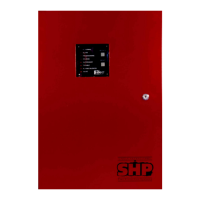
Twinflex V3 Control Panel Engineering and Commissioning Manual
32
Checkpoint Plus
Introduction
The instructions in this section apply only to the Checkpoint Plus mode which is a part of the Twinflex
control panel and is supplementary to the rest of this manual. Prior to September 2007, two separate
versions existed, Standard and Checkpoint Plus.
The Checkpoint Plus technology has been designed primarily to address the problem of unwanted alarms
in apartment blocks or ‘Houses of Multiple Occupancy’ (HMO).
The Checkpoint Plus facility enables certain detector alarms to be checked, or confirmed, before the entire
system is activated. Further more, a local (at that detector) or zonal ‘Alarm Confirmation Warning’ sound is
given, allowing any persons nearby to check the area for a possible fire. If the cause of the alarm is
removed (i.e., burnt toast or a dust cloud) then the ‘Alarm Confirmation Warning’ will cease and the system
returns to normal. If the cause of the alarm is still present at the end of the confirmation time then the entire
system enters a full alarm state.
System planning prior to installation is essential, as certain zones need to be cabled separately, in order
that they may be configured for ‘Dwelling’ (delayed) or ‘Communal’ (instant). I.e., The stairwell and
communal corridors in a block of apartments will need to be wired on separate zones to the apartments.
If there is any doubt please refer to your supplier.
Zone Modes
Each zone on the system can be separately configured as an ‘Instant’ (normal) zone, or as a ‘Delayed’
zone. ‘Instant’ zones should be used for communal areas in apartment blocks and for escape routes such
as stairwells, where normal fire alarm operation is detected. ‘Delayed’ zones introduce an ‘Alarm
Confirmation Delay’ to a smoke or heat detector alarm on a zone, for use within apartments and other
areas where unwanted alarms are likely to be a problem. Manual Call Points always give instant operation,
whichever type of zone they may be a part of.
Instant Zones - Normal Operation in Communal Areas
Communal zones are those covering general access areas such as entrance hallways, corridors, stairwells
etc., including any area which is an escape route for a private or dwelling area.
The activation of any Manual Call Point or detector in these areas generates an immediate alarm and
operates the sounders in all areas.
The drawing below shows a typical arrangement with the communal areas highlighted. This area should be
cabled on it’s own zone and set as an ‘Instant Zone’.
CORRIDOR
FLAT
FLAT
FLAT
FLAT
FLAT
FLATFLATFLATFLAT
FLAT



 To Next Page