32
CREW MEMBERS AND THEIR DUTIES
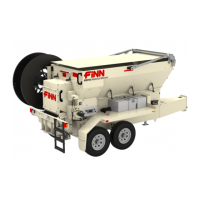
1. The Operator controls the placement of the mulch by moving and aiming the discharge
hose.
2. The Loader(s) feed material to the machine by using a skid steer or loader tractor,
dumping it directly into the hopper or by shoveling from the tow vehicle to the feed floor
via the feed chute.
THE MATERIAL-FEED SYSTEM
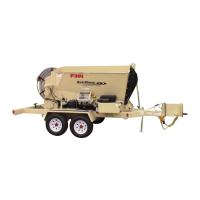
The material-feed system on the Bark Blower has been designed to give fast and uniform
mechanical feeding. The adjustable feeding rate and the automatic reverse control system allow
the use of varied materials while obtaining maximum production. The system is an integration of
the following four subsystems, all of which contribute to efficient material flow:
SUBSYSTEM 1: MATERIAL-HANDLING GROUP
The four major components of the material-handling group are the blower, the drag chain
conveyor or floor, the feed roll, and the rotary air valve.
The blower is a rotary lobe, positive-displacement type unit having two double-lobe impellers.
The blower is directly driven off the engine flywheel via a flexible coupling. Therefore, whenever
the engine is running, air is being pumped through the system. The blower is equipped with a
relief valve, limiting maximum air pressure to 10 psi (69 kPa), an inlet and outlet silencer for
noise attenuation, and an inlet air filter.
The drag chain conveyor moves material from along the hopper interior to an opening located
at the rear of the machine where the feed roll is located. The feed roll ensures a uniform feed
of bulk material to the rotary air valve. The drag chain conveyor is powered by a variable-speed
hydraulic motor, which also powers the feed roll.
The rotary air valve receives the material from the drag chain conveyor and feed roll as well
as pressurized air from the blower. Its primary function is to convey the bulk material from the
hopper, to a sealed chamber where the blower air picks it up and blows it out of the discharge
hose. To enable the Bark Blower to convey fibrous material, the rotary air-valve housing is
equipped with a cutting knife and the vanes on the rotor are angled and hardened. If any long
strands of fibrous material should protrude above a vane, it will be sheared off by a scissor-like
action between the vane and cutting knife. The rotor of the rotary air valve is directly coupled and
driven by a bi-rotational hydraulic motor.


 To Next Page