800027-A 25 06/05/2023
4.6.6 Altitude Correction Factor (ACF)
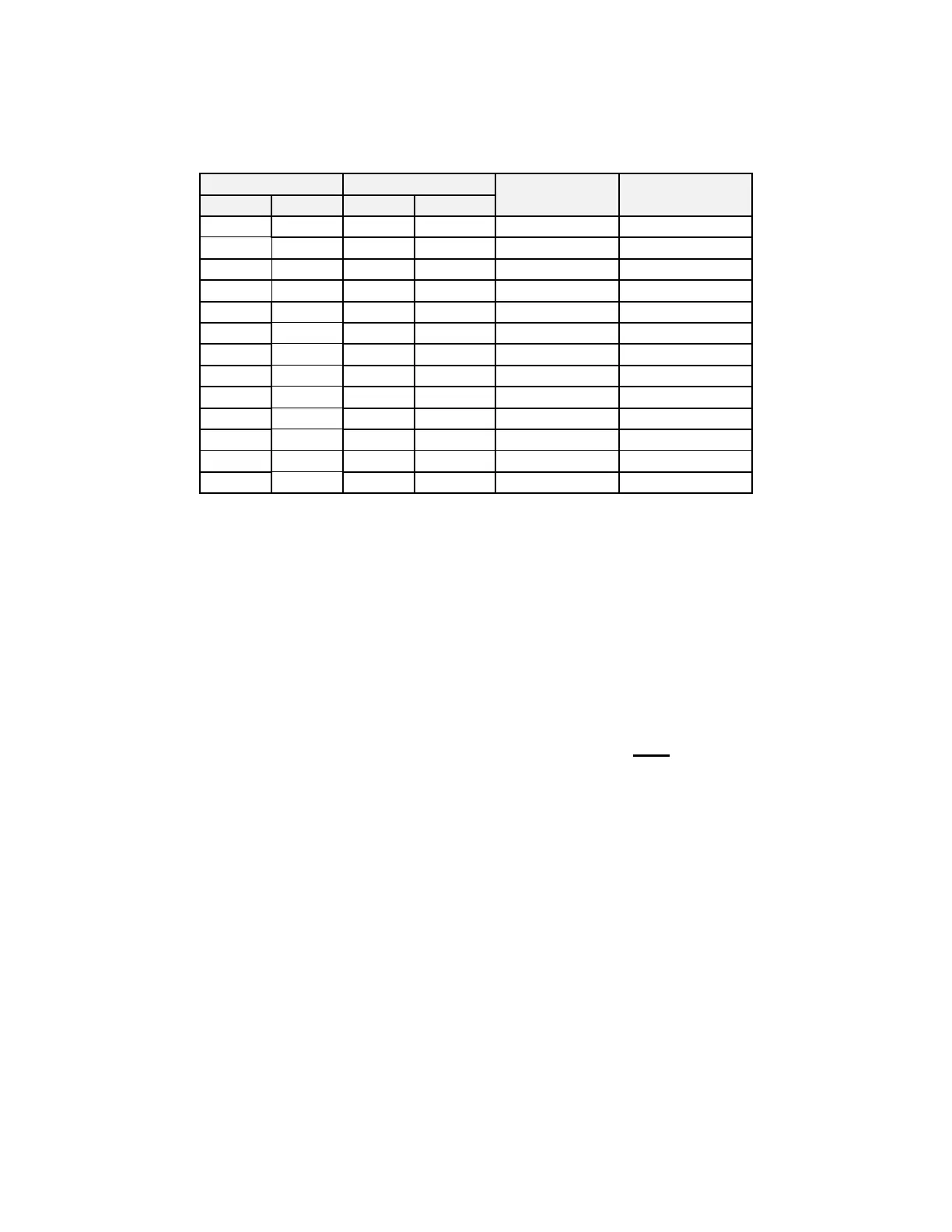
The design quantity of agent shall be adjusted to compensate for ambient pressures that vary with elevations greater than 1,000 ft. [300 m] above
standard sea level, see Table 31 – Atmospheric Correction Factor for applicable multipliers.
Table 31 – Atmospheric Correction Factor
4.6.6.1 MCF Example
If the calculated agent quantity was 18 lbs (8.17 kg) of FK-5-1-12 and the altitude was 2,000 ft (0.61 km) above sea level – the resulting ACF should
be applied from the table as “0.93”, which is 93% of the calculated mass at sea level, using the MCF column:
18 lbs (8.17 kg) x 0.93 = 16.74 lbs (7.60 kg)
The resulting mass of agent required at 2,000 ft (0.61 km) elevation above sea level, would be 16.74 lbs (7.60 kg).
4.6.6.2 VCF Example
If the required protected volume was 90 ft
3
(2.55 m
3
) and the hazard was a class B risk at 70°F (21.1°C) (Table 27 – Class B Fire Enclosure Volume
Limitations) a 5 lb FK-5-1-12 system could be specified. However if the altitude was 1,000 ft (0.30 km) below sea level, the VCF is stated as “0.96”,
we can only use 96% of this protected volume:
90 ft
3
(2.55 m
3
) x 0.96 = 86.4 ft
3
(2.45 m
3
)
This means the 940555 system can only protect 86.4 ft
3
(2.45 m
3
) at 70°F, as our volume is 90 ft
3
(2.55 m
3
) we would need to use a larger system.
4.6.7 Ventilation Shut-Down and Unclosable Openings
Openings in the protected enclosure must be sealed. When the unit is discharged into an enclosure, normal gaps and openings under doorways
must not impact system performance. Doors and normal vents that are required in the enclosure must be closed prior to, or at the time of unit
discharge. Doors or closures that normally swing to a closed position and are not held open do not require a system generated mechanism to
operate. Doors and closures, including ventilation, which are held open while operating must have devices installed to close at the start or prior to
unit discharge. All doors should be closed and ventilation fans shut down prior to discharge.
4.6.8 Pressure Relief Vent Area
In the event of a discharge, the protected enclosure must have sufficient structural strength and integrity to contain the agent discharge. If the
pressure difference across the enclosure boundaries presents a threat to the hazard enclosure, venting shall be provided to prevent excessive
pressures.
Guidance to determine the pressure relief vent area can be found in the FSSA Application Guide to Estimating Enclosure Pressure & Pressure Relief
Vent Area for Use with Clean Agent Fire Extinguishing Systems and shall be in accordance with NFPA 2001 requirements.


 To Next Page