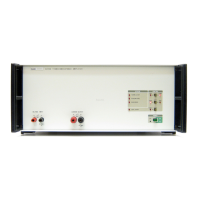
52120A
Users Manual
3-10
OUTP? Gets back 1 if the Product is in operate mode.
Gets back
0 when the Product is in standby
mode.
OUTPut:TERMinal:ROUTe(?) <cpd>
Description Sets or gets which front-panel output terminal is in use.
Parameters <cpd> = LOW Output current on LOW terminals. 2A and 20A
ranges.
HIGH Output current on HI terminals. All ranges.
Example
OUTP:TERM HIGH Puts the output current through the HI terminals
on the front panel of the Product.
OUTP:TERM? Gets back HIGH or LOW.
[:SOURce]:CURRent:RANGe(?) <nrf>
Description Sets or gets the current range of the Product.
Parameters <nrf> = 2 Sets output current range to 2 A.
= 20 Sets output current range to 20 A.
= 120 Sets output current range to 120 A.
Example
CURR:RANG 20 Sets output current range to 20 A.
CURR:RANG? Gets back 2, 20, or 120.
[:SOURce]:CURRent:LCOMp(?) <bool>
Description Sets or gets the state of the LCOMP (inductive-load compensation)
function.
Parameters <bool> = ON or 1 Turns on LCOMP.
OFF or 0 Turns off LCOMP.
Example
CURR:LCOM ON LCOMP on.
CURR:LCOM? Gets back 1 or 0.
[:SOURce]:CURRent:COMPliance?
Description Retrieves the percentage of compliance.
Example
CURR:COMP? Gets back a number that shows the percentage of
compliance.
SYSTem:VERSion?
Description Retrieves the SCPI command version of the Product.
Examples
SYST:VERS? Gets back the SCPI version.
Returns
1999.0 This is an example. The number returned can be
different,
SYSTem:ERRor?
Description Retrieves an error from the error queue. Errors are retrieved in first-in,
first-out (FIFO) sequence. The response has two elements: a code number
and error message. For some messages, supplementary information is
supplied by a “;” separated clause. The error queue stores a maximum of
50 errors at which point no more errors are stored until errors are removed
from the queue.
Examples
SYST:ERR? Gets back the error at the head of the queue
(earliest).



 To Next Page