6
Adjustment and Verification
Introduction
Introduction
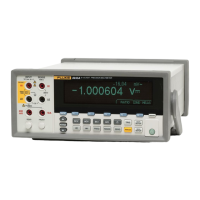
Chapter 6 describes the calibration menus, and lists the adjustment and performance
verification procedures for the 8508A Reference Multimeter. Remote commands for
adjustment of the 8508A are described in Chapter 4 Remote Operations using the
IEEE 488 Interface. In this chapter menu and button selections are shown as all-caps text.
Adjustment Overview
The 8508A is adjusted via an electronic autocal feature which allows full adjustment of
all functions from the front panel (or remotely via the IEEE 488.2 Interface). No
hardware adjustments are required.
For each combination of function and range, an appropriate calibration standard (source)
is input. At each setting, one keystroke immediately calibrates to the standard by
updating an internal non-volatile memory. The instrument automatically determines
whether the operation is to be a Zero or Range Gain adjustment; or for AC ranges
whether it is to be a Zero, LF Gain or HF Gain adjustment. As part of the adjustment
procedure, a non-volatile input-offset compensation is derived independently for the front
and rear inputs. The autocal process can operate only when the rear panel Calibration
switch is in the ‘Enable’ position. Applying a calibration integrity seal to prevent access
to the rear panel Calibration switch is a convenient way to ensure the security of
adjustment. When an adjustment operation is performed the 8508A internal adjustment
memory is immediately updated. It is possible to adjust a single range or single point if
the user chooses to do so. However, it is recommended that the adjustment procedure
listed later in this chapter be followed closely.
Adjustment Interval and Performance
It is recommended that the 8508A be adjusted on either a 365-day or 90-day interval
depending on the requirements of the applications for which the 8508A is used and the
performance specifications required. The performance of the 8508A is specified for
periods of 365 days and 90 days – if readjustment takes place on a 90-day cycle use the
90-day specifications for improved performance.
During manufacture, the 8508A is adjusted with low uncertainties, reflected in the
Absolute Specifications listed in Chapter 5 Specification section. After readjustment, the
user should apply the uncertainties for the standards and for the process applicable to that
adjustment by combining those calibration uncertainties with the 8508A Relative to
Standards specifications, as described in Chapter 5.
Many 8508A owners prefer using Fluke calibration services instead of maintaining their
own standards to support their 8508A.To help ensure optimum performance from the
8508A, Fluke offers our calibration service at a variety of worldwide locations. Our
worldwide service network provides fast efficient calibration to ensure low uncertainties
and optimum accuracy consistent with the original adjustment at manufacture.
Adjustment Points
There is generally more than one adjustment point for each range. An initial measurement
(made when the adjustment is triggered) determines the intended adjustment point. The
points for each range and function are listed later in this chapter.
6-3



 To Next Page