EasyManua.ls Logo

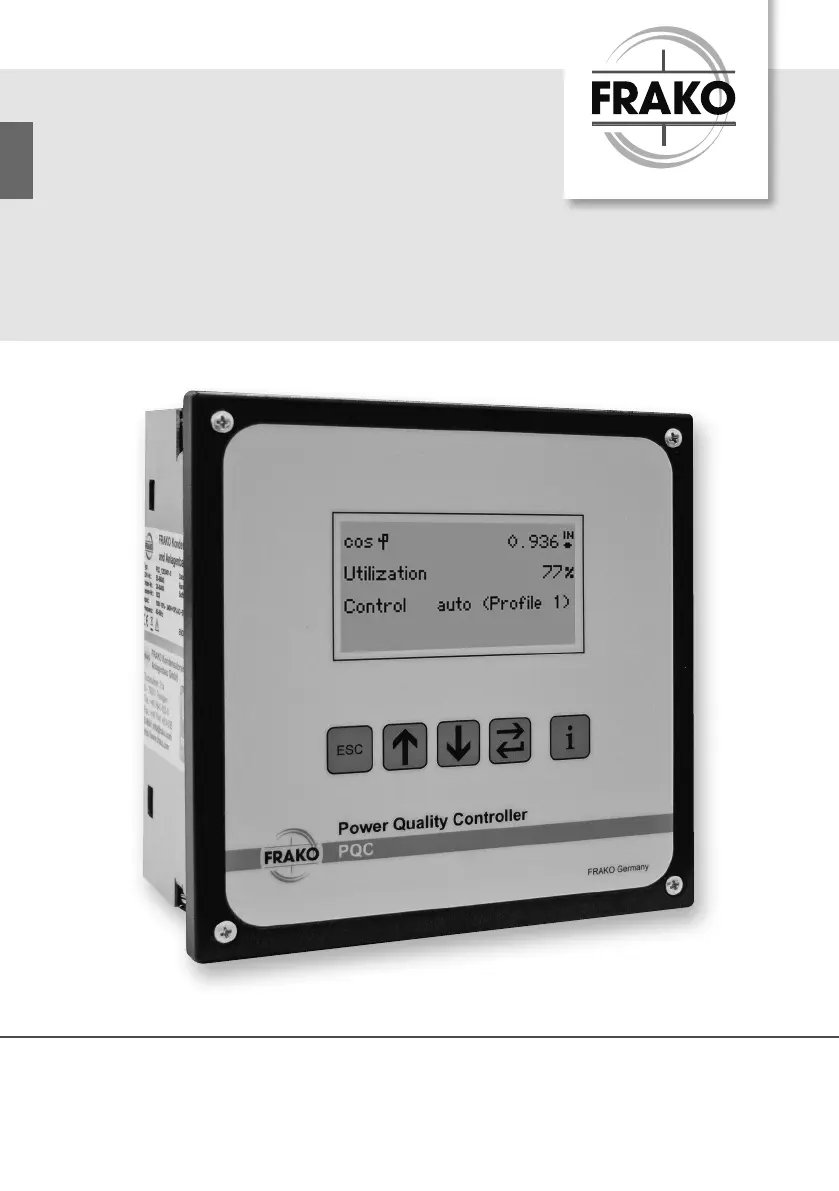
frako PQC - User Manual

frako PQC
80 pages
Print Icon
To Next Page IconTo Next Page
Loading...
FRAKO Kondensatoren- und Anlagenbau
www.frako.com
OPERATING MANUAL
The controller that maximizes reliability
and monitors power quality
PQC
Power Quality Controller

Table of Contents

Questions and Answers

  • B
    Brittany MooreNov 21, 2025
    What to do if frako PQC shows 'Connection not detected' or 'Stages not detected'?
    • J
      Jessica AcevedoNov 21, 2025
      Several issues can cause this problem. First, a fault in the control circuit or missing/defective fuses for the capacitor stages could be the reason. Check the control circuit against the connection diagram and verify the fuses. Ensure capacitors are energized after switching. The current transformer might be in the wrong location, so check its installation according to the connection diagram. Severe reactive power fluctuations can also cause this; wait for the power supply to stabilize and manually set the c/k factor and connection type. If the PQC programming has c/k, switching time delay, or discharge time set too high, check and adjust these settings. In automatic operation, an incorrectly identified response current c/k can cause the issue; check the control circuit and repeat the cal...
  • S
    sharon82Aug 25, 2025
    How to troubleshoot a frako Controller PQC with no display?
    • M
      Michael CunninghamAug 26, 2025
      The issue could be due to a power problem. Check that the correct instrument power supply is connected to the frako Controller and that the fuse in the circuit has not blown.
  • O
    odonnellchadAug 27, 2025
    What to do if frako PQC shows 'Current less than set limit'?
    • H
      Hannah ReedAug 27, 2025
      This can happen due to a break or short-circuit in the current transformer cable. Use an ammeter to check the current in the current path (I * 0.015 A). It can also be caused by too low current in the current path, in this case, install a smaller current transformer. A defective current transformer can also be the reason, so check the current transformer.
  • M
    michelle37Aug 27, 2025
    Why doesn't my frako Controller switch out all stages under low load?
    • R
      Rose ArmstrongAug 27, 2025
      This issue may arise if the c/k is set too high; adjust the c/k according to the table. The frako Controller might be in manual mode, so deactivate manual control. It's also possible that the wrong control profile is selected; adjust the control profile to suit system requirements.
  • X
    xrodriguezAug 28, 2025
    What causes 'Voltage less than set limit + Current less than set limit' on frako Controller?
    • P
      parkerchristopherAug 28, 2025
      This problem is caused by multiple zero-voltage crossings in measured voltage. To solve it, change the setting for the Network nominal parameters from Auto to the appropriate network frequency (50 Hz or 60 Hz) on your frako Controller.
  • S
    stacy19Sep 16, 2025
    Why frako Controller does not switch in stages in automatic mode?
    • B
      Brenda SmithSep 16, 2025
      If no stages are switched in when the frako Controller is in automatic mode despite an inductive load, it could be because: * When the Controller was programmed, c/k, switching time delay, or discharge time have been set too high. Check the programming and change if necessary. * In automatic operation, the response current c/k was not correctly identified. Check the control circuit against the connection diagram and repeat the calibration procedure. * Another current measuring instrument (e.g., an ammeter) has been connected in parallel with the current path. All measuring instruments in the current path must always be connected in series.
  • D
    Danielle EverettSep 14, 2025
    What to do if frako Controller displays less cos target?
    • C
      clongSep 14, 2025
      If the displayed cos ? is less than the target cos ?, even though the frako Controller has switched in all stages, consider the following: * The type of connection may be incorrectly entered. Select the type of connection again. * There might be a fault in the control circuit. Check whether the capacitor contactors have been activated. * There could be a fault in the capacitor circuit. Check the fuses and contacts of the capacitor contactors, and possibly measure the currents of each capacitor stage with a tong tester. * There may be severe reactive power fluctuations. Read off the corrective power still lacking from the menus. * The calibration may be faulty. Repeat the calibration procedure.
  • B
    Bradley BookerSep 15, 2025
    What to do if frako Controller cannot determine the type of connection?
    • J
      juanperrySep 15, 2025
      If, during the automatic connection and stage identification procedure, the frako Controller can't determine the type of connection or the relative value of the stage capacitance, it might be due to: * A fault in the control circuit (contactors not switching). Check the control circuit against the connection diagram and check the fuse. * Fuses for the capacitor stages missing or defective. Check whether capacitors are energized after switching. * The current transformer installed in the wrong location. Check whether the current transformer has been installed as per the connection diagram. * Severe reactive power fluctuations. Wait for the power supply to stabilize; set the c/k value and connection type manually.
  • L
    Larry BeardSep 6, 2025
    What to do if frako Controller indicates voltage is less than set alarm limit?
    • D
      David DanielSep 6, 2025
      If the frako Controller indicates that the voltage is less than the set alarm limit, even though a voltage is displayed, it's likely that the alarm limit hasn't been adjusted for the network nominal voltage. To fix this, set the correct alarm limit for the network nominal voltage.
  • P
    Patrick MeyerSep 4, 2025
    What to do if frako PQC Controller shows 'Voltage less than set limit'?
    • L
      Lisa MillerSep 4, 2025
      Set the correct alarm limit for the network nominal voltage, because the alarm limit has not been adjusted for the network nominal voltage. Note that the default setting is for 400 V networks and is triggered when the network voltage is less than 85 % of the nominal voltage.

Summary

About This Manual

Manual Objective and Safekeeping

Purpose of the manual and instructions for its storage.

Symbols and Warning Signs

Explanation of symbols and warning sign conventions used throughout the manual.

Reference Documents

Lists related documentation for further information on the PQC.

Safety

Intended Use and Potential Dangers

Defines the proper application of the PQC and lists instrument-specific hazards.

Management Information and Disclaimer

Outlines personnel qualifications, user responsibilities, and liability limitations.

Relevant Standards and Repair

Lists applicable standards for installation and procedures for obtaining repair services.

Technical Data

Instrument Description

Function and Operation

Explains the PQC's function, power factor correction, and regeneration modes.

Instrument Versions and User Interface

Details PQC models and describes the device's operating keys and their functions.

Password Protection

Explains the system for securing sensitive menu items from unauthorized access.

Installation

Mounting and Location Procedures

Covers preparation, suitable location selection, and physical mounting of the PQC.

Electrical Installation and Connections

Details electrical wiring, specifications, diagrams, and connection steps for the PQC.

Commissioning and Initial Start-up

Covers start-up preparations, initial setup dialogue, and connection/stage identification.

Description of the Menu

Main Menu Overview

Introduces the main menu structure and primary groups: Display, Configuration, About PQC.

Display Options

Details available displays for PFC overview, System & PQ, Service, and Alarms.

Configuration Options

Explains parameter settings for system, PFC equipment, control, alarms, and communication.

Service Functions and Interface

Covers temperature I/O, communication, service interface, and 'About PQC' information.

General Operation

Cleaning and Maintenance

Safety, Cleaning, and Maintenance

Provides safety warnings, cleaning methods, and maintenance information for the PQC.

Troubleshooting

Alarm and Fault Resolution Guide

A guide for identifying and resolving common PQC alarms and faults.

Decommissioning and Disposal

Decommissioning and Removal Procedures

Details procedures for safely decommissioning and removing the PQC from installation.

Storage and Disposal Guidelines

Provides instructions for storing the PQC and guidelines for environmentally sound disposal.

frako PQC Specifications

General IconGeneral
Brandfrako
ModelPQC
CategoryController
LanguageEnglish