9ENG8008 GFM436 User Manual
GFM436 Product Specification- 19
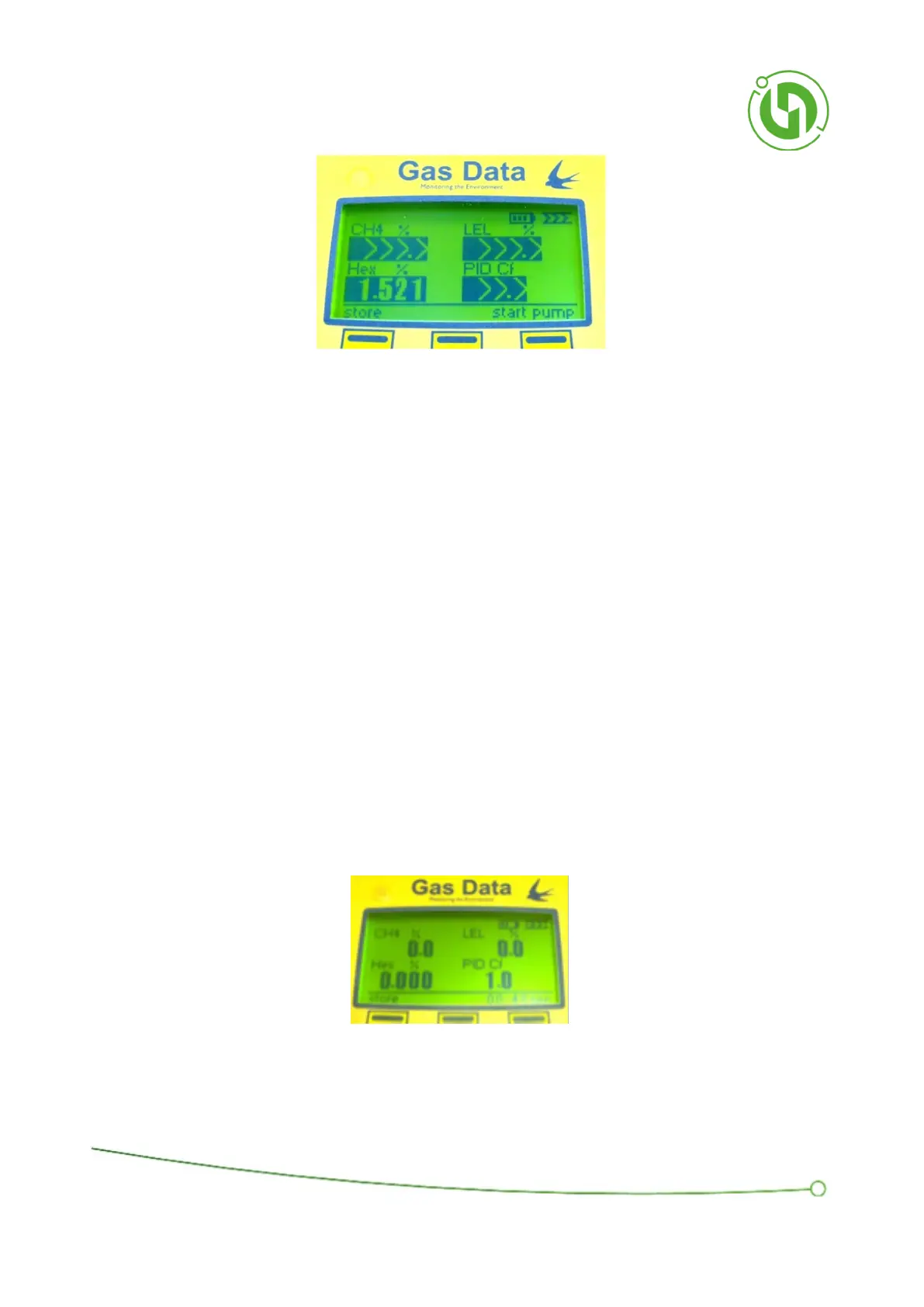
This response range is chosen as it allows typical concentration levels of hydrocarbon vapours that would be found
in contaminated ground due to the spillage of common liquid fuels and oils to be quantified on a standard scale as
a percentage hexane vapour equivalent. The Hexane signal is taken from the infra-red bench and processed to
another output on the instrument display in the scale 0.000 – 2.000%.
It does not need additional gas calibration as the infra-red beam is normalised using the existing methane
calibration gas. At 100% Methane concentration the Hexane reading will be typically showing 0.200 – 0.300% and
will continue to rise if there is a hydrocarbon problem present. Laboratory sampling is needed to establish a
baseline and identify the specific hydrocarbon compound but repeat tests with the GFM436 will allow trends to be
determined with great consistency.
Using this technique, the Hexane reading can also be used for an immediate indication that remedial action on the
borehole has been successful or not. Boreholes can be re-measured knowing that readings are “in scale” by
referencing the original readings taken. No more waiting for samples to come back from the lab!
Boreholes across a site can be compared and peak readings established to indicate those of significant interest,
worst case and negligible etc.
6.3.3 PID Compensation Factor Prediction
The PID (Photo Ionisation Detector) is the instrument widely accepted by the industry to quantify other
hydrocarbon gases present in ground boreholes. It is a good choice of instrument as it is highly sensitive to a broad
range of hydrocarbon gases and it does not directly detect methane. It uses a UV light source to ionise hydrocarbon
gases in its sample cell so that they can be quantified using an electronic charge amplifier. However, even small
quantities of methane present in a borehole can absorb the UV light thus quenching the ionisation and de-
sensitising the instruments response leading to under measurement or complete non-detection of any
hydrocarbon gases present.
The built in PID Compensation factor in the GFM436 is a figure derived from extensive testing of the non-linear
characteristics of this phenomenon and is displayed on the GFM instrument as a number between 1 and 10. This is



 To Next Page