12 iNET Series Reference Manual 05-2806A01, Rev. J
1.4 NETWORK DESIGN
CONSIDERATIONS
1.4.1 Extending Network Coverage with Repeaters
What is a Repeater System?
A repeater works by re-transmitting data from outlying remote sites to
the Access Point and vice-versa. It introduces some additional
end-to-end transmission delay but provides longer-range connectivity.
In some geographical areas, obstacles can make communications diffi-
cult. These obstacles are commonly large buildings, hills, or dense
foliage. These obstacles can often be overcome with a repeater station.
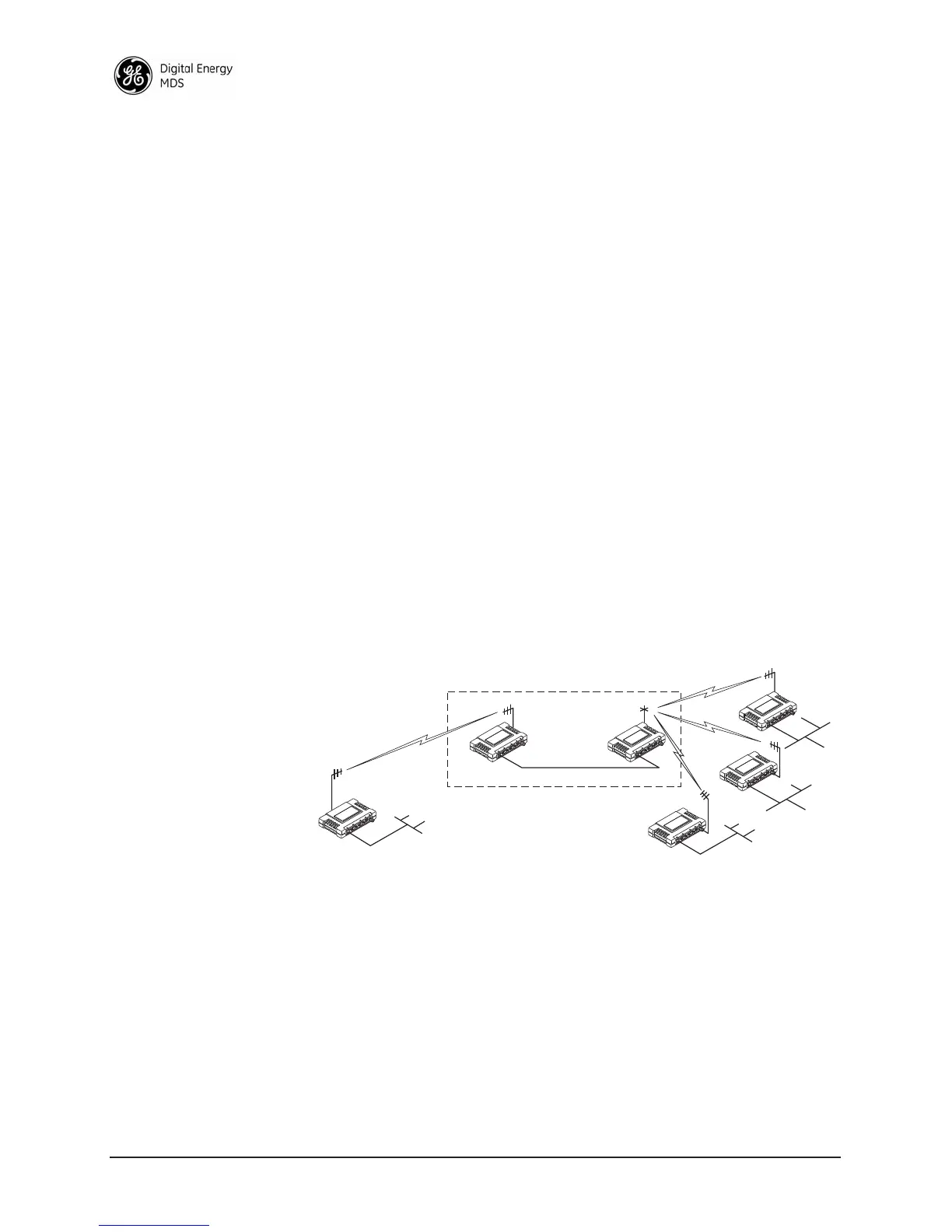
Option 1—Using two transceivers to form a repeater station
(back-to-back repeater)
Although the range between transceivers can be a nominal 40 km (25
miles) over favorable terrain, it is possible to extend the range consider-
ably by connecting two units together at one site in a “back-to-back”
fashion to form a repeater, as shown in Figure 1-8. This arrangement
should be used whenever the objective is to utilize the maximum range
between stations. In this case, using high-gain Yagi antennas at each
location will provide more reliable communications than their counter-
parts—omnidirectional antennas.
Invisible place holder
Figure 1-8. Typical LAN with a Repeater Link
Overview
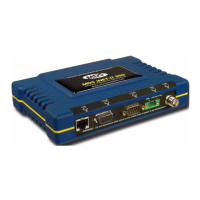
Two transceivers may be connected “back-to-back” through the LAN
Ports to form a repeater station. (The cable must be a “cross-over”
Ethernet cable for this to work). This configuration is sometimes
required in a network that includes a distant Remote that would other-
wise be unable to communicate directly with the Access Point station
due to distance or terrain.
The geographic location of a repeater station is especially important. A
site must be chosen that allows good communication with both the
Access Point and the outlying Remote site. This is often on top of a hill,
building, or other elevated terrain from which both sites can be “seen”
Access Point
Remote
Remote
Remote
Remote
Access
Point
LAN/WAN
REPEATER
Crossover Cable
LAN
LAN
LAN
Ethernet
POINT-TO-POINT LINK


 To Next Page