4 - 13
2. Raise the seat plate.
3. Remove the check plug. Oil level should be at the
top of the check tube.
To add oil:
1. Remove breather. Add oil to fill tube until oil level
can be seen in check tube.
2. Replace breather and check plug.
IMPORTANT: To prevent severe damage to
transmission, always maintain proper oil level.
Check oil daily after changing transmission oil and/or
filter. Add oil if necessary. Continue daily checks until
oil level is stable.
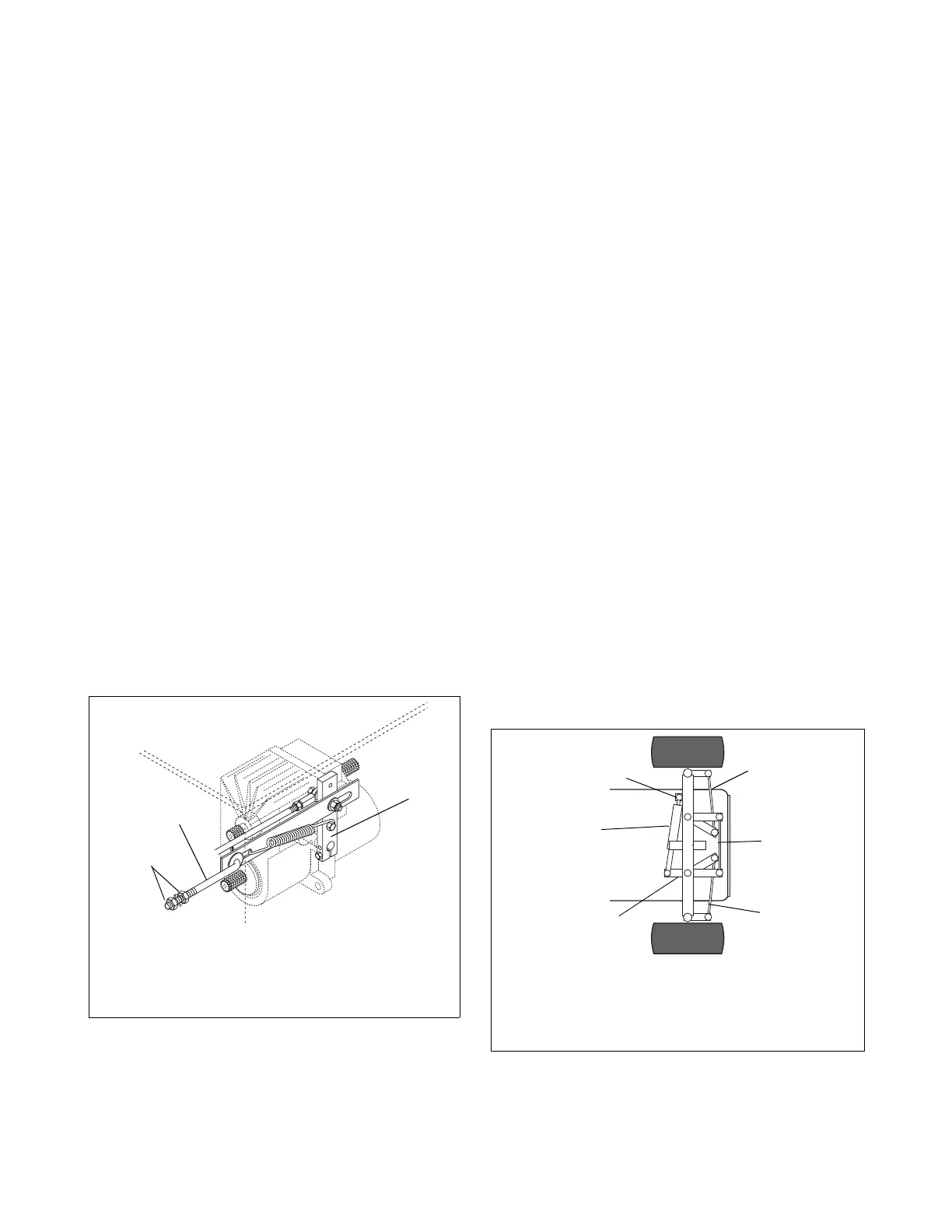
4.4 TRANSMISSION NEUTRAL
The direction control pedal should return to neutral
after foot pressure is removed. If the unit creeps while
in neutral, the neutral stop mechanism may need
adjusting (Figure 4).
NOTE: Adjusting the neutral at operating temperature
is recommended.
1. Stop the engine, remove the ignition key, and lock
the brakes.
2. Raise the seat plate and loosen the hex nuts on
the neutral detent rod.
3. Loosen/tighten hex nuts to shift pump arm in
opposite direction of the creep. Make small
adjustment (one turn or less.)
4. Tighten the hex nuts.
5. Run the unit and check for creeping.
6. Repeat above steps as necessary.
4.5 TIRES AND WHEELS
Tires
Before each use, make a visual check of the tires.
Check the pressure every 25 hours. See the side wall
for correct air pressure.
Wheel Alignment
Proper alignment of rear wheels is necessary to assure
proper steering and to reduce tire wear. Proper toe-in is
when the front of the wheels are 1/16" to 1/8" closer
together than the rear of wheels, measured at
horizontal center line of rim flange.
If unit steering wanders or excessive tire wear
develops, toe-in should be checked.
Outer tie rods should be adjusted equally; the correct
length is 13.25" from bolt centers.
The correct length for the center tie rod is 12.75" from
bolt centers on two wheel models. On models with four
wheel assist, the correct distance is 12.12". The center
tie rod should not be used to make other adjustments.
To change toe-in (Figure 5):
1. Loosen jam nuts on the outer tie rods.
2. Turn outer tie rods to adjust toe-in.
3. Tighten jam nuts.
4. Turn the wheels to each side until the idler arms
stop against the tab on the center of the axle. If the
idler arms do not reach the tab, the steering
cylinder is adjusted properly.
To adjust the steering cylinder (Figure 5):
1. Turn wheels so that cylinder is extended.
2. On one end of steering cylinder, loosen jam nut on
rod end and remove hardware fastening rod end.
3. Fully extended cylinder and lock rear wheels to
one side.
4. Turn rod end until it aligns with hole in axle
weldment or steering arm.
5. Replace hardware and tighten jam nut.
Figure 4
1. Hex Nuts
2. Detent Rod
3. Pump Arm
OF0790
1
2
3
Figure 5
1. Outer Tie Rods
2. Center Tie Rods
3. Steering Cylinder
4. Axle Weldment
5. Steering Arm
OF0800
1
1
2
3
4
5



 To Next Page