10 - 46
Voltage Measurement
There are two basic rules to be remembered when
using a voltmeter. A voltmeter measures the voltage
difference between the test leads and the voltmeter is
always connected across the circuit under test.
Current Measurement
The two rules to remember when measuring current
with an ammeter are; an ammeter measures the cur-
rent that flows through the meter, and to measure cur-
rent an ammeter must be connected into the circuit.
The latter rule means that the circuit must be opened,
and the ammeter wired into it. Because this procedure
is usually difficult, an ammeter is seldom used for trou-
bleshooting.
Resistance Measurement
An ohmmeter is used to make resistance measure-
ments and to check continuity through wires and elec-
trical components.
There is one rule to keep in mind when using an ohm-
meter. The ohmmeter has a self contained battery and
requires no electrical power. Using the ohmmeter on a
circuit that has power applied may result in damage to
the meter.
IMPORTANT: Disconnect the equipment battery when
making Ohmmeter test or damage to the Ohmmeter
may result.
IMPORTANT: An ohmmeter reads the resistance of
whatever component is connected between the test
leads. It can be used to check wires, coils, light bulbs,
or any item that conducts current.
10.3 BATTERY
Set-Up
A new battery is dry charged. Electrolyte must be
added (sulfuric acid and water).
1. Remove the battery from the unit.
2. Remove all the vent caps from the battery and set
the caps to one side.
3. Take the electrolyte which should be 1.265 specific
gravity at 80
o
F (27
o
C), and fill each cell so that the
electrolyte is level with the bottom of the fill ring.
4. The battery should stand for 1/2 hour. Now check
electrolyte level in each cell again. If necessary
add more electrolyte to bring the level up to the
bottom of the ring.
5. Charge until all cells are gassing freely, and the
specific gravity is constant over three successive
readings taken at 30 minute intervals.
6. Immediately after charging check level of
electrolyte. If the level is low add distilled water to
bring it up to the required level.
7. Replace the vent caps. It is not necessary to
tighten more than finger tight.
8. Wash off the battery to remove electrolyte which
may have spilled.
Maintenance:
Do an occasional visual inspection. See to it that the
battery remains clean, both the case and the terminals.
This visual inspection should be done once a month.
Check the level of the electrolyte. It may be necessary
to add distilled water. This should be checked before
each usage.
CAUTION: REVERSE CONNECTIONS may
result in sparks which may result in injury.
ALWAYS connect/disconnect cables in proper
order.
DIESEL FUEL ONLY
RANGE
N
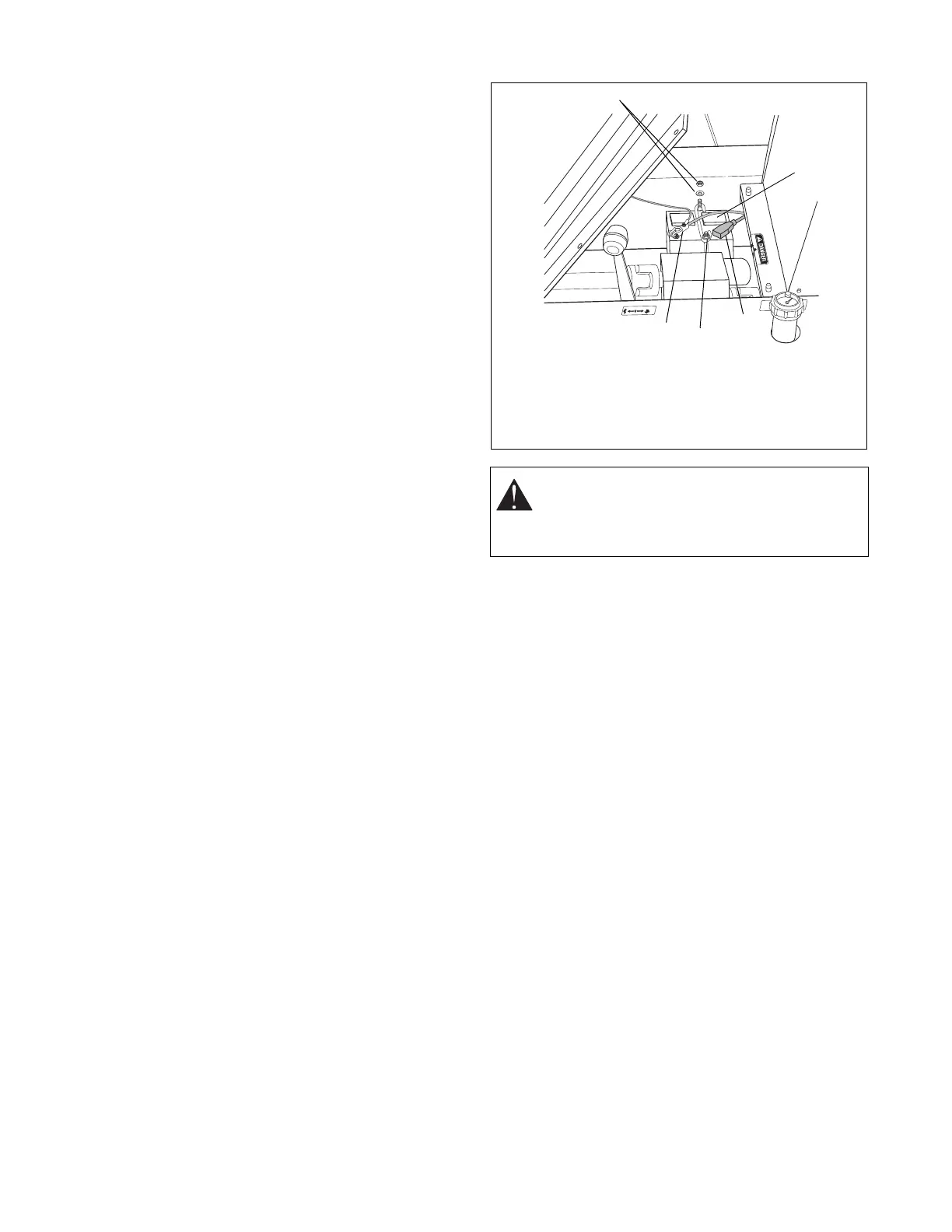
Figure 55
1. Battery
2. Positive Terminal
3. Negative Terminal
(ground)
4. Hold Down Bracket
5. Fastening Hardware
1
2
3
4
5



 To Next Page