Model G0771Z (Mfd. Since 01/21)
-37-
Cutting Dadoes with a Dado Blade
Because dado blades are much wider than stan-
dard blades, they place a greater amount of force
against the workpiece when cutting. This addition-
al force increases the risk of kickback, requiring
the operator to take additional steps when cutting
to keep their injury risk at an acceptable level.
The Model G0771Z can accommodate dado
blades up to 10" in diameter. However, you MUST
install the included riving knife while using a 10"
diameter dado blade, as it provides a barrier
behind the blade and reduces the risk of hands
being pulled into the blade if kickback occurs.
DO NOT use the riving knife if you install a dado
blade smaller than 10" in diameter. Otherwise,
the riving knife height will exceed the blade height
and the workpiece will hit the riving knife during
the cut, forcing the operator into a dangerous
situation and trying to turn the saw off with the
workpiece stuck halfway through the cut.
Installing a Dado Blade
1. DISCONNECT SAW FROM POWER!
2. Remove table insert, blade guard assembly,
spreader/riving knife, and saw blade.
3. Attach and adjust dado blade system accord-
ing to dado blade manufacturer’s instructions.
4. Install included dado table insert.
Never try to cut a warped board by hold-
ing it down against the table. If kickback
occurs, your hand could be pulled into the
blade, resulting in accidental contact with
the rotating blade, causing severe lacera-
tions or amputation.
DO NOT make through cuts with a dado
blade. The extra width of a dado blade
will increase the risk of kickback during a
through cut. Dado blades are only intended
for non-through cuts. Failure to heed this
warning could result in serious injury.
Blade Tilt/Bevel Cuts
When the blade tilt adjustment bolts are properly
adjusted (as described on Page 60), the blade tilt
handwheel allows the operator to tilt the blade to
the left, between 0° and 45°. This is used most
often when cutting bevels, compound miters, or
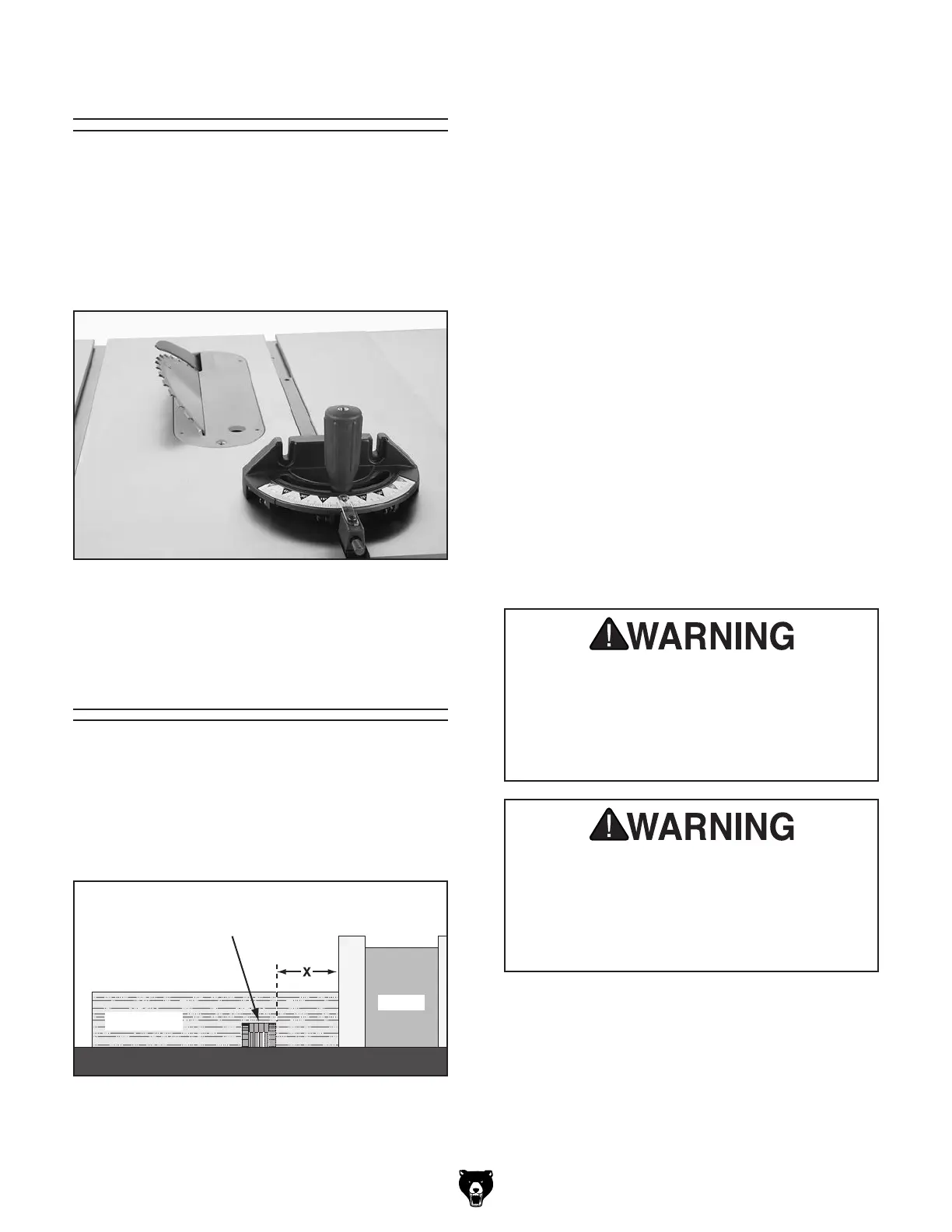
chamfers. Figure 57 shows an example of the
blade when tilted to 45°.
Figure 57. Example of blade tilted to 45° for
bevel cutting (blade guard only removed for
clarity.
Dado Cutting
Figure 58. Example of a dado being cut with a
dado blade.
Commonly used in furniture joinery, a dado is a
straight channel cut in the face of the workpiece.
Dadoes are "non-through" cuts that can be made
with a dado blade or a standard saw blade. The
Figure
below
shows a cutaway view of a dado cut
being made with a dado blade.
Dado Blade
Workpiece
Fence



 To Next Page