Model G0771Z (Mfd. Since 01/21)
-47-
5"
5"
4" Slot
(Top View)
(Side View)
3
/
8
"
Countersink on Bottom
1
/
4
" Hole
Figure 75. Miter bar pattern.
5. Cut a miter bar approximately 5" long that will
fit in table miter slot, as shown in Figure 75.
7. Mark a 4" line through center of countersunk
hole in center, then use a jig saw with a nar-
row blade to cut it out.
8. Assemble miter bar and featherboard with
a
1
⁄4"-20 x flat head screw, flat washer, and
a wing nut or a star knob (see Figure 76).
Congratulations! Your featherboard is com-
plete.
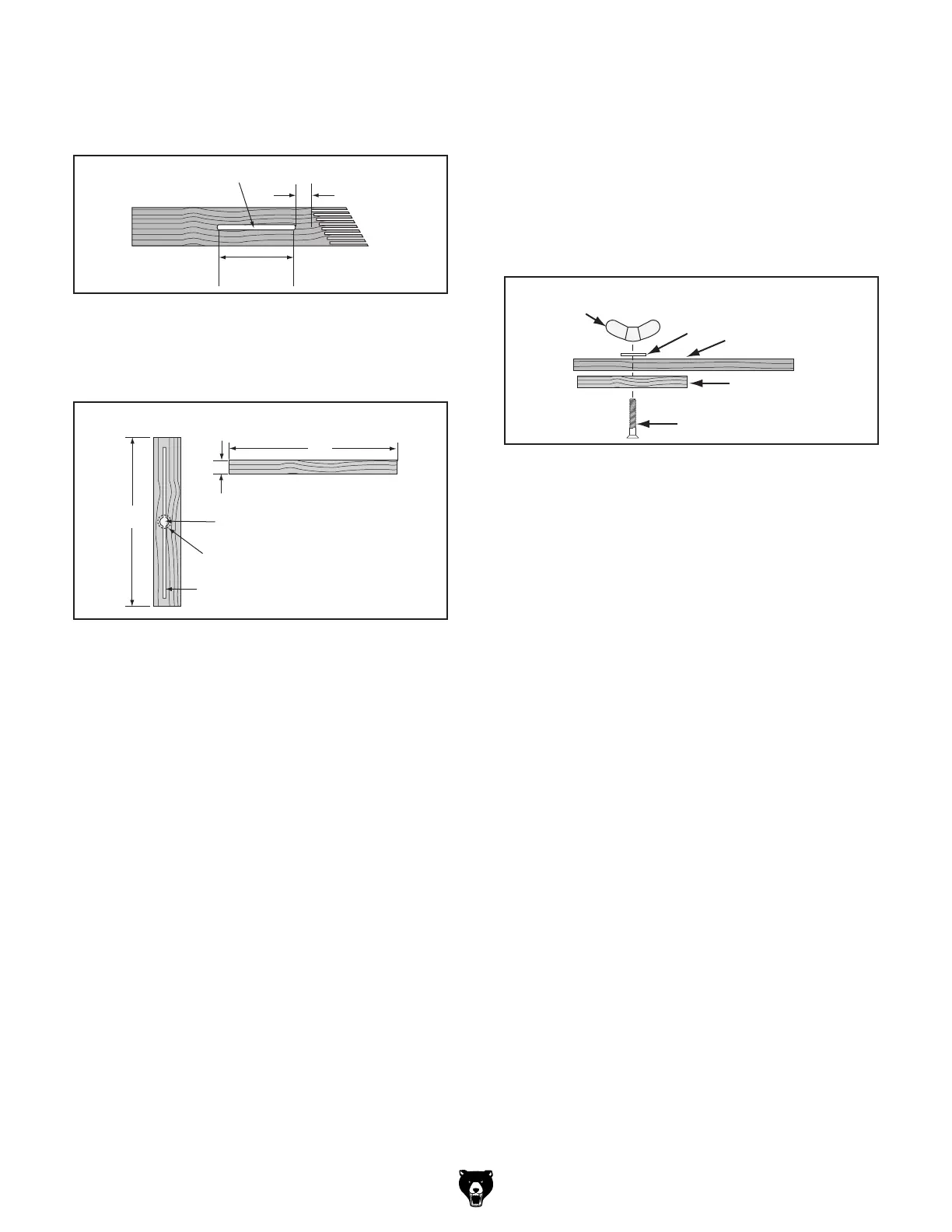
4. Rout a
1
⁄4"–
3
⁄8" wide slot 4"–5" long in
workpiece and 1"–2" from short end of feath-
erboard (see Figure 74).
Figure 74. Slot routed in featherboard.
1"-2"
4"-5"
1
/
4
"-
3
/
8
" Slot
(Side View)
Wing Nut
Miter Bar
Featherboard
Flat Head Screw
Flat Washer
Figure 76. Assembling miter slot featherboard
components.
Note: The routed slot, countersink hole, and
flat head screw are essential for miter bar to
clamp into miter slot. When wing nut is tight-
ened, it will draw flat head screw upward into
countersunk hole. This will spread sides of
miter bar and force them into walls of miter
slot, locking featherboard in place.
Tip: The length of the flat head screw depends
on thickness of featherboard—though 1
1
⁄2" to
2" lengths usually work.
Now, proceed to Mounting Featherboard in
Miter Slot on Page 48.
6. Drill a
1
⁄4" hole in center of bar, then counter-
sink bottom to fit a
1
⁄4"-20 flat head screw.
Tip: Consider making miter bar longer for
larger featherboards—approximately half the
length of total featherboard—to support force
applied to the featherboard during use.



 To Next Page