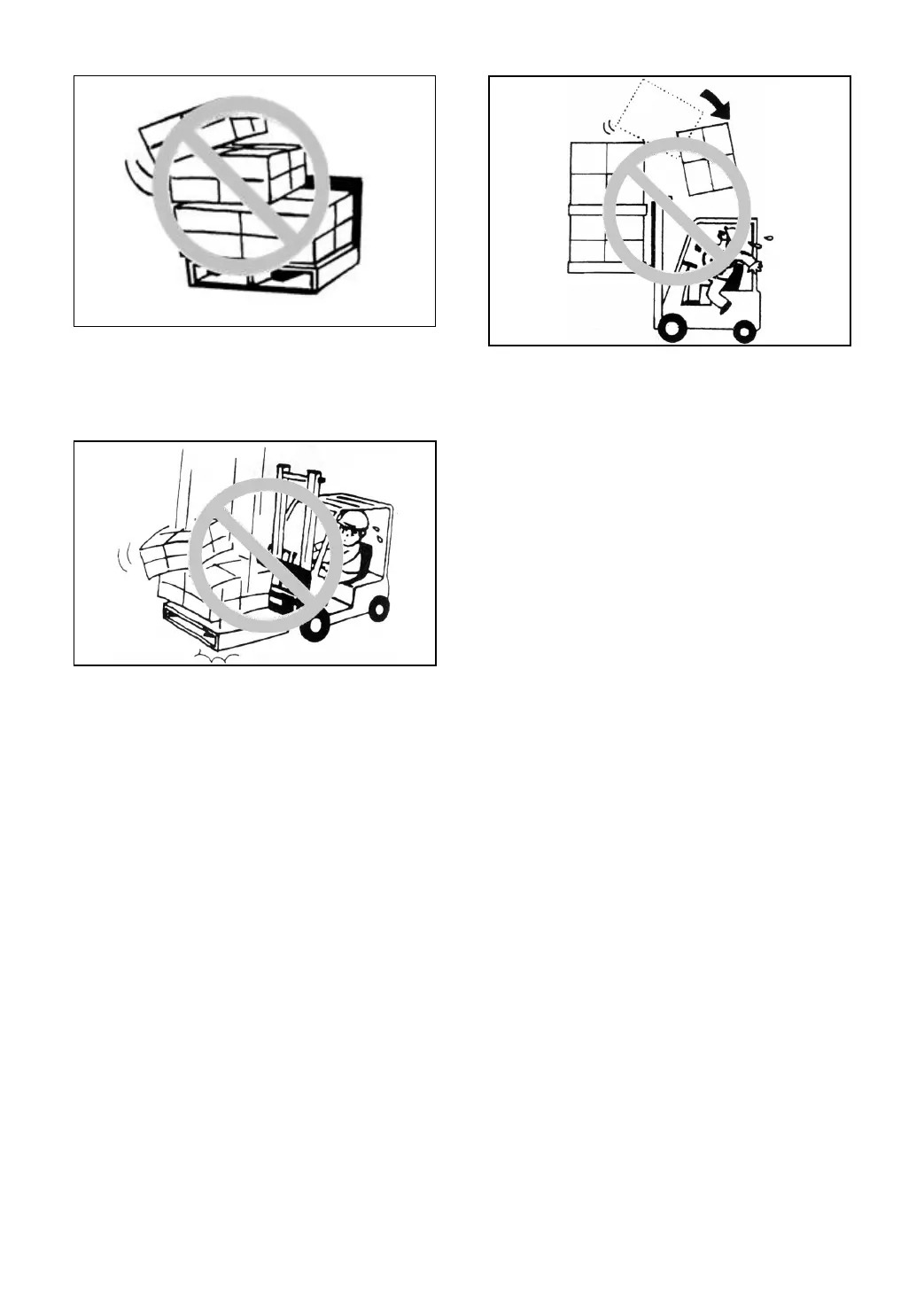
37. Do not lift cargo at high speed. Cargo
should be fixed securely before lifting the fork.
Pause before lifting cargo and only lift after
confirming there are no obstacles.
38. Ensure that the cargo is tied firmly and
placed flat on the two forks; do not lift cargo
with a single fork.
For forklift trucks with accessories (like flat
holding clamps), the cargo should be tied
firmly and clamped; the multiway valve control
lever should then be pulled into place.
39. Do not lift cargo when the forklift truck is
on a slope and avoid loading and unloading
operations on the ramp.
40. The stacking height of cargo should not
exceed that of the load-backrest; if it cannot be
avoided, the cargo should be fixed firmly.
Please drive in reverse or under guidance when
handling large cargo that obstructs visibility.
41. Reduce the forward tilt angle as much as
possible when stacking for unloading; when
the height of the cargo is slightly higher or
lower than that of the stacking layer, the cargo
can tilt forward.
When stacking at height and the distance to
the ground is 15cm-20cm, the mast should be
vertical and then lifted; be careful to not tilt
the mast when the cargo is raised.
When picking up goods at height, insert the
fork into the pallet, slowly lift, back up and
then descend, lower the rear mast and tilt it
backward. Never tilt the mast when the goods
are at height.
42. Do not tow a forklift truck with a faulty
engine, abnormal steering system or damaged
brake system.
Obey traffic rules when towing a forklift truck
on the highway.
43. Wear overalls and other personal safety
protective devices, such as earplugs, safety hat,
goggles, dust mask, safety shoes, anti-static
clothing etc. at work as appropriate; do not
wear a tie or accessories for your own safety.
44. The workplace should be provided with a
fire extinguisher. The user can choose to
provide a fire extinguisher for the truck, which
is generally installed on the rear leg of the
safety frame for easy access.
The driver and management personnel should
be familiar with the position and operation of
the fire extinguisher.
45. Use a pallet when handling small objects
and do not place them on the forks directly.
46. There are warnings and operation methods
on the truck labels. Please operate according to
the directions of the manual and truck labels.
Check labels, signs and marks, and change




 To Next Page