Center of gravity and stability
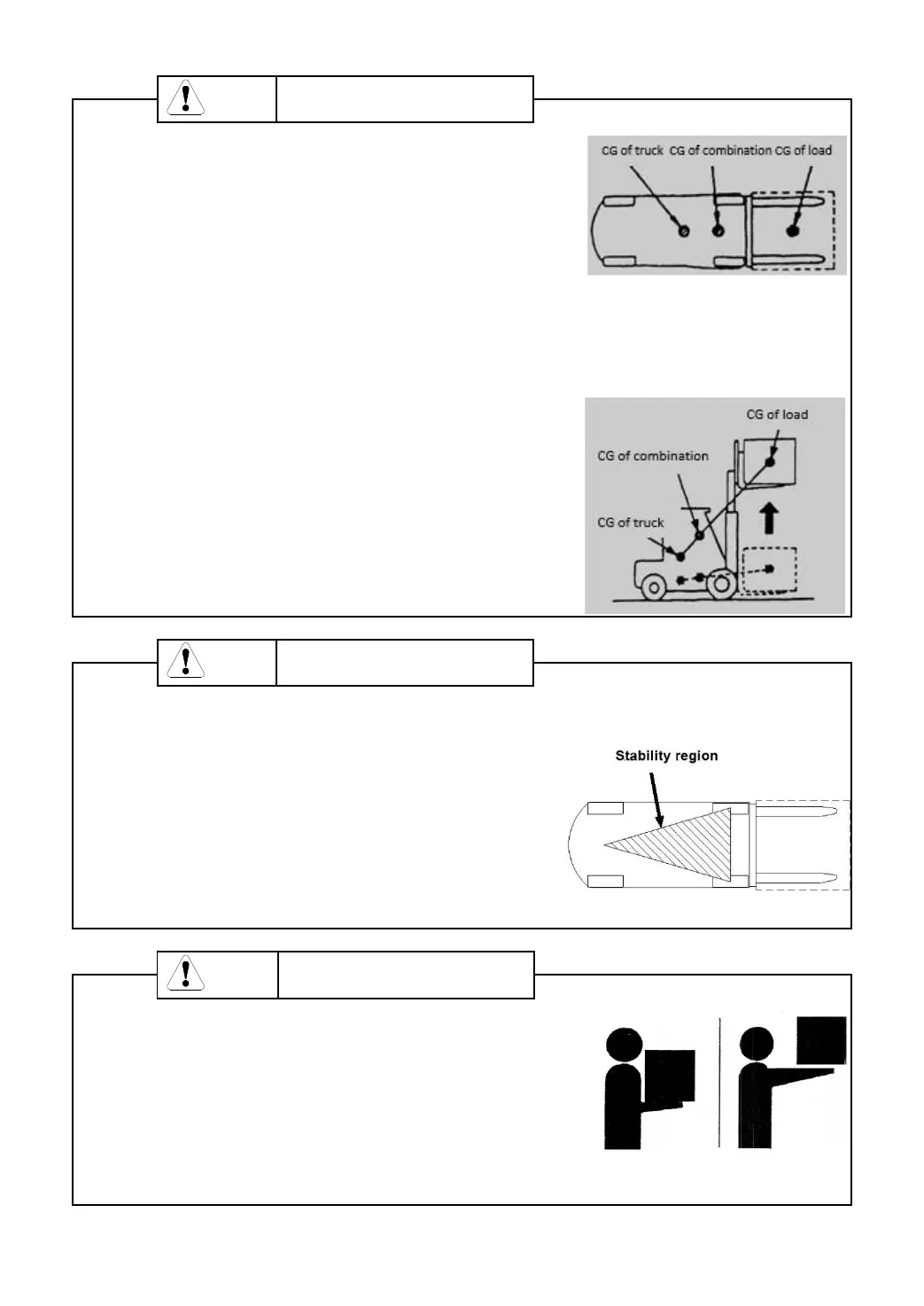
The center of gravity of the forklift truck depends on the
combined center of gravity of the forklift truck.
When the forklift truck is unloaded, the center of gravity
remains unchanged; when it is loaded, the center of gravity is
formed by the combined center of gravity of the forklift truck
and the load.
The center of gravity of the load is determined by whether the mast is tilted forward or backward or
whether it is lifted or lowered, thus the combined center of gravity can change.
The combined center of gravity of the forklift truck is determined by the following factors:
· Load magnitude, weight and shape;
· Lift height;
· Tilt angle of the mast;
· Tire inflation pressure;
· Acceleration, deceleration and turning radius;
· Road conditions and road tilt angle;
· Accessories.
Stable center of gravity region
In order to make the forklift truck stable, the combined center of gravity has to be within the
triangle formed by contact point of the front left and right
tires and the midpoint of the rear axle.
If the combined center of gravity is on the rear axle, the two
front tires will form a fulcrum and the forklift truck will tilt
forward. If the combined center of gravity moves out of the
stable center of gravity triangle, the forklift truck will roll over
in the direction towards the combined center of gravity.
Maximum load (weight and
load center distance)
The horizontal distance between the center of gravity of the load
on a fork and the load-backrest of the fork or the front surface of
the fork (whichever is smaller) is called the load center distance.
The maximum load refers to the maximum load that the fork can
bear at the standard load center distance. The relationship
between the maximum load and the load center distance is
shown on the Bearing Capacity Chart of the forklift truck. If the
load center distance moves towards the front fork, the overall center of gravity will move forward,
thus the load has to be reduced.




 To Next Page