24
T12
HBM
A24633.0en/de
7 Loading capacity
Nominal (rated) torque can be exceeded statically up to the limit torque.
If the nominal (rated) torque is exceeded, additional irregular loading is not
permissible. This includes longitudinal forces, lateral forces and bending
moments. Limit values can be found in the "Specifications" section.
7.1 Measuring dynamic torque
The torque flange can be used to measure static and dynamic torques. The
following applies to the measurement of dynamic torque:
• The T40 calibration performed for static measurements is also valid for
dynamic torque measurements.
• The natural frequency f
0
of the mechanical measuring arrangement
depends on the moments of inertia J
1
and J
2
of the connected rotating
masses and the torsional stiffness of the T40.
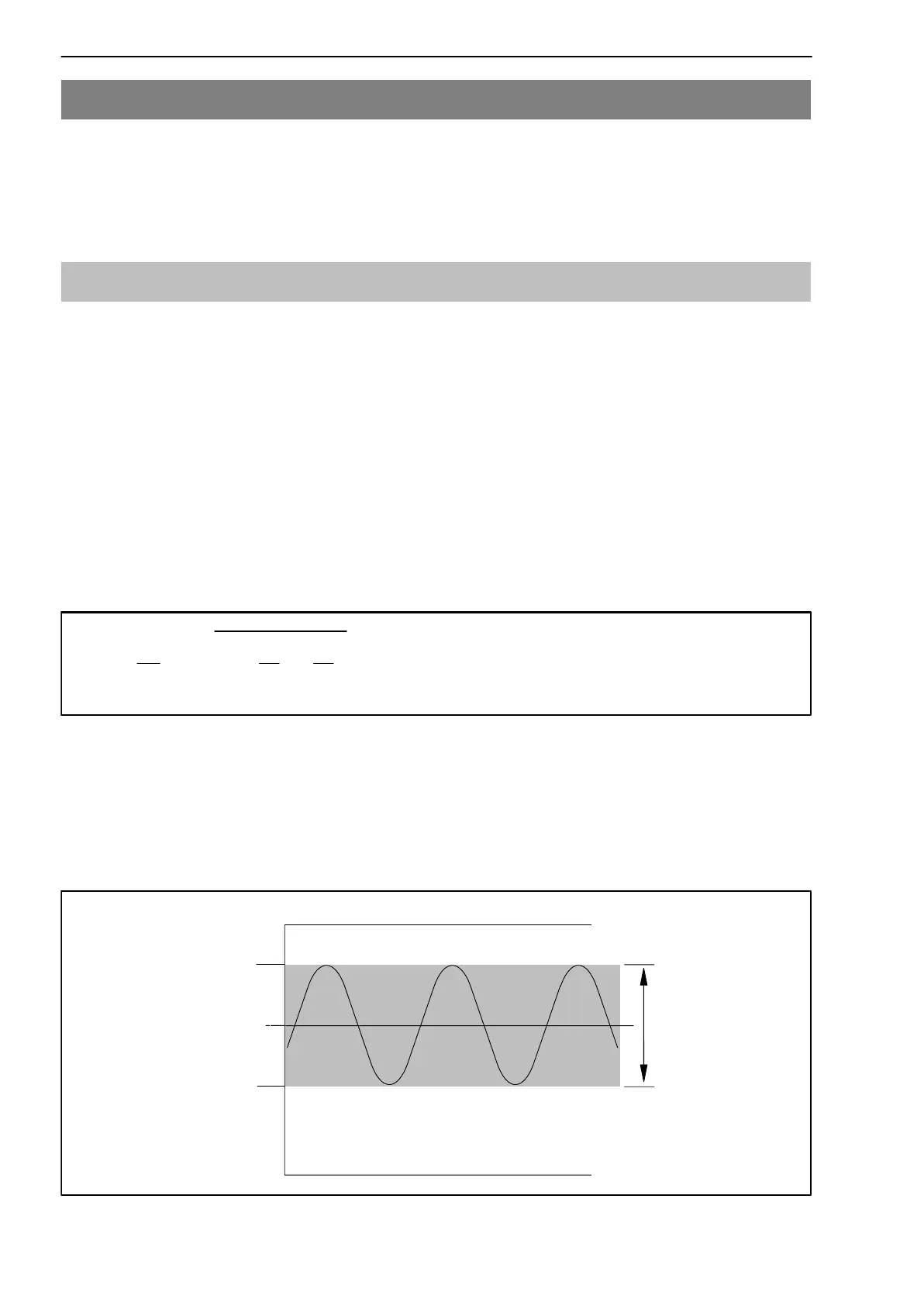
Use the equation below to approximately determine the natural frequency f
0
of
the mechanical measuring arrangement:
f
0
+
1
2p
· c
T
·
1
J
1
)
1
J
2
f
0
= natural frequency in Hz
J
1,
J
2
= mass moment of inertia in kg⋅m
2
c
T
= torsional stiffness in N⋅m/rad
• The maximum mechanical oscillation width (peaktopeak) is 200 %
(measuring range 3 kN⋅m: 160 %) of the nominal (rated) torque
characteristic of the T40. The oscillation width must fall within the loading
range specified by −M
nom
and +M
nom
. The same also applies to transient
resonance points.
0
+ M
nom
100%
Oscillation width
200 % M
nom
(3 kN⋅m: 160 %)
− M
nom
100%
Nominal (rated) torque M
nom
as %
Fig.7.1: Permissible dynamic loading



 To Next Page