Testing the EPC9 EPC9 Manual 20
3. In the bottom position a ”model cell” in the whole cell patch-clamp
configuration is simulated. The ”input resistance” is 5.1 MΩ, the ”membrane
resistance” is 500 MΩ and the ”membrane capacitance” is 22pF. This mode
lets you test the C-slow compensation and the current clamp mode.
Furthermore it is useful to check stimulation patterns you design within
PULSE.
Note: This model cell has a long “membrane” time constant (about 10 ms).
The following tutorial can be best executed with E9SCREEN. However, since PULSE
offers the same functionality with respect to the EPC9, you could use that program
instead. The figures shown were taken from E9SCREEN.
Step 1: Applying the Test Pulse
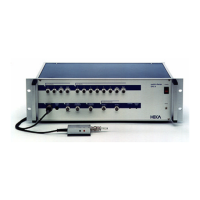
First, connect the model circuit to the probe input via a BNC adapter and plug the
black cable to the black ground connector on the probe. If E9SCREEN is not running
yet, start the program which is located in the E9SCREEN folder inside the HEKA folder.
Windows users might alternatively use the Start button to launch E9SCREEN from
Programs HEKA. The left side of the E9SCREEN window, the so called ”virtual front
panel”, provides a graphical representation of the EPC9 amplifier. The panel lets you
control all hardware settings of the amplifier(s) such as gain or filters. Signal display
is provided by an oscilloscope-like display in the right part of the window.


 To Next Page