Operating Modes EPC9 Manual 54
6. Operating Modes
The EPC9 is fundamentally an instrument for measuring small electrical currents. It
uses a current-to-voltage (I-V) converter circuit to convert the currents to an analog
voltage, which is then made available at the current monitor outputs for display or
recording. At the same time that pipette currents are being recorded, the potential
must be specified, and the various operating modes of the EPC9 correspond mainly
to different ways of controlling that potential.
Voltage-Clamp Mode
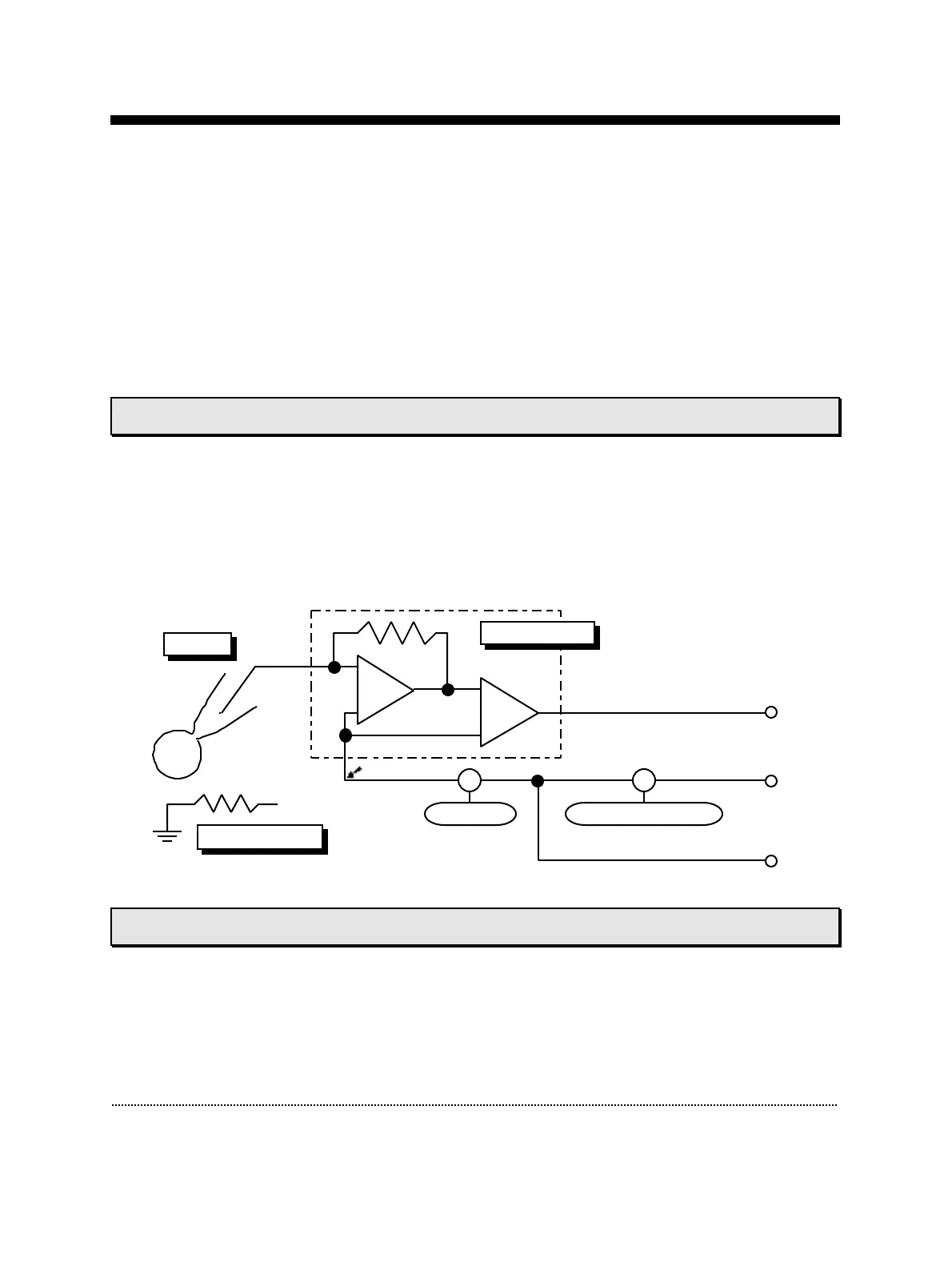
This is the basic patch-clamp mode, and is implemented by the circuitry shown in
the figure below. The pipette potential is derived from the signal applied to Stim. In,
with a variable offset added from the V-membrane control. The sum of these two
sources is displayed and monitored as the V-mon signal. Before being applied to the
pipette a further variable offset is added from V
0
(which includes the value of LJ, see
Chapter 7. Compensation Procedures on page 59).
Ref. Pot.
V
0
-Offset V-memb. + Stim. In
Σ Σ
Pipette
Current
Monitor
Stim. In
Voltage
Monitor
Bath Electrode
IV Converter
Current-Clamp Mode
In the Current Clamp mode, the feedback is employed between the current monitor
signal and the pipette potential (see figure below). The feedback acts rapidly (with a
time constant of about 30 µs) to keep the current at zero by varying the pipette
potential appropriately; in this way, a high-impedance voltage follower is created,
with the output voltage available at the V-mon output. The original V-membrane


 To Next Page