Compensation Procedures EPC9 Manual 61
consists of adjusting C-slow and R-series to cancel the transient currents due to the
cell membrane capacitance. Once this has been done, the relative amount of R
s
-
compensation can then be selected with the %-comp control.
Theoretically, it is desirable to compensate as much of the series resistance as
possible. In practice, however, a degree of compensation above 90% can involve
considerable technical problems, and in some recording situations a value below
90% is preferable. To illustrate one technical problem, consider the case when a 100
mV potential change is commanded and 90% compensation is in use. This degree of
compensation means that the cell membrane capacitance will be charged 10 times
faster than normally. The rapid charging is accomplished in the compensation
circuitry by forcing the pipette potential to (very transiently) reach a potential of 1V.
The resulting large current causes the membrane capacitance to charge quickly to its
final value of 100 mV. In general, when a voltage step of size ∆V is commanded, the
pipette potential actually receives an initial transient of size ∆V / (1-α) due to the
compensation effect. The technical problem comes from the fact that the maximum
pipette potential excursion in the EPC9 is about ±1.2 V, implying that 90%
compensation can be used for steps only up to about 120 mV in amplitude. Overload
of amplifiers (obvious in practical use due to the loss of proper transient cancel-
lation) will occur if larger pulses are applied, unless the %-comp setting is reduced.
The degree of R
s
-compensation is also limited by stability considerations. Stable R
s
-
compensation requires that the C-fast control is properly set to cancel the fast
capacitance transients; when the series resistance is high, say above 10 MΩ,
misadjustment of C-fast can easily cause oscillation. In cases where R
s
is this size or
larger, it is often advisable to use the slower settings of the R
s
switch which, in
slowing down the speed of the compensation feedback, makes it less susceptible to
high-frequency oscillations. In cases where R
s
is relatively small, on the other hand,
it is sometimes not possible to use full 90% compensation because of the limited
speed of the compensation feedback, even in the fastest, 2 µs setting of the switch.
This problem arises when the time constant τ
u
is smaller than about 100 µs, and
comes from the fact that compensated membrane time constant τ
c
cannot be made
smaller than a value that depends on the speed of the R
s
-compensation feedback. If
you turn up the %-comp control to try to obtain a smaller τ
c
, you will observe
overshoot or ringing in the current monitor signal, due to an overshoot in the
membrane potential. The minimum value for τ
c
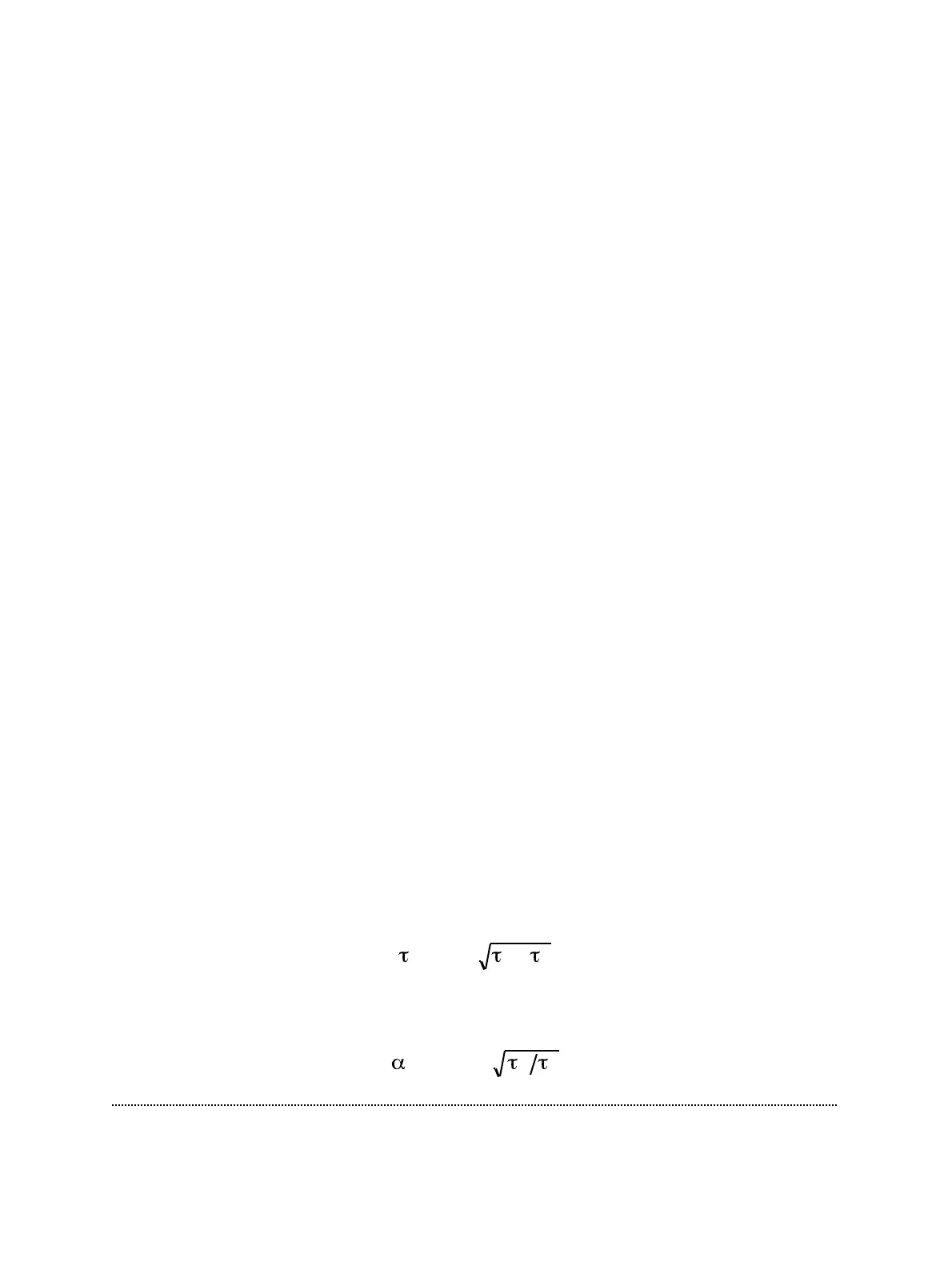
is given approximately by
c(min)
=
u
−
f
where τ
f
is the effective time constant of the feedback loop. The corresponding
maximum α values are given by
(max)
= 1−
f u


 To Next Page