Ch. 18 ELECTRICAL EQUIPMEMNT
18-6
Inspection on Charging Voltage
Caution
Before conducting the inspection, make sure
that the battery is fully charged. If undercharged,
the current changes dramatically.
Use a fully charged battery having a voltage larger
than 13.0 V
While starting the engine, the starter motor draws
large amount of current from the battery.
After the engine is warmed up, replace original
battery with a fully charged battery.
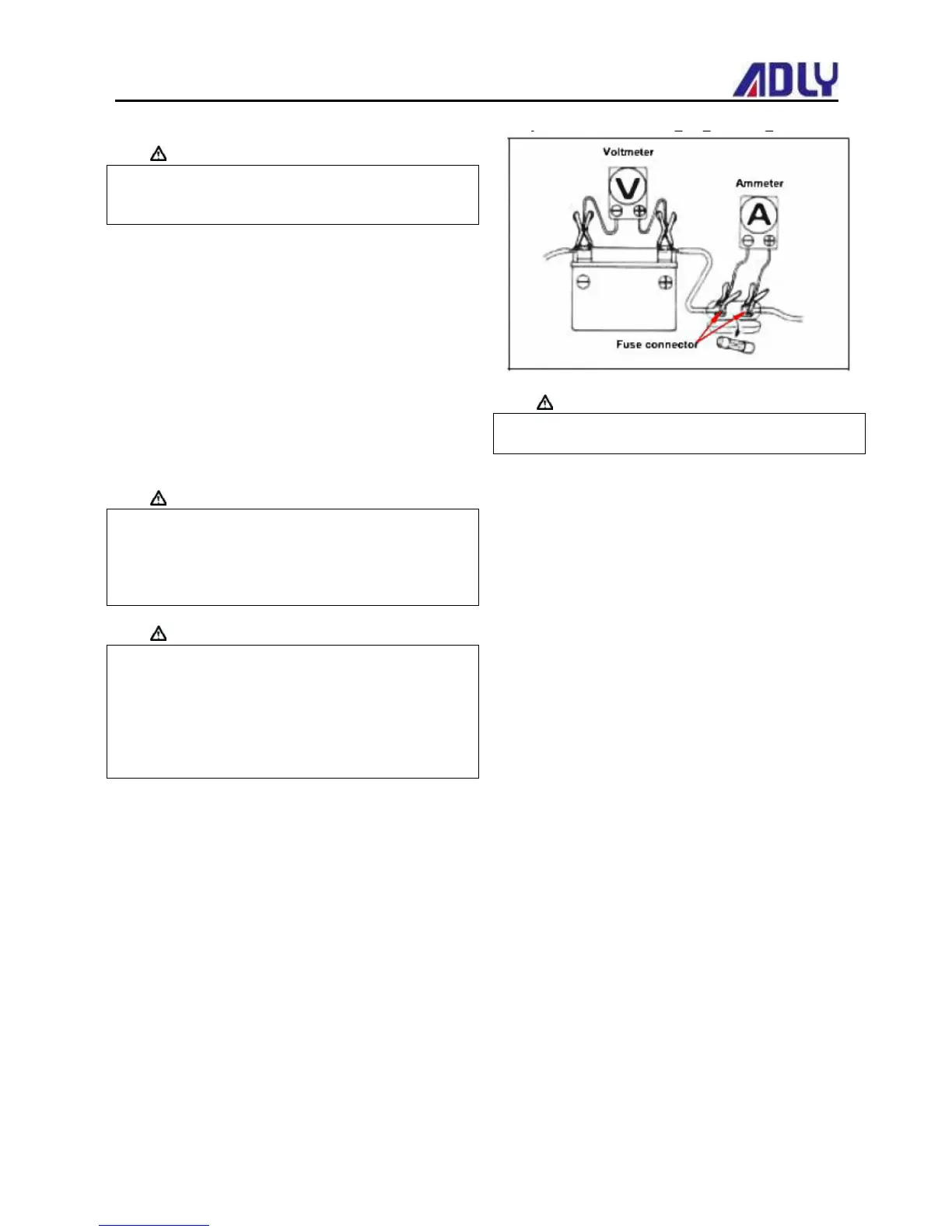
Connect a digital voltmeter to the battery
terminals.
Connect an ammeter between both ends of the
main fuse.
Caution
When the probe is reversibly connected, use
a voltmeter having an indication that the Current
flows from the positive or the negative direction
and the measurement should be at zero, ammeter
at one direction only.
Caution
Do not uses short-circuit cable. It is possible
to measure the current by connecting an Amp
meter between the battery positive terminal and
the cable position terminal, however, while the
starter motor is activated, the surge current the
motor draws from the battery may damage the
ammeter.
The main switch shall be turned to OFF position
during the process of inspection.
Never tamper with the ammeter and the cable
while there is current flowing through. It may
damage the ammeter.
Connect to a tachometer.
Turn on the headlight to high beam and start the
engine.
Accelerate the engine to the specified revolution
per minute and measure the charging voltage.
Specified Charging Current:
Min. 1.2 A / 6000 rpm
Control Charging Voltage:
14.5 + 0.5 V / 2000 rpm
Caution
To replace the old battery, use a new battery
with the same current and voltage.
The following problems are related to the
charging system; follow the instructions
provided in the checking list to correct it if any
one of the problems takes place.
(1) The charging voltage can not exceed the
voltage between two battery terminals and the
charging current is in the discharging direction.
(2) The charging voltage and current are too
much higher than the standard values.
The following problems are not related to the
charging system; correct it if any by following
steps indicate in the checking list.
(1) The standard charging voltage and current
can only reach when the revolution of the
engine exceeds the specified rpm.
Bulbs used exceed their rate and
consume too much power.
The replacement battery is aged and
does not have enough capacity.
(2) The charging voltage is normal, but the
current is not.
- The replacement battery is aged and does not
have enough capacity.
- Battery used does not have enough electricity
or is over charged.
- The fuse of the ammeter is blown.
- The ammeter is improperly connected.
(3) The charging current is normal, but the
voltage is not.
- The fuse of the voltmeter is blown.



 To Next Page