
 Need help?
Do you have a question about the HikRobot ID3000 Series and is the answer not in the manual?
Provides instructions for using and managing the product, subject to change without notice.
Lists Hikrobot's trademarks and other companies' properties in various jurisdictions.
Outlines limitations of liability, user responsibilities, and prohibited product uses.
Details FCC compliance, device limits, and measures to correct harmful interference.
Confirms compliance with EU directives and provides WEEE disposal information.
Defines symbols used in the document to indicate danger, caution, or notes.
Ensures the user can use the product correctly to avoid danger or property loss.
Provides safety instructions for wiring, handling exposed circuits, and power connections.
Advises avoiding heavy pressure and vibration during transportation to prevent damage.
Lists conditions and precautions for using the device in various environments.
Details measures to prevent damage from static electricity during handling.
Provides instructions on how to clean the image sensor carefully.
Advises against installing on vibrating or impact-prone surfaces.
Outlines qualifications and skills needed for installation and maintenance personnel.
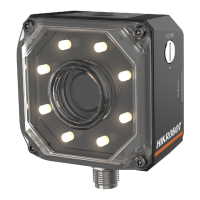
Visual representation of the device for reference.
Details the signals and functions provided by the 17-pin interface connector.
Describes the focus knob and OK/NG indicator for device operation.
Explains the PWR, STS, and LNK indicators for device status and network.
Describes the function of the device's physical button.
Details pin assignments and functions for the 17-pin connector.
Describes the device's input signals, internal circuit, and electrical features.
Describes the device's output signals, internal circuit, and electrical features.
Explains how to wire external input signals to PNP, NPN devices, and switches.
Explains how to wire output signals to PNP and NPN devices.
Describes serial port interfaces and pin definitions for 9-pin and 25-pin connectors.
Lists necessary accessories and preparation steps before installing the device.
Provides step-by-step instructions for installing the device.
Guides on installing the IDMVS client software for device configuration.
Recommends disabling the Windows firewall for stable client operation.
Guides on configuring PC network settings for device communication.
Explains how to set the device's IP address to match the PC's network segment.
Guides on connecting the device to the client software for operation.
Describes the main window components like menu bar and control toolbar.
Area for connecting devices, setting parameters, and managing configurations.
Details the three operating modes: Test, Normal, and Raw.
How to set image-related parameters via client software.
Configure parameters for 1D and 2D code reading algorithms.
Set trigger parameters and modes for image acquisition.
Configure output signals based on selected event sources.
Set rules to filter barcodes and format output results.
Compares read data with preset data for contrast results.
Configure communication protocols and parameters for data transmission.
Save, load, and manage device parameter sets.
View statistics related to code reading, such as frame counts and read rates.
Monitor memory and CPU usage rate, and other system events.
Viewing the real-time image stream from the device.
Acquiring the real-time video stream from the device.
Adding a cross line on the live view image for object positioning.
Recording video files and capturing images continuously.
Splitting the window to view multiple devices simultaneously.
Viewing device reading status and statistics.
Viewing and exporting device logs for diagnostics.
Synchronizing device time using NTP.
Automatically entering operating status after power-on.
Updating device firmware via the client software.
Rebooting the device using the client software.
Troubleshooting dark image issues and providing solutions.
Troubleshooting low image frame rate issues and providing solutions.
Troubleshooting issues with no devices listed in the IDMVS client.
Troubleshooting issues with no image displayed in the live view.
 General
| Frame Rate | 60 fps |
|---|---|
| Communication Interface | USB, RS-232 |
| Scanning Technology | CMOS |
| Image Sensor | CMOS |
| Resolution | 1280 x 800 |
| Supported Symbologies | 1D, 2D, Postal, OCR |
| Field of View | Horizontal: 42° |
| Barcode Types | 1D and 2D |
| Operating Temperature | 0°C to 45°C |

 To Next Page
