Model
8904A
I
670KHZ
Operation
Filters
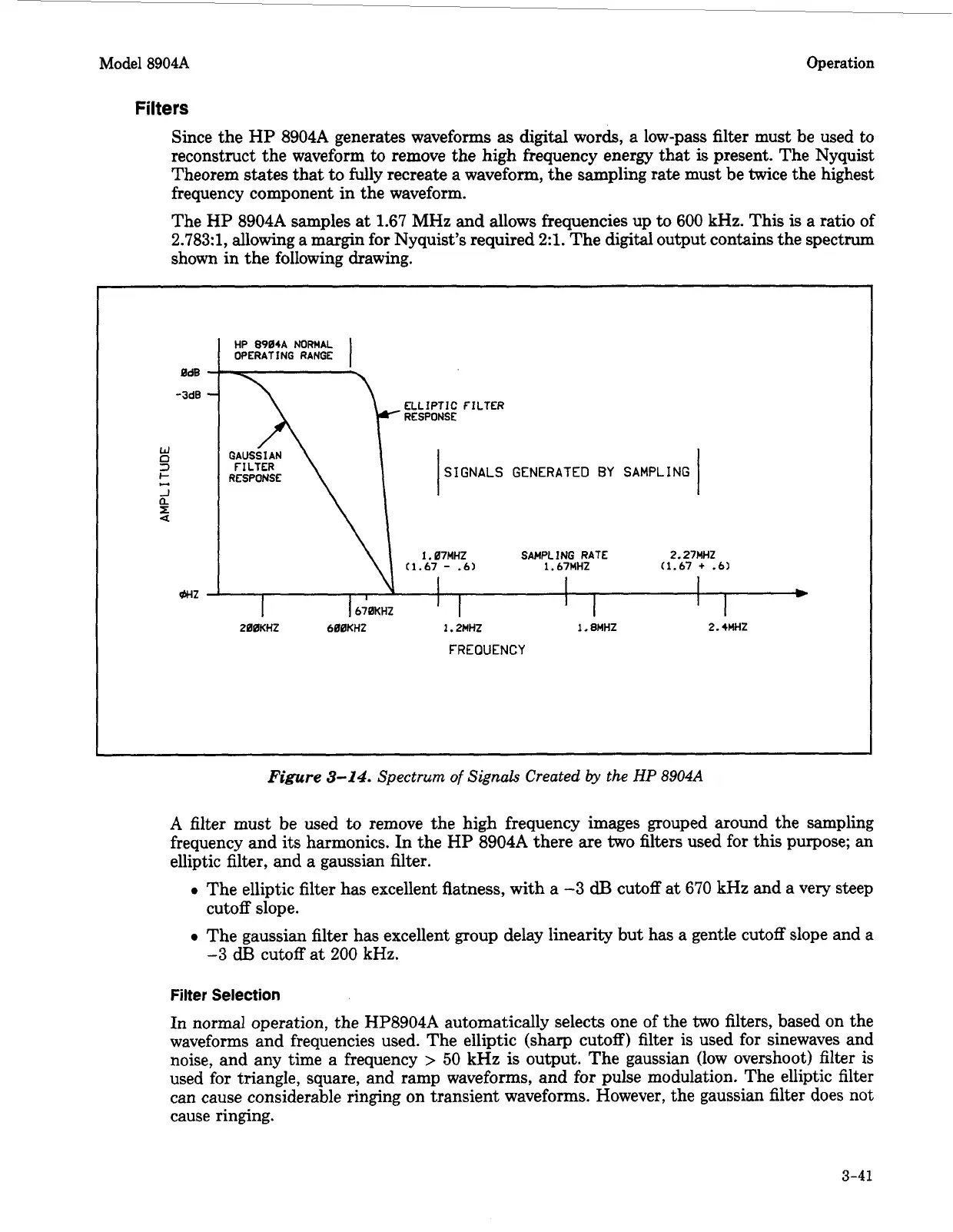
Since the
HP
8904A generates waveforms
as
digital words, a low-pass filter must be used to
reconstruct the waveform
to
remove the high frequency energy that is present. The Nyquist
Theorem states that to fully recreate a waveform, the sampling rate must be twice the highest
frequency component in the waveform.
The
HP
8904A samples at 1.67
MHz
and allows frequencies up
to
600
kHz.
This
is
a ratio of
2.783:1, allowing a margin for Nyquist’s required
2:l.
The digital output contains the spectrum
shown in the following drawing.
0dE
-
-3dB
-
w
0
5)
I-
-I
a
z
C-.
a
WZ
-
Figure
3-14.
Spectrum
of
Signals Created
by
the
HP
8904A
A
filter must be used
to
remove the high frequency images grouped around the sampling
frequency and its harmonics. In the
HP
8904A there are
two
filters used for this purpose;
an
elliptic filter, and a gaussian filter.
0
The elliptic filter has excellent flatness, with a
-3
dB
cutoff at 670
kHz
and a very steep
The gaussian filter has excellent group delay linearity but has a gentle cutoff slope and a
cutoff slope.
-3
dB
cutoff at 200
kHz.
Filter
Selection
In
normal operation, the HP8904A automatically selects one of the
two
filters, based on the
waveforms and frequencies used. The elliptic (sharp cutoff) filter is used for sinewaves and
noise, and any time a frequency
>
50
kHz
is
output. The gaussian (low overshoot) filter
is
used
for
triangle, square, and ramp waveforms, and for pulse modulation. The elliptic filter
can cause considerable ringing on transient waveforms. However, the gaussian filter does not
cause ringing.
3-41
Artisan Technology Group - Quality Instrumentation ... Guaranteed | (888) 88-SOURCE | www.artisantg.com


 To Next Page