Underwater Gear
6.1
This section will detail those components which are sub-
merged or generally under water. We will organize these
components into the following categories:
Mechanical propulsion components
Steering components
Intakes and discharge skin fittings
Monitoring equipment
Anchoring and Windlass (optional)
Keel
6.1 Mechanical Propulsion Components
Keep clear of moving parts at all times. Protect
moving parts from impact during normal use.
Propulsion components are those involved in the move-
ment of your boat.
6.1.1 Propeller
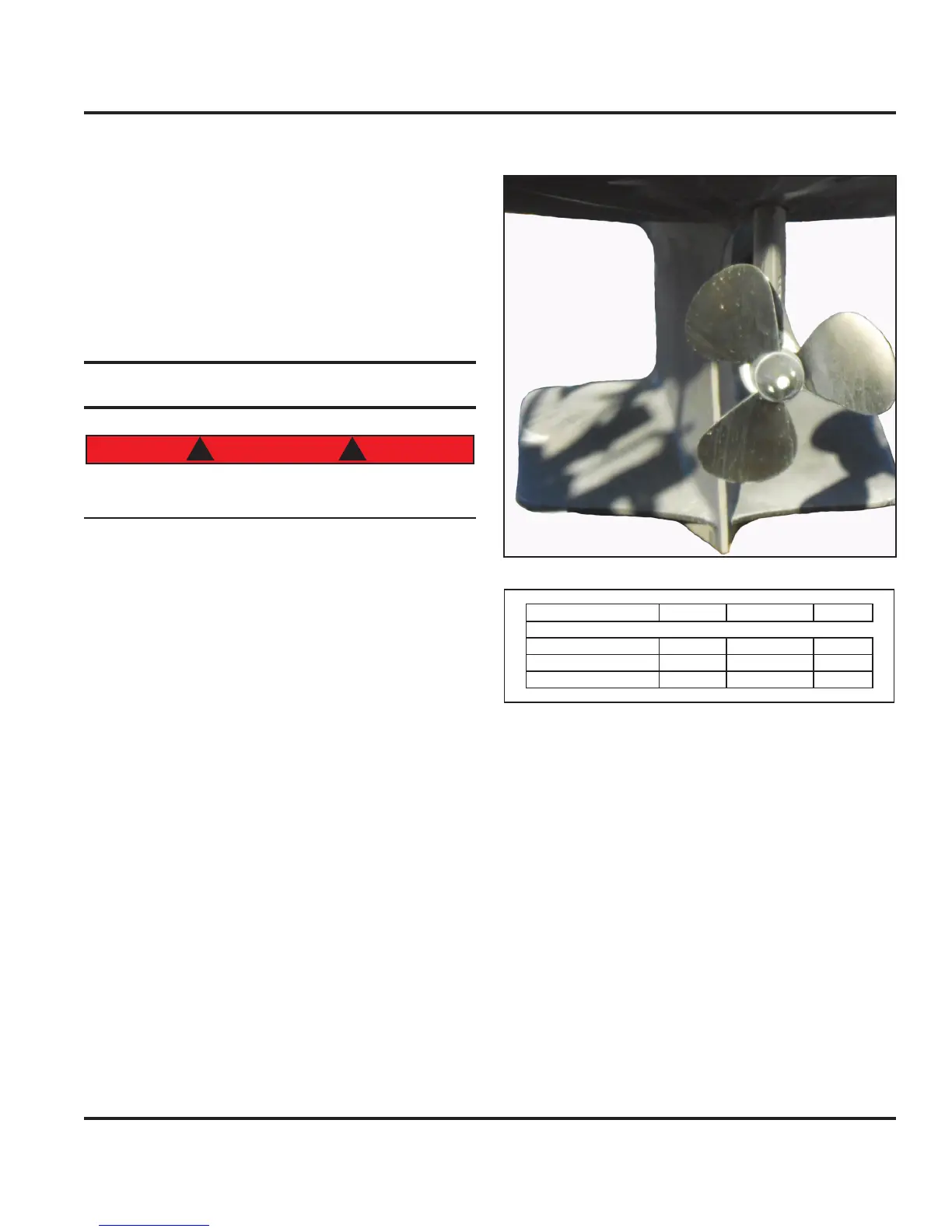
The propeller supplied with your boat (Fig. 6.1 saildrive
example) has been selected as the best propeller for
average use. Propellers use “pitch” as part of its speci-
fications and determines the amount of power exerted
from your engine. Pitch is the displacement resulting
from a 360 degree revolution of the propeller. A 16” pitch
means a 16” advancement from a complete spin of the
propeller. Do not change the pitch of your propellers
without getting your dealer’s recommendations first. If
you change to a different propeller pitch, do NOT use a
propeller which allows the engine to operate at a higher
than recommended RPM. Your engine OEM manual will
specify the maximum recommended RPM.
To maintain rated power, propellers should be free of
nicks, excessive pitting and any distortions that alter them
from their original design. Badly damaged propellers
should be replaced, but those that are chipped, bent or
merely out of shape can be reconditioned by your marine
dealer.
Consider keeping an extra propeller on your boat (see
Fig. 6.2 for propeller specs). If the installed propeller
becomes damaged, it can be replaced with the spare
without major disruption to your outing. We recommend
the replacement procedure be performed by competent
1.
2.
3.
4.
5.
6.
professionals.
Figure 6.1
CONFIGURATION BLADES DIAMETE
PITCH
29 HP 2 16" 11"
40 HP 2 17" 16"
40 HP 3 16" 15"
Figure 6.2
6.1.2 Shaft Drive
The 29HP engine (see the Engines and Transmissions
chapter of this manual for additional details about the
engine) utilizes the traditional shaft method of propul
-
sion. The shaft is made of 1 1/4” diameter Aquamet 19
or equivalent stainless steel which has excellent corro-
sion resistance and very high strength. The coupling at
one end of the shaft is bolted to the transmission. The
other end of the shaft is tapered, threaded, and keyed for
installation of the propeller.
The propeller shaft passes through the hull via a shaft
seal followed by a strut mounted to the underside of the
hull which holds and stabilizes the propeller shaft in posi
-
tion. Refer to Fig 6.3 for details of the shaft, shaft seal
strut and propeller assembly.
6.1.2.1 Shaft Alignment
Underwater Gear
6.1



 To Next Page