Sails and Rigging
12.2
After the mast has been stepped and standing rigging
installed (see below), it should be properly tuned before
serious sailing begins.
12.2 Standing Rigging
Standing rigging is the collection of fixed cables and hard-
ware which provide stability and strength to the mast.
Cables can be either stays or shrouds. Stays run fore
and aft from the mast to the hull. Your Hunter only uses
the forestay and is integrated into the roller furling jib (see
sections on the Jib and Running Rigging below). Shrouds
run symmetrically port and starboard of the mast. Their
connection points can be either the mast or a spread-
er and terminate at the deck chainplates. Chainplates
are substantial metal components tied into the hull with
attachment points extending into the deck. Chainplates
can be classified as outer or inner, depending on their hull
attachment point.
Refer to Figures 12.16 and 12.17 for the location, descrip-
tion and specification of individual components of the
standard rigging. Refer also to the Rigging the Boat sec-
tion below for installation instructions. Finally, refer to the
rigging manufacturer’s OEM manual for further details on
standing rigging installation.
NOTE: Standing rigging will stretch slightly when initially
loaded. Therefore, the rigging may have to be further tensioned
slightly after a few sails in a strong breeze to compensate for
this initial stretch. Once the mast is tuned and initial stretch is
taken out, the rig should need retuning only at the beginning of
each season.
12.3 Boom
The boom is a horizontal aft-facing spar attached to the
aft mast. It provides control of the shape and angle of
the mainsail and provides points of attachment for control
lines.
The boom is attached to the aft mast at the gooseneck.
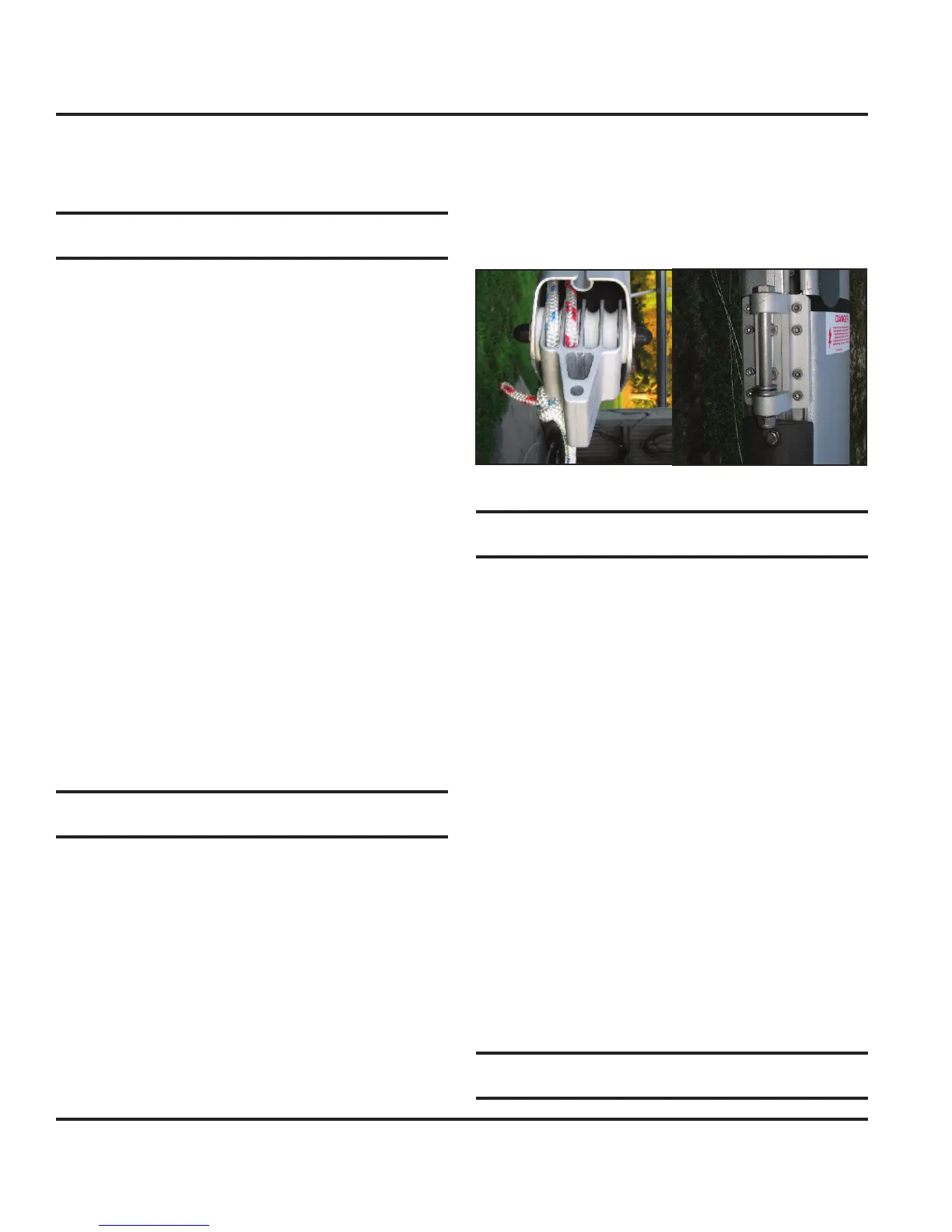
The end-cap of the forward boom has a wedge shaped
casting, or toggle, (Fig. 12.2) which is bolted into the mast
fitting (Fig. 12.3). This hardware configuration will allow
the boom to pivot port and starboard (and up and down)
allowing the mainsail to harness the wind power.
The type of boom on your boat will correspond to the
type of mast, either the standard conventional mast or
the optional in-mast roller furling mast. Both booms will
have common and some unique control points for the cor-
responding lines used. The conventional boom will have
a slot on the top where an optional sail cover can be
installed. The roller furling boom will have a raised track
and car on the top to facilitate the furling process.
Figure 12.2 Figure 12.3
12.4 Mainsail
The mainsail is a triangular shaped sail located behind
the mast and is the largest sail on your boat and main
source of propulsion by wind. Hunter provides the con-
ventional mainsail as standard and the in-mast roller furl-
ing mainsail as optional. The shape of the respective
sails will be slightly different. The conventional mainsail
will have a larger sail area than the roller furling mainsail
and will include a larger roach. The smaller size of the
furling mainsail derives from the constraints of the furl-
ing method and corresponding mast weight (see Figures
12.4 for general sail terminology and 12.15 for sail speci-
fications).
When strong winds exist one can decrease the sail area
by reefing (see the Sail Reefing and Stowage section
below) the mainsail to provide more stability and less risk.
Reefing the conventional mainsail involves lowering the
sail to predetermined levels, called reef points (Hunter
sails usually consist of 2 reef points). Along these reef
points are a pair of cringles. These cringles are used by
the reef lines (part of the running rigging) to pull the sail
down to the reef point. Reefing the in-mast furling main-
sail simply involves furling the mainsail within the mast
until the sail area is considered safe and effective.
12.5 Headsails



 To Next Page