Sails and Rigging
12.3
Hunter provides a jib headsail as part of the standard sail
configuration. Also available is the rigging and hardware
necessary to fly an optional spinnaker headsail (sail not
included).
12.5.1 Jib
The jib is a triangular shaped sail located forward of the
mast and is your boat’s main headsail. The jib’s main role
is to provide overall stability and performance. Given its
sail area, its direct contribution to propulsion is secondary
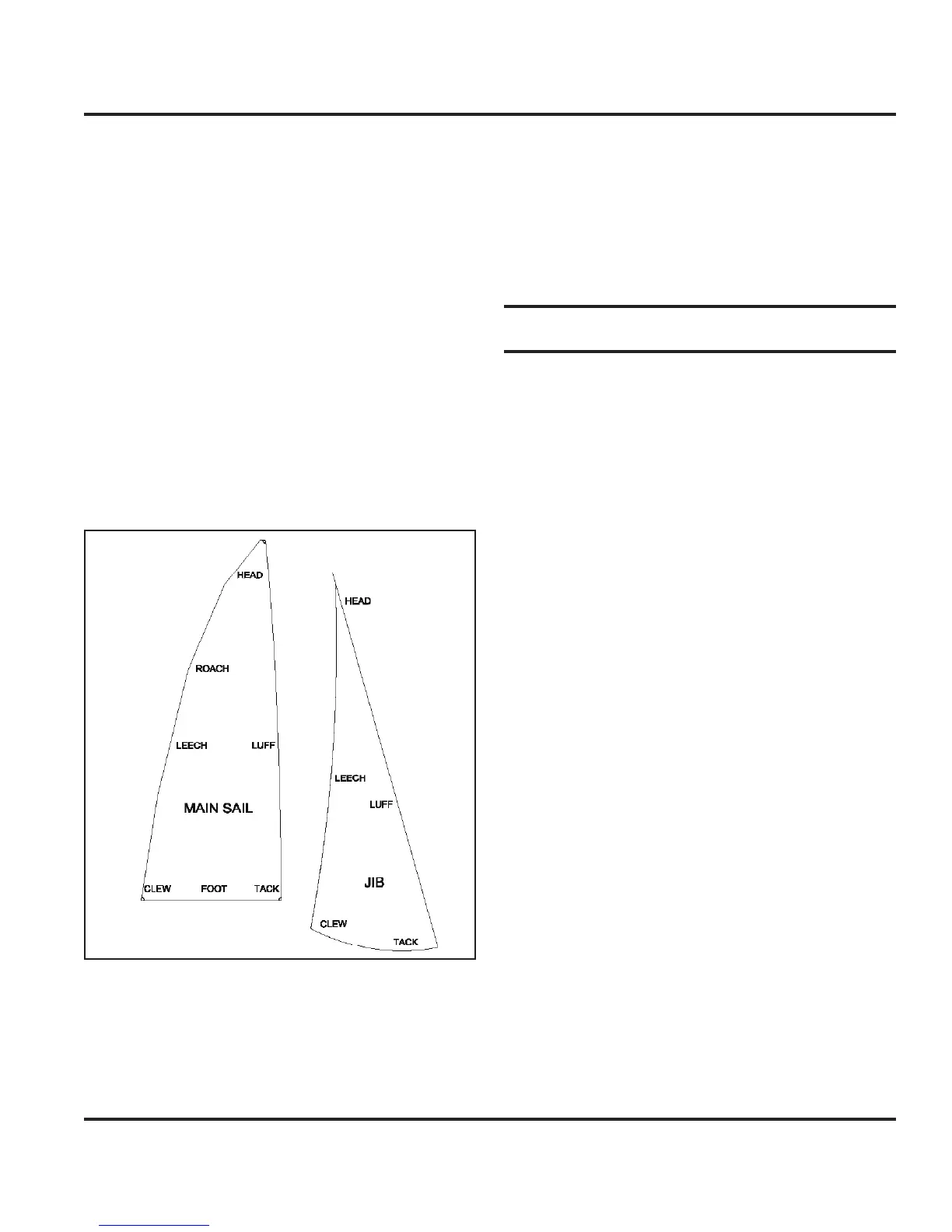
compared to the mainsail (see Figures 12.4 for general
sail terminology and 12.15 for sail specifications).
The standard jib is a roller furling arrangement. It is inte-
grated into the forestay which swivels and rolls up when
furling the sail. The jib is raised by using the jib halyard
(see Running Rigging section below). The jib is unfurled
and trimmed by using the jib sheets (see Running Rigging
section below).
Figure 12.4
12.5.2 Spinnaker
The spinnaker is a more specialized sail designed for sail-
ing off the wind (reaching to running) and is significantly
larger than the jib. The spinnaker option includes the
hardware and rigging necessary to support an asymmet-
rical spinnaker. The styling of the sail is often a reflection
of the owner or operator and, as such, is generally best
served through direct sourcing by the owner or operator.
The sail is arranged with the tack attached to the forward
facing eye on the stem plate. The sail is raised by the
spinnaker halyard (see Running Rigging section below).
The clew is managed by port and starboard sheets termi-
nating in the cockpit and served by the helm winches.
12.6 Running Rigging
Running rigging consists of lines used on your boat to
raise, lower and control the sails. They will vary in length,
thickness and color, depending on their purpose. Your
Hunter features control of all running rigging (except the
topping lift and, depending on your model, the vang line)
from the cockpit. The running rigging includes the fol-
lowing lines as specified in Fig. 12.18 and discussed in
subsequent sections:
Main halyard - raises the mainsail
Jib halyard - raises the jib
Topping lift - supports/raises the boom
Main furling line - used to furl the mainsail into the
mast with the in-mast furler system
Outhaul - pulls the mainsail along the boom
Mainsheet - used to control lateral movement of the
boom and thereby controls the clew of the mainsail
Jib sheet - set of two lines, one port, one starboard,
used to control the clew of the jib
Traveler - set of two lines, one port, one starboard,
which facilitates the movement (travel) of the boom
Vang - a block and tackle assembly attached to the
boom (and mast) and controls the mainsail leech ten-
sion; an optional solid vang is reinforced with tubes,
similar to a shock
Spinnaker halyard - raises the spinnaker (optional
sail)
Reef line 1 - lowers the mainsail to the first reef posi-
tion
Reef line 2 - lowers the mainsail to the second reef
position
Spinnaker sheet - set of two lines, one port, one star-
board, used to controls the clew of the spinnaker
1.
2.
3.
4.
5.
6.
7.
8.
9.
10.
11.
12.
13.



 To Next Page