DC Electric Systems
7.7
to “On” to provide power from one battery or position the
“House Battery” switch to the “Combined” position to sup-
ply starting power from both batteries.
Figure 7.12
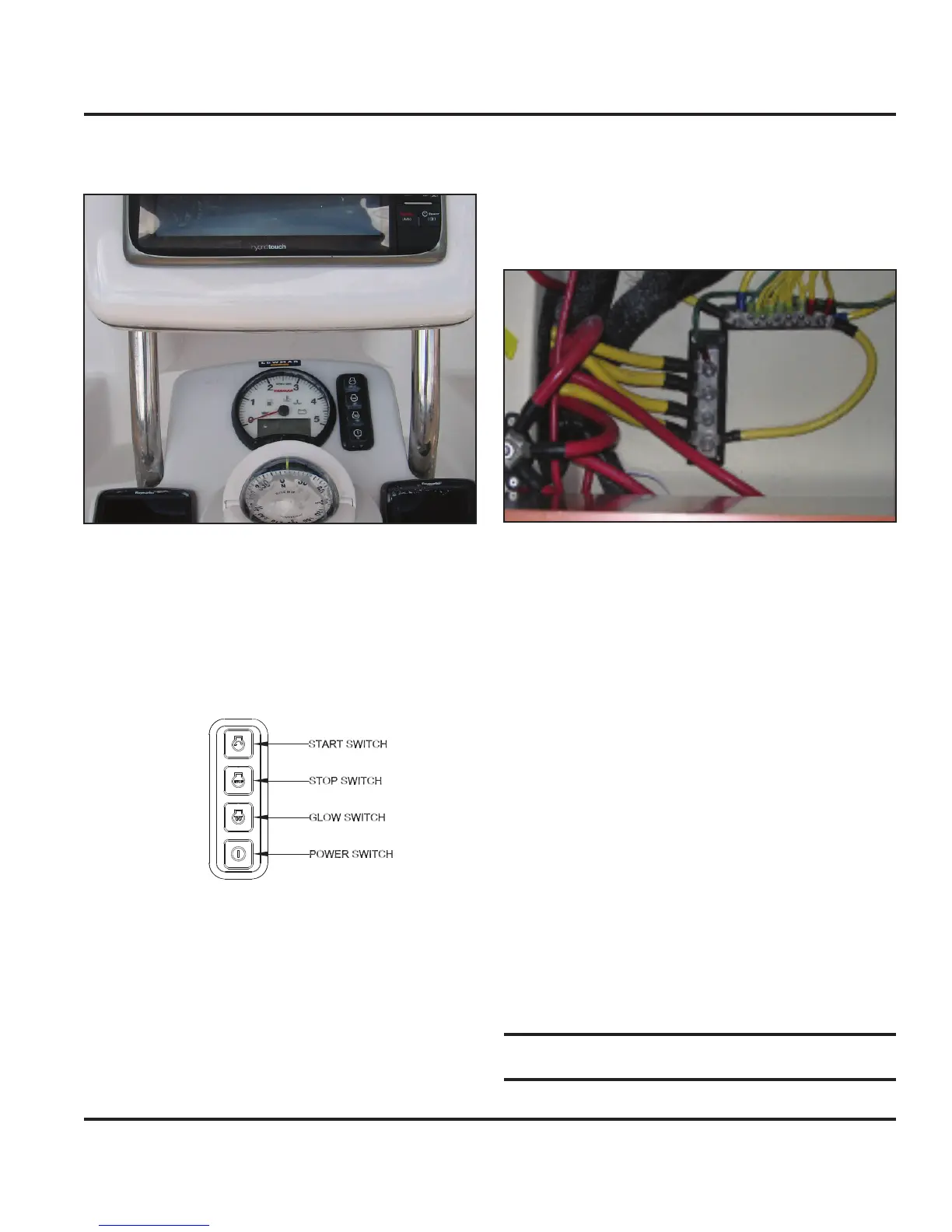
Once done, press the “Power Switch” button on the
Engine Control Panel (Fig. 7.13) to energize the panel. At
this point, the engine may be started or stopped. See the
Engines & Transmissions section of this manual for gen-
eral engine operation details and the Getting Underway
chapter of this manual for engine starting and stopping.
Figure 7.13
7.2.10 Generator
The optional generator supplies AC power to the boat.
However, as with the boat engine, the generator engine
requires power from the DC system to start and is con-
sequently briefly mentioned here. For a full discussion
of the optional generator system, please refer to the AC
Electrical Systems section of this manual.
7.2.11 Grounds and Zincs
The negative ground system incorporates busbars in
various locations within the boat (Fig. 7.14). These are
identified by the congregation of yellow (negative) wires
attached to the bar. All electrical circuits require a ground,
and they are joined in sections at these busbars.
Figure 7.14
Sacrificial zinc anodes are included within some compo-
nent assemblies to protect them from the effects of gal-
vanic corrosion. Galvanic corrosion occurs primarily in
salt water but can occur to a lesser degree in fresh water.
Salt water allows electric current to flow from anodic to
cathodic material. Any two metals from two components
and their relative position in the galvanic rating table
will determine which metal loses material (anode) and
which metal remains largely undisturbed (cathode). The
distance apart in the galvanic table of the two metals
determines the rate of wear.
Consequently, zinc anodes are used as the sacrificial
metal allowing corrosion of the anodes but limiting cor-
rosion of the more costly underwater components. The
sacrificial zinc anodes are considerably easier and less
expensive to replace and their deterioration will not affect
the performance of your boat as would the deterioration
of any underwater components. The zinc anodes are
replaced on a periodic basis (see the Maintenance sec-
tion in this manual).
Important: DO NOT PAINT any part of the sacrificial zinc anode
as it will retard the flow of electric current through them and
render them ineffective.
7.3 DC System Components and Operation



 To Next Page