Engines and Transmissions
11.6
Also, refer to the DC Electric section of this manual for
details on the controls and protection of engine circuitry
including the engine start panels.
11.3.2 Controls
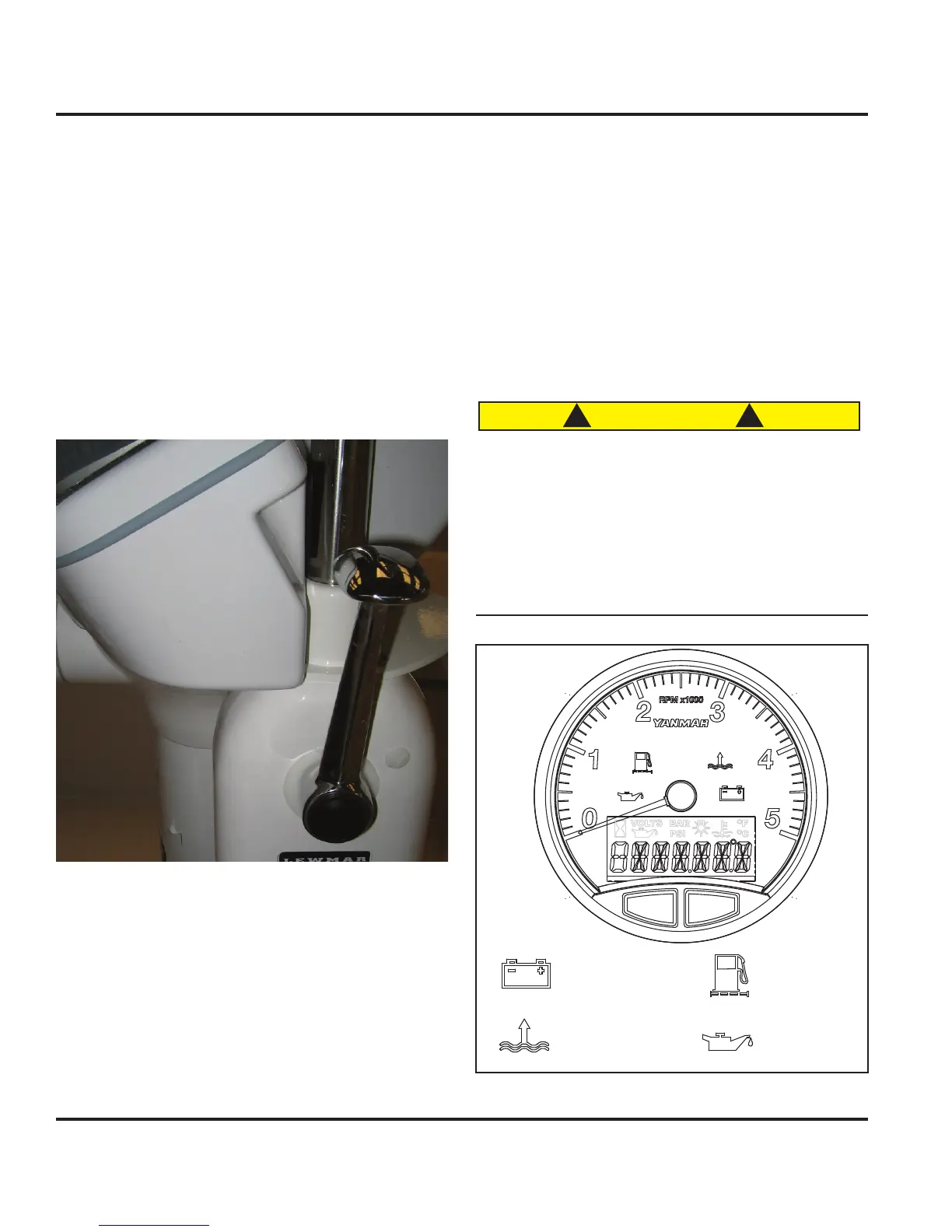
The boat’s engine controls (throttle) is located on the
starboard side of the pedestal (Fig. 11.6).
Neutral is in the center or vertical position. Moving the
lever forward will engage the engines forward. Moving
the lever backward will engage the engines in reverse.
Additional movement of the lever in a direction will
increase power in that direction.
Figure 11.6
IMPORTANT: Shift the transmission only when the engine
speed is at or below 1000 rpm. Shifting at higher engine
speeds could severely damage the boat, the transmission and
the engine. Allow the transmission to remain in neutral for a few
seconds before reversing the rotation of the propeller.
11.3.3 Monitoring and Emergency Response
Engine status and performance alerts will be commu-
nicated through the engine start panel gauge (left side
Fig. 11.5). Alerts will be conveyed by red lighted panel
symbols and an accompanying audible buzzer. Fig. 11.7
illustrates the engine start panel gauge with the potential
alerts noted.
The engine manual states the maximum RPM rating
established by the engine manufacturer. Do not exceed
this rating as indicated by the tachometer. Check the
manual for additional information about maximum RPM’s.
If alerts are communicated, immediately shut down the
engines and determine the source of the alert. Consult
the engine manufacturer’s OEM manual for the proper
procedures to correct.
Always monitor your boats engine panel for alert
displays while underway, even if your
engine systems are equipped with an alert alarm.
Immediately shut down the engines if gauges are not
in normal ranges or an alarm sounds.
Do not restart your engines until all alerts are
corrected.
BATTERY LOW CHARGE
INDICATOR
WATER IN SAIL DRIVE
SEAL INDICATOR AND
ALARM
ENGINE OIL LOW
PRESSURE INDICATOR
AND ALARM
WATER IN FUEL FILTER
INDICATOR AND
ALARM
Figure 11.7



 To Next Page