Boating Safety
4.13
lights not only have a certain arc through which they can
be seen but must be seen from a minimum distance. See
Fig. 4.2 for lighting requirements for recreational vessels
both less than 12 meters in length (approximately 39.4”),
and over 12 meters in length to 20 meters (65').
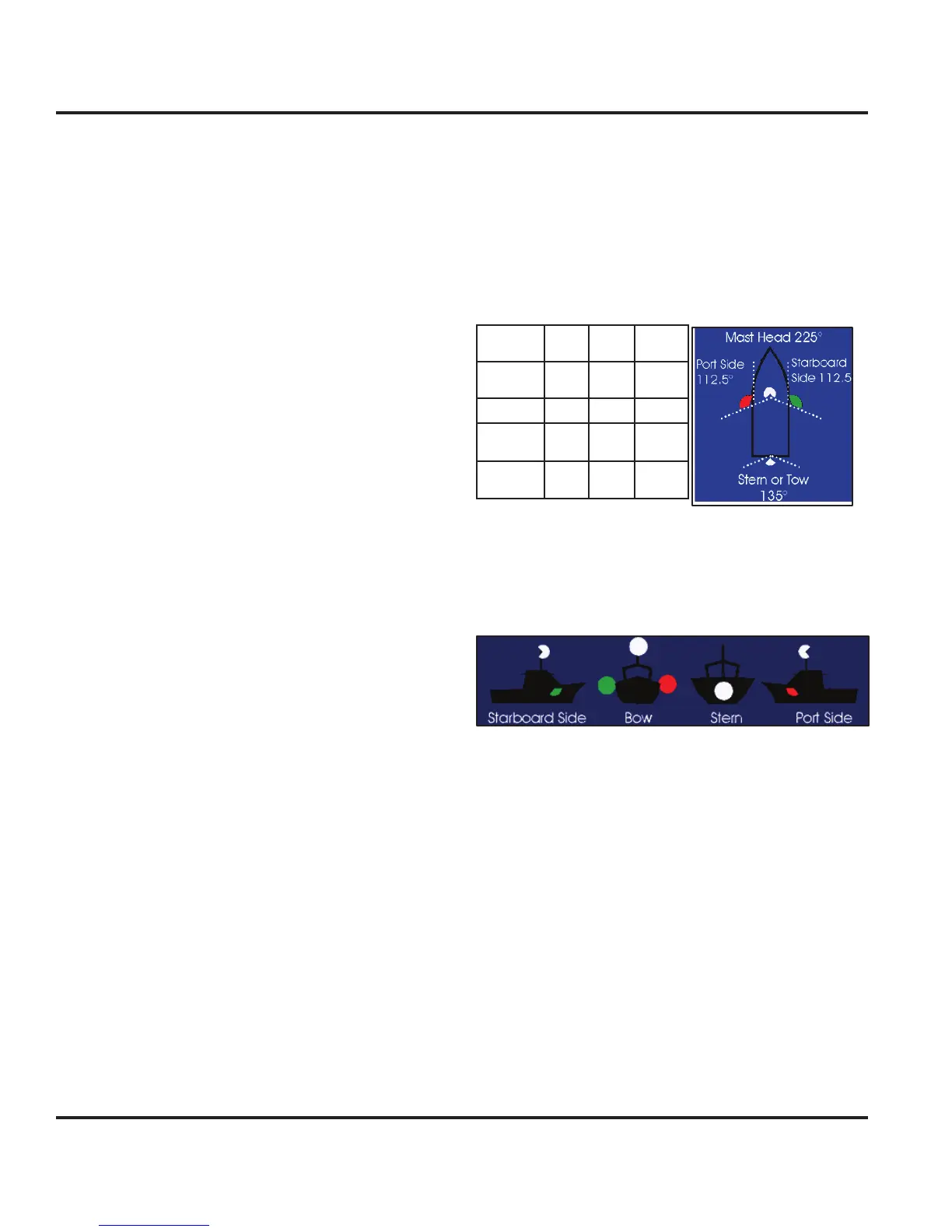
The arc of the lights and color allows you to determine the
direction a vessel is moving (see Fig. 4.3). How good are
your lights? You should test them to see how visible you
might be at night. Whether on a trailer or at the marina,
switch on your lights and see how well they can be seen.
Light Arc Color Visible
Range
Masthead
Light
225 Wht 2
Starboard 112.5 Grn 1
Port
Sidelight
112.5 Red 1
Sternlight 135 Wht 2
Figure 4.3
If you are at anchor or at a mooring, walk or row away
from the boat and see how visible the lights are as you
move further away. How easy are they to see against the
background of lights on shore?
Figure 4.4
It is allowable to have a 360 degree mast light. This mast
light, in conjunction with the side lights, will indicate the
boat's orientation (see Fig. 4.4).
Check your sidelights from dead ahead. You should see
both red and green. However, by moving toward one side
by 1-3 degrees, you should then see only one light. If you
still see two lights, an approaching vessel won’t be able
to tell which direction you are going.
When boating at night, remember the following: “When
two lights you see ahead, turn your helm and show your
red.”
4.6.4 Sound Signaling Device
Boats configured based on American specs are provided
home country's requirements for visual distress equip-
ment.
The U.S. Coast Guard requires visual distress equipment
must be in serviceable condition and stowed in a readily
accessible location. Equipment having a date showing
useful service life must be within the specified usage date
shown. Both pyrotechnic and non-pyrotechnic equip-
ment must be U.S. Coast Guard approved.
Pyrotechnic U.S. Coast Guard approved visual distress
signals and associated equipment include: red flares,
handheld or aerial orange smoke, hand held or floating
launchers for aerial red meteor or parachute flares. Non-
pyrotechnic equipment includes an orange distress flag,
dye markers, and an electric distress light.
No single signaling device is ideal under all conditions for
all purposes. Consider carrying various types of equip-
ment. Careful selection and proper stowage of visual
distress equipment is very important. If young children
are frequently aboard, you should select devices with
packages which children, but not adults, will find difficult
to open.
Other helpful publications available from the U. S. Coast
Guard include “Aids to Navigation” (U.S. Coast Guard
pamphlet #123), which explains the significance of
various lights and buoys, the “Boating Safety Training
Manual”, and “Federal Requirements for Recreational
Boats”. Check with your local Coast Guard Station, your
dealer, or a local marina about navigational aids unique
to your area.
4.6.3 Running and Navigation Lights
Your boat must have running and navigation lights for
safe operation after dark. Observe all navigation rules for
meeting and passing. Do not run at high speeds during
night operation. Always use common sense and good
judgment.
Operating at night can present some special challenges.
Not only is your depth perception lessened, bright lights
on the shore can cast misleading reflections on the water
and if you wear glasses, or worse yet, bifocals, you sim-
ply don’t see as well at night as you do during the day. It
is not only important that you be able to identify other ves-
sels operating in your proximity, it is equally important that
other vessels see you. Most recreational vessels are less
than 30 feet in length and, according to “The Rules of the
Road”, shall be equipped with navigation lights. These



 To Next Page