98
Tire sensors come already paired to the RVMaster sys-
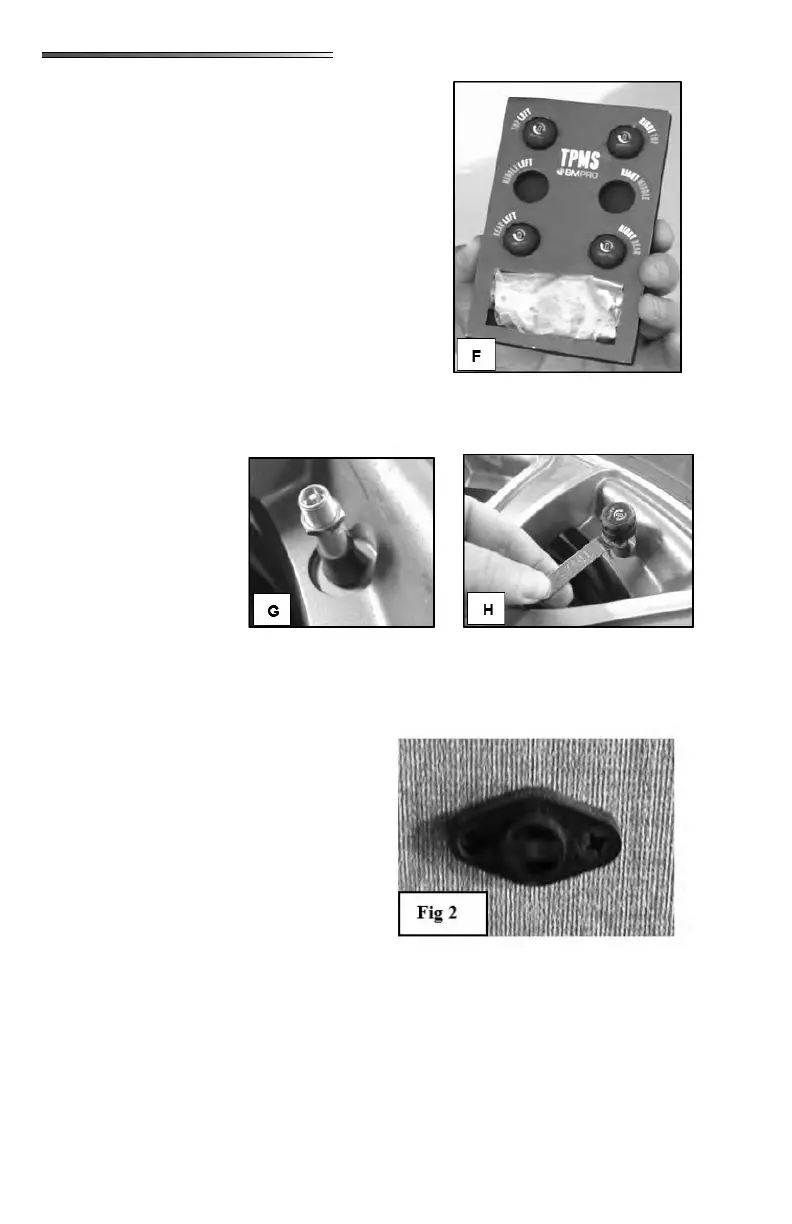
tem from the factory. Sensors come on a card (F) that
shows where each sensor should be installed on the
RV. The top of the card represents the “hitch” end of
the RV. Top left sensor would install on the front driver
side tire. Top right sensor would install on the front
passenger side tire, etc.
The bag shown at the bottom of the card is the parts kit
(refer to photo A previously).
Install a nut from the parts kit (A) on to the valve stem
of each tire. Run the nut all the way down the valve
stem (G).
Screw one of the sensors onto the valve stem. You
will hear a pu of air as you tighten the sensor on the stem. Sensor should be screwed as
far onto the valve stem
as possible. DO NOT
OVERTIGHTEN. Once
the sensor is installed
on the stem, run the nut
back up the valve stem
until it contacts the bot-
tom of the sensor. Use
the wrench to tighten the
nut under the TPMS sen-
sor (H).
There are no thermostats located in the RV.
Heating and cooling is controlled through the
BMPro RVMaster touchscreen Climate screen.
One or more small sensors (Fig 2) are located
on the walls of the RV. These sensors work
with the touchscreen to monitor how hot or
cold an area of the RV is and to tell the system
when to turn on the AC or the heat according to
climate settings on the touchscreen.
Shows an overview of the key features of your
RV. Climate, lights, motors, tanks and energy.
Shows your tank monitors (black, gray, fresh) water pump switch, water heater switches for
gas and electric and possibly the tank heater switch.
The Motors Screen is where you will nd controls for the leveling system, the awnings, the
slideouts, jacks and the ramp door (if you have a toyhauler with an automated ramp door).




 To Next Page