27
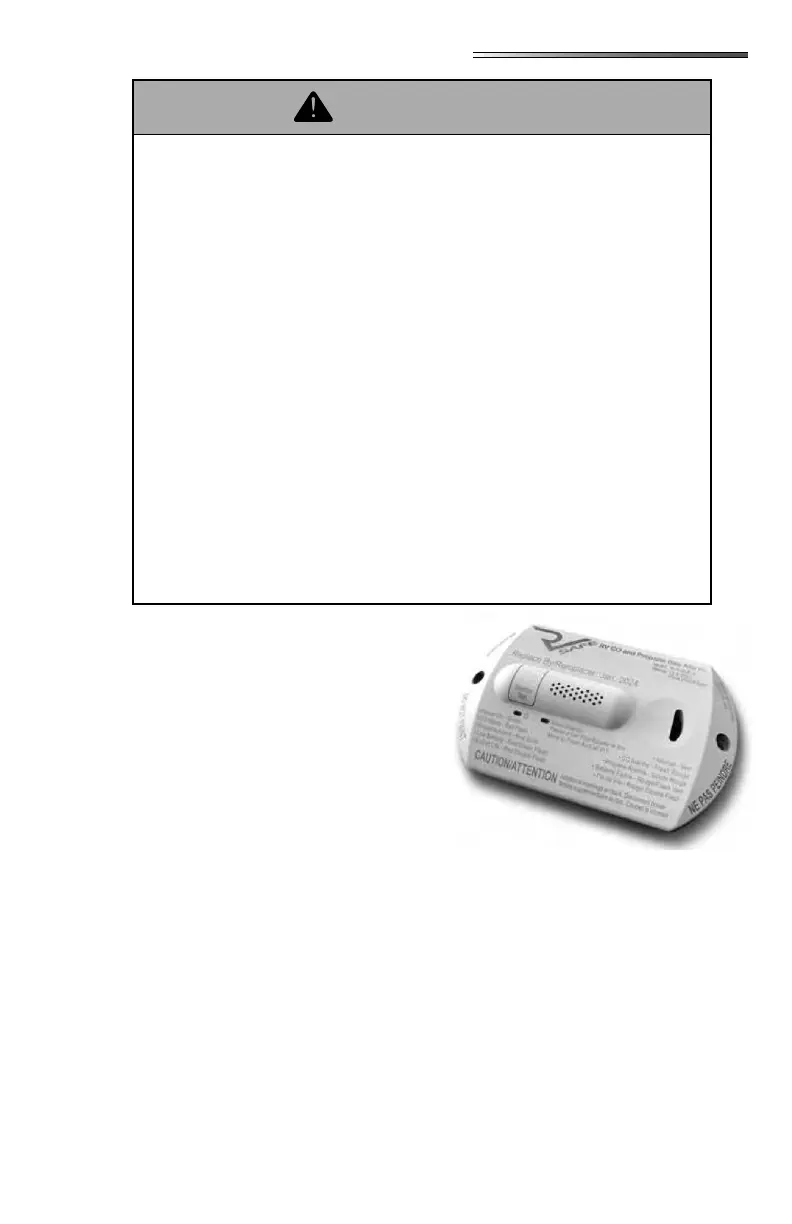
Combination Carbon Monoxide /Propane Alarm
Your recreation vehicle is equipped with a combination carbon monoxide (CO) / propane
alarm (RVCOLP) that is listed for use in recreation vehicles. The combination carbon mon-
oxide/propane alarm will only work if it is operational and maintained.
The alarm is directly wired to the 12-volt electrical system, with continuous power being
supplied by the recreational vehicle batteries. There is no 9-volt battery power supply. As
a result, the alarm is always drawing a small amount of current from the recreation vehicle
batteries. Although the current draw is slight, it could drain the batteries during extended
storage periods. This condition is not likely to occur except during storage situations when
the inverter cannot restore the battery charge.
Be sure to read, understand
and follow the owner’s information from the manufacturer of the combination CO/propane
alarm. This includes information regarding the limited life of the alarm.
Carbon monoxide (CO) is an insidious poison. It is a colorless, odorless and tasteless gas.
Many cases of reported carbon monoxide poisoning indicate while victims are aware they
are not well, they become so disoriented they are unable to save themselves by either exiting
the recreational vehicle or calling for assistance. Young children and household pets may
be the rst aected.
Your combination carbon monoxide/propane alarm is designed to detect the toxic carbon
monoxide fumes that result from incomplete combustion, such as those emitted from appli-
ances, furnaces, replaces and auto exhaust.
The carbon monoxide detector installed is intended for use in ordinary
indoor locations of recreation vehicles. It is not designed to comply with
Occupational Safety and Health Administration (OSHA) commercial or
industrial standards.
Individuals with medical problems may consider using warning devices
that provide audible and visual signals for carbon monoxide concentra-
tions under 30 PPM.
This alarm will only indicate the presence of carbon monoxide gas at the
sensor. Carbon monoxide gas may be present in other areas.
Installing a carbon monoxide/propane
alarm is just the rst step in protecting your family from toxic carbon
monoxide poisoning.
should be discussed with all members of the
household:
Slight headache, nausea, vomiting, fatigue (often de-
scribed as “u-like” symptoms).
Severe throbbing headaches, drowsiness, confu-
sion, fast heart rate.
Unconsciousness, convulsions, cardio-respiratory
failure, death.
A carbon monoxide/propane alarm is
for other combustible gas, re
or smoke alarms. This carbon monoxide alarm
is designed to detect carbon monoxide gas from
ANY source of combustion. It is not designed
to detect smoke, re or any other gas. Please
note that there are hazards against which carbon
monoxide detection may not be eective, such as
natural gas leaks or explosions.
This alarm is designed to sense the presence of
carbon monoxide/propane gas, however there are
other combustible fumes or vapors that may be
detected by the sensor including (but not limited
to): acetone, alcohol, butane and gasoline.
These chemicals can be found in commonly used items such as deodorants, colognes, per-
fumes, adhesives, lacquer, kerosene, glues, wine, liquor, most cleaning agents and the pro-
pellants of aerosol cans.
High temperatures can activate glue and adhesive vapors. If you close up a recreational
vehicle on a hot day, the chemicals used in its construction may be detected for months after
the vehicle was constructed (for more information, refer to Sec. 2, Formaldehyde).





 To Next Page