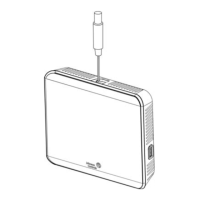
Terminal identification
Table 5: Terminal identification (See Wiring diagrams for details)
FunctionTerminal label
TEC3030, TEC3031, TEC313x TEC3330, TEC3331 TEC3630, TEC3631
24 V 24 VAC hot from the sensor
Y1 Cooling stage 1
Y2 Cooling stage 2
AUX Auxiliary binary output
AUX Auxiliary power input
W1 OB Heating 1 (RTU mode)/Reversing valve (O/B) (Heat Pump mode)
1
RH
1
Power for W1 and W2
W2 SUP Heating 2 (RTU mode)/Supplemental heat (Heat Pump mode)
OAD Outdoor air damper, 0 VDC - 10 VDC
2
COM
2
Common
COM
2
Common
G Fan
BI-2 Configurable binary input 2
BI-1 Configurable binary input 1
RSEN Configurable analog input 1
OAT Configurable analog input 3
SAT Configurable analog input 2
NET+ n/a Not connected Field bus+/N2+
NET- n/a Not connected Field bus-/N2-
NET COM n/a Not connected Isolated common for field bus
1 RH needs to be connected for W1 and W2 to energize. For heating systems with an isolated power supply, connect RH to the R
terminal of the heating system. For systems that switch the hot supply to the heating commands, connect the jumper to 24 V. For
systems that switch the neutral supply to the heating commands, connect the jumper to COM.
2 For the networked models, the common terminals, which do not include NET COM, are internally connected and can be used for all
inputs and outputs. For the wireless models, the common terminals are connected and can be used for all inputs, outputs, and 24
VAC ground or common.
TEC3000 Series Networked and Wireless Single- or Two-Stage Economizer Thermostat Controllers Installation Guide6


 To Next Page
 Loading...