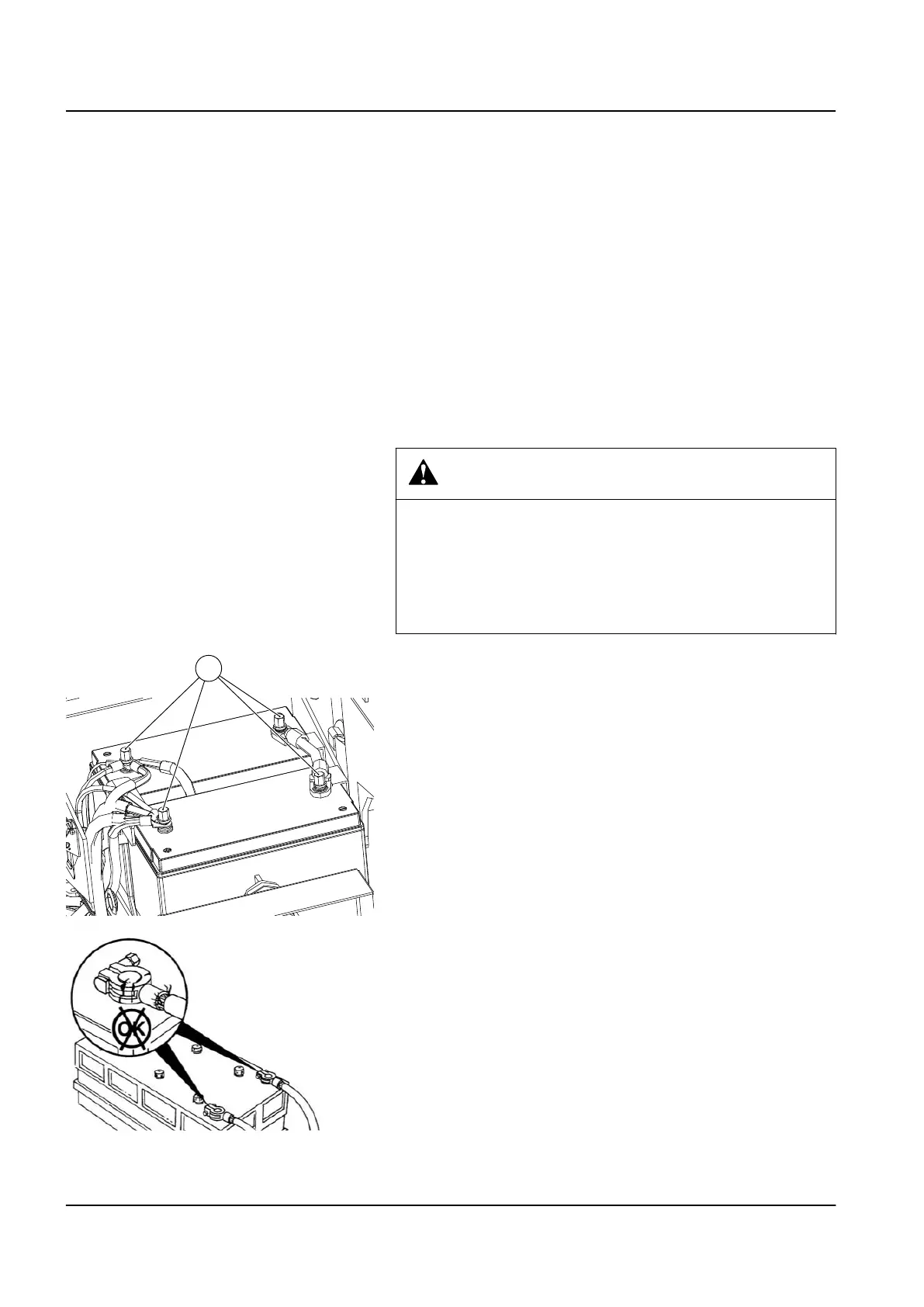
Note the battery polarity. Incorrect connection damages the
batteries and electric devices. Connect the ground cable last.
4 Examine the battery charge status by measuring the density
of the electrolyte. The density of the electrolyte in a fully-
charged battery is about 1.28 g/cm 3. The corresponding
value for a discharged battery can be as low as 1.15 g/cm 3.
When this is the case, the electrolyte will freeze at -10°C. If
significant differences in the density between cells is noted,
the battery is exhausted.
5 Examine the electrolyte level in the cells. The level must be
about 10 mm above the top of the battery plates; add liquid if
necessary. Add distilled water only. Also check that the air
holes in the filler plugs are not clogged.
Examine battery cables and connections
WARNING
EXPLOSION HAZARD!
Batteries can emit explosive gases.
To reduce the possibility of personal injury, always ventilate the
compartment before servicing the batteries. To reduce the possibil‐
ity of arcing, remove the negative (-) battery cable first and attach
the negative (-) battery cable last.
1 Remove and inspect the battery cables and connections (A)
for cracks or corrosion.
2 Replace broken terminals, connectors, or cables.
4 11 Common electrics – 11.3 Batteries
TL2 Maintenance Manual
591 003 Default



 To Next Page