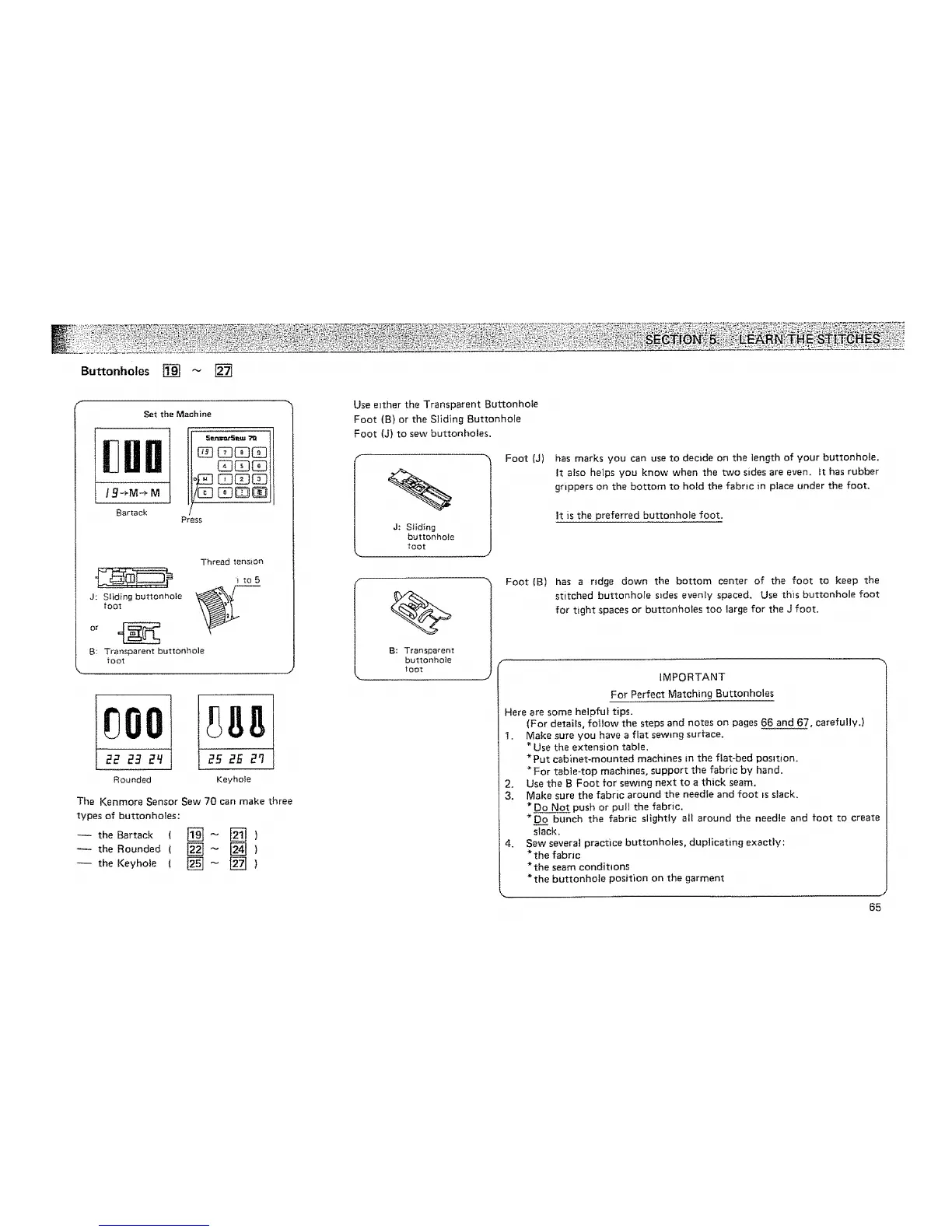
Buttonholes _ _ []
I .q_M-_ M
Bartaek
J: Sliding buttonhole
tOOt
Thread _ension
{ to 5
B: Transparent buttonhole
foot
22 23 2_
Rounded
25 2G 2g
Keyhole
The Kenmore Sensor Sew 70 can make three
types of buttonholes:
the Bartack ( [_ _ _ )
the Rounded ( _
)
-- the Keyhole ( [] _ [] )
Use either the Transparent Buttonhole
Foot (B) or the Sliding Buttonhole
Foot (J) to sew buttonholes.
Foot (J) has marks you can use to decide on the length of your buttonhole.
It also helps you know when the two sides are even. it has rubber
grippers on the bottom to hold the fabric in place under the foot.
It is the preferred buttonhole foot.
El: Transparent
buttonhole
tOOt
Foot (B) has a ridge down the bottom center of the foot to keep the
stitched buttonhole sides evenly spaced. Use this buttonhole foot
for tight spaces or buttonholes too large for the J foot,
IMPORTANT
For Perfect Matching Buttonholes
Here are some helpful tips.
(For details, follow the steps and notes on pages 66 and 67, carefully.)
1. Make sure you have a flat sewing surface.
* Use the extension table.
*Put cabinet-mounted machines in the fiat-bed position,
*For table-top machines, support the fabric by hand,
2. Use the B Foot for sewing next to a thick seam.
3, Make sure the fabric around the needle and foot is slack.
*Do Not push or pull the fabric.
*D__oobunch the fabric slightly all around the needle and foot to create
slack.
4. Sew several practice buttonholes, duplicating exactly:
* the fabric
* the seam condit{ons
*the buttonhole position on the garment
65



 To Next Page