Need help?
Do you have a question about the Kidde IG-55 and is the answer not in the manual?
Key information and disclaimers regarding system responsibility and data accuracy.
Guidelines for securely shipping and handling Agent cylinders.
Procedures to prevent damage from dropping or striking cylinders.
Requirements for safely storing Agent cylinders upright and secured.
Importance and use of the anti-recoil safety cap to prevent accidental discharge.
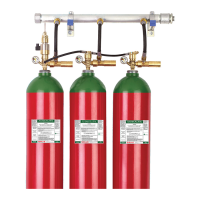
Overview of Kidde IGS systems, agents, and key features.
Describes the applications and suitability of Kidde IGS for various fire classes.
Lists fire types and materials that Kidde IGS should not be used for.
Classifies fires according to different standards and provides LOAEL/NOAEL data.
Discusses limitations and considerations for the number of agent cylinders.
Method of releasing agent into an enclosure for total flooding.
Agent release for specific units like cabinets, not total flooding.
Using common cylinder banks and selector valves for multiple areas.
Safeguards for evacuation, rescue, and avoiding hazardous atmospheres.
Guidelines for safe exposure levels based on agent concentration and oxygen reduction.
Calculation of oxygen partial pressure at different altitudes.
Setup of cylinders in banks, manifold connections, and storage requirements.
Use of selector valves to distribute agent to multiple hazards from a common bank.
Requirements for agent release time based on fire class and standards.
Optional instrumentation for local and remote pressure monitoring of cylinders.
How the release unit's solenoid coil satisfies placement supervision requirements.
Recommendation for adding safety factors to extinguishing concentrations based on standards.
Details on IG-100 agent, its purity specifications, and pressure/temperature curves.
Details on IG-55 agent, its composition, and specifications.
Specifies the purity requirements for Argon and Nitrogen components.
Formulas relating agent pressure to temperature for IG-100 and IG-55.
Specifies the operational and discharge temperature ranges for the Kidde IGS system.
Discusses temperature range considerations for balanced and unbalanced systems.
System release triggered by detection and control panel signals.
Manual release via a remote station or control panel.
Manual release in case of total power failure using override mechanisms.
Overview of modules and assemblies in Kidde IGS systems.
How the Kidde IGS system operates, from agent storage to nozzle distribution.
Storage and installation of agent cylinders and their configurations.
Details on pneumatically operated high-pressure cylinder valves and their features.
Function and types of release units connecting to cylinders for agent release.
Provides pressure indication for slave cylinders and low-pressure monitoring.
Description and dimensions of hoses used for pneumatic actuation in multi-cylinder systems.
Function of the bleed valve to prevent unintended discharge from pilot lines.
Cables for wiring pressure gauges of release units and slave assemblies.
Routing agent from cylinders to manifold piping using flexible hoses.
Safety device to relieve overpressure in closed pipe sections.
Gauge connected to the manifold for pressure indication.
Optional device to visually indicate system discharge and act as a vent.
Check valves used between discharge hoses and manifold for proper flow.
Switches connected to piping, actuated by agent pressure for alarms and shutdowns.
Device connected to piping that uses agent pressure for actuation.
Switch to toggle connection between main and reserve cylinders for maintenance or discharge.
Injects a scent to warn personnel of agent presence during discharge.
Labels to identify primary and backup agent cylinders.
Warning signs for protected area entrances and exits.
Valves used to distribute agent to multiple hazards from a common bank.
Manifold providing pressure to selector valves, including regulators and solenoids.
Hose connecting solenoids to selector valves.
Spare solenoids for the back-plate manifold.
Manually operated valves installed in discharge pipe network for agent containment.
Lists available nozzle part numbers and types (180°/360°).
Systems using nitrogen pressure for delays or sirens.
Devices providing pneumatic delay for pilot media release.
Siren providing audible alarm before agent discharge.
Two sizes of cylinders for pilot systems, meeting USDOT and TC requirements.
Details on the 108 cu. in. pilot cylinder, its capabilities, and mounting.
Details on the 1040 cu. in. pilot cylinder, its capabilities, and strap installation.
Component that discharges contents of the 1040 cu. in. pilot cylinder.
Kit for electric actuation of pilot cylinders, including monitor and control head.
Lever control for bypassing time delay on discharge delay systems.
Control head allowing manual and pressure actuation of pilot cylinders.
Provides supervision for control head placement in normal and explosive environments.
Adapter for filling cylinder/valve assemblies during cylinder charging.
Details on manifold availability, coupling, and capacity matching.
Outlines modular components for cylinder racking systems.
Component used with cylinder bracketing to support cylinders.
Presses cylinders against wooden spacers.
Spacer located between the cylinder and the Unistrut.
Used between rows on multi-row cylinder banks.
Bracket used for single row cylinder installations.
Connects the front clamping bar to the Unistrut rail.
Protects the edges of the unistrut rail.
Spacer used in multi-row systems for odd numbers of cylinders.
Overview of Kidde IGS systems, standards, and flow calculation software.
Factors to consider when examining enclosures for system design.
Considerations for cylinder storage location, environment, and security.
Use of extended discharge for enclosures with non-closable openings.
Design concentrations for IG-01 and IG-55 based on fuel types.
Requirements for achieving 95% of design concentration within specified times.
Defines MDC and ROL requirements for hazard areas.
Tables for calculating IG-55 mass required per unit volume at different temperatures.
Tables for calculating IG-100 mass required per unit volume at different temperatures.
Factors influencing agent quantity, including room integrity and ventilation.
Minimum clearance requirements for energized electrical equipment during maintenance.
Requirement to maintain extinguishing concentration for a specified period after discharge.
Impact of discharge on enclosure temperature and system operating range.
Requirement to use listed flow calculation software for system design.
Outputs from flow calculation software, including pipe dimensions and nozzle orifice diameters.
Method for calculating net enclosure volume for agent quantity.
Determining minimum design concentration based on flammable materials.
Design requirements for floor voids and ventilation systems.
Correction factors for altitude to adjust extinguishant quantity.
Lists nominal agent quantities for IG-100 and IG-55 cylinders at different pressures.
Guidelines for locating and installing cylinder banks.
Considerations for positioning cylinders horizontally or vertically.
Diagrams and dimensions for cylinder bank layouts.
Tables for calculating floor load based on cylinder bank configuration.
Considerations for installing cylinders in areas with constant or shock vibrations.
Limitations on valve actuation cycles and discharge thrust.
Rules for designing selector valve systems, including solenoid energization and manual handles.
Manifold controlling selector valve opening via solenoids and pressure regulators.
Criteria for selecting nozzle quantity, size, and location for proper agent distribution.
Maximum area coverage for 360° and 180° nozzles.
Orifice area to pipe area ratios and nozzle configurations.
Guidelines for nozzle orientation, ceiling clearance, and height limitations.
Placement requirements for 360° nozzles for maximum coverage.
Spacing requirements for intersecting discharge patterns.
Adjustments for nozzle spacing due to obstructions.
Table outlining limitations for different tee styles and orientations.
Table for estimating distribution piping size based on flow rate.
Operating, storage, and assumed temperatures for Kidde IGS equipment.
Lists maximum cylinders actuated per release unit or discharge delay.
Limitations for pressure-activated accessories like trips and sirens.
Maximum load specification for pressure trip devices.
Installation and operation of N2 pressure-operated sirens.
General instructions for installing Kidde Fire Systems equipment.
Required Personal Protective Equipment (PPE) for Kidde IGS installation.
Compliance with local standards, practices, and approved drawings.
Minimum clearance requirements from energized electrical equipment.
Step-by-step general process for installing the system.
Items to be supplied locally and main system components.
How the system releases Agent, automatic vs. manual release.
How cylinders are connected to the manifold and system release mechanisms.
Distributing agent to hazards from a common bank using selector valves.
How discharge delays prevent premature system discharge using nitrogen pilot cylinders.
Guidelines for locating and installing cylinder banks.
Tables for calculating floor load based on cylinder bank configuration.
Diagrams for planning cylinder racking installation.
Diagrams and dimensions for single-row clamp racking systems.
Diagrams and dimensions for dual-row wooden racking systems.
Use of distance pipe for securing odd numbers of cylinders in wooden brackets.
Diagrams showing cylinder components and typical assemblies.
Procedures for assembling the cylinder bank and securing components.
Steps for mounting manifold brackets and securing the manifold to supports.
Safety device to relieve overpressure in closed pipe sections.
Connecting discharge hoses to manifold check valves after manifold installation.
Procedure for securing cylinders in a single row.
Procedure for securing cylinders in multi-row setups.
Procedure for positioning cylinders in brackets and performing leak tests.
Mounting and connecting the back-plate manifold for systems with selector valves.
Procedures for installing release units, including lubrication and leak testing.
Steps for installing slave cylinder gauge assemblies and performing leak tests.
Indicates points for leak testing valve and cylinder connections.
Indicates points for leak testing release unit connections.
Methods for venting agent from burst discs to atmosphere or distribution pipework.
Ensuring correct hose installation and avoiding exceeding minimum bend radius.
Installation guidelines for piping and fittings, avoiding restrictions and ensuring support.
Requirements for piping material, physical, and chemical characteristics.
Use of black steel or galvanized pipe, and specific material restrictions.
Conformance requirements for fittings, including restrictions on Class 150 and cast iron fittings.
Guidelines for supporting pipes and manifolds.
Table of maximum distances between pipe supports.
Requirements for adequate support of nozzles against reactive forces.
Diagrams illustrating various pipe support types and nozzle details.
General practices for pipe installation, including route, fittings, and cleaning.
Use of rolled grooved joining and consultation with suppliers.
Sealing threaded connections and addressing potential leaks.
Procedures for blanking, pressurizing, and blowing through pipework.
Installing discharge nozzles according to drawings, ensuring correct type and orientation.
Recommends pressure testing before cylinder bank assembly.
Safety precautions for pneumatic testing involving compressed gas.
Step-by-step procedure for pressure testing pipework with gas.
Requirements for signs and labels on storage rooms, cylinders, and protected areas.
Signage requirements for the cylinder storage room doors.
Labeling requirements for agent cylinders (instruction, agency, transport).
Signs or labels for selector valves indicating the protected space.
Signage for access doors to protected areas, including automatic closing.
Audible and visual alarms within the protected space.
Cable routing plans and electrical component details.
Wiring diagram and connection of release units and slave gauge assemblies.
Recommendations for fitting solenoid release units and cable management.
Wiring diagrams for solenoid connections to control panels.
Connection and mounting of pressure-operated switches.
Installation of pressure-operated trip connected to discharge piping.
Instructions for installing nitrogen pilot cylinder accessories.
Steps for installing the 108 cu. in. nitrogen pilot cylinder and bracket.
Procedures for installing the 1040 cu. in. pilot cylinder and securing it.
Connecting discharge hose to piping or manifold.
Attaching discharge head to pilot cylinder valve after hose installation.
Installing electric and lever/pressure operated control heads.
Steps for installing electric control heads and monitors on 1040 cu. in. pilot cylinders.
Steps for installing electric control heads on 108 cu. in. pilot cylinders.
Procedure for installing lever/pressure operated control heads.
Instructions for installing discharge delays and setting time units.
Steps for connecting discharge delay adapters, regulator, and actuation hose.
Siren location, connection requirements, and actuation limits.
Examples of siren operation via pneumatic or electric control.
Installation of pressure trip on discharge manifold or piping.
Installation of discharge indicator on manifold.
Location and installation of odorizer assemblies downstream of selector valves.
Installation steps for various sizes of selector valves.
Installation procedures for 1", 1.5", and 2" selector valves.
Installation procedures for 3" and 4" selector valves, including flange connections.
Requirements and wiring diagrams for lockout valves.
Wiring diagrams for single and dual solenoid transfer switches.
Inspections and tests to perform after Kidde IGS installation is complete.
Procedure to check the integrity of the complete pilot line arrangement.
Overview of controls and Kidde Fire Systems IGS.
General description of compressed gas agent in cylinders and discharge.
Procedures for automatic and manual operation of the system.
Evacuation procedures during automatic system operation.
Emergency manual control for single area systems.
Emergency manual control for multi-area systems using selector valves.
Maintenance procedures to be performed after system discharge.
Maintenance instructions for Kidde IGS systems and awareness points.
Handling and storage precautions for pressurized agent cylinders.
Importance of systematic maintenance and recording inspection logs.
Owner's schedule for weekly and monthly preventative maintenance tasks.
Weekly maintenance tasks for cylinder pressure and inspections.
Verifying cylinder pressure gauges against calibrated devices.
Checking nitrogen pilot cylinder pressure and recharge criteria.
Inspecting hazard area and enclosure integrity for system performance.
Visually inspecting pipework and controls for damage.
Monthly maintenance tasks, including general inspections.
General survey of cylinders and equipment for damage or missing parts.
Checking nozzles for dirt, damage, or blockage.
Inspecting pull stations for damage, cracks, or dirt.
Checking pressure switches for damage, cracks, or dirt.
Checking if operating personnel are trained and authorized.
Ensuring hazard areas and components are unobstructed.
Inspecting actuation and discharge hoses for damage and fittings.
Checking release units and slave gauges for damage, corrosion, and electrical lines.
Inspecting cylinder/valve assemblies for leakage, damage, and burst discs.
Inspecting electric control heads for damage, corrosion, dirt, and electrical lines.
Checking mounting hardware for looseness, damage, or corrosion.
Semi-annual inspection tasks including lockout valves and selector valve actuators.
Manually operating the ball valve and observing the micro-switch.
Operating the valve manually using the emergency handle.
Visually inspecting pipe work and nozzles for damage or obstructions.
Inspecting the protected room for changes affecting system performance.
Testing discharge pressure switches semi-annually for proper operation.
Semi-annual testing of release units without full agent discharge.
Semi-annual testing of control heads on nitrogen pilot cylinders.
Testing electric control heads without discharging pilot cylinders.
Semi-annual testing of lever operated control heads.
Semi-annual testing of lever/pressure operated control heads.
Annual examination of system hoses for damage.
Checks for the odorizer assembly, including burst disc integrity.
Annual inspection tasks beyond semi-annual checks.
Annual comparison of system gauges against a calibrated device.
Procedures to be performed every two years.
Procedures for blowing out distribution piping to remove obstructions.
Procedures for cylinders subject to Code of Federal Regulations every 5 years.
Inspection and retest requirements for UN specification cylinders.
Procedures for EU approved cylinders every 10 years.
Retest procedures for TPED specification EU cylinders, including valve replacement.
Procedures for cleaning, nozzle service, and repairs.
Methods for cleaning metallic and non-metallic parts.
Procedures for cleaning and inspecting discharge nozzles.
Replacing damaged parts and cylinder recharge criteria.
Step-by-step instructions for removing a Kidde IGS cylinder.
Procedure for reinstalling a Kidde IGS cylinder in reverse order of removal.
Information for post-discharge maintenance procedures.
Returning the system to operational mode and required technician involvement.
Procedures for replacing used or low-pressure agent cylinders.
Procedure for re-installing release units after service or discharge.
Re-installation of slave cylinder gauge assemblies, including O-ring replacement.
Contacting Kidde Fire Systems or authorized distributor for cylinder service.
Service and maintenance for nitrogen pilot cylinders.
Hydrostatic test requirements for nitrogen pilot cylinders.
Procedures for removing pilot cylinders when expended or low on pressure.
Steps for recharging nitrogen pilot cylinders, including adapter and pressure monitoring.
Inspection and servicing of the Nitrogen I-Valve on 1040 cu. in. pilot cylinders.
Step-by-step procedure for disassembling the I-Valve.
Assembling the valve after inspection, including gasket replacement.
Procedure for replacing the safety disc and washer.
Inspection and servicing of components in the plain nut discharge head assembly.
Overview of the parts list, covering agent cylinders, release units, etc.
Tables for agent and cylinder part number combinations.
Lists part numbers for Kidde IGS release units and service kits.
Lists part numbers for slave cylinder gauge assemblies.
Lists part numbers for Kidde IGS quick connect cables.
Lists part numbers for discharge hoses, safety devices, gauges, and signs.
Lists part numbers for Kidde IGS selector valves and back-plate manifolds.
Lists part numbers for Kidde IGS lockout valves.
Lists NPT and BSP nozzle part numbers by type and orifice size.
Offers 360 degree nozzles in brass for NPT and BSP piping.
Offers 180 degree nozzles in brass for NPT and BSP piping.
Lists part numbers for discharge delay kits, sirens, and related accessories.
Lists part numbers for Kidde IGS fill adapter assemblies and O-rings.
Lists part numbers for manifolds, couplings, end caps, adapters, and brackets.
Lists part numbers for Unistrut wall brackets, clamping bars, wooden spacers, and distance pipes.
 General
| Brand | Kidde |
|---|---|
| Model | IG-55 |
| Category | Firefighting Equipment |
| Language | English |

 To Next Page