13
2.2 CONDITIONS FOR OPERATION
ASSESSMENT OF THE GROUND
Analysis of the ground can consist of a visual inspecon of the surface or a detailed geotechnical survey.
Nevertheless, it is essenal that the assessment be carried out by personnel with enough experse and experience to be aware
when advice must be sought from someone more skilled.
Assessing the load capacity of the underlying ground
is the primary task of a civil engineer.
1) Loose ground
All forms of loose ground, including just laid
surfacing (gravel, sand, mud, etc.) must be
avoided.
2) Non-compacted lling material
Areas of ground may have been lled with soil or
other materials without it being properly
compacted. Cracks appearing around the
perimeter of a dug area are signs that the area
has not been properly compacted.
3) Proximity to dug areas
The machines must not be posioned near the edges of earthworks or other excavaons as they are likely to subside
without warning. If the machine has to be posioned near the edge of a slope or a dug area with the outriggers or wheels
in a ‘hazardous area’, a technical assessment report should be sought from a skilled geotechnical engineer before seng up
the MEWP and rendering it operaonal.
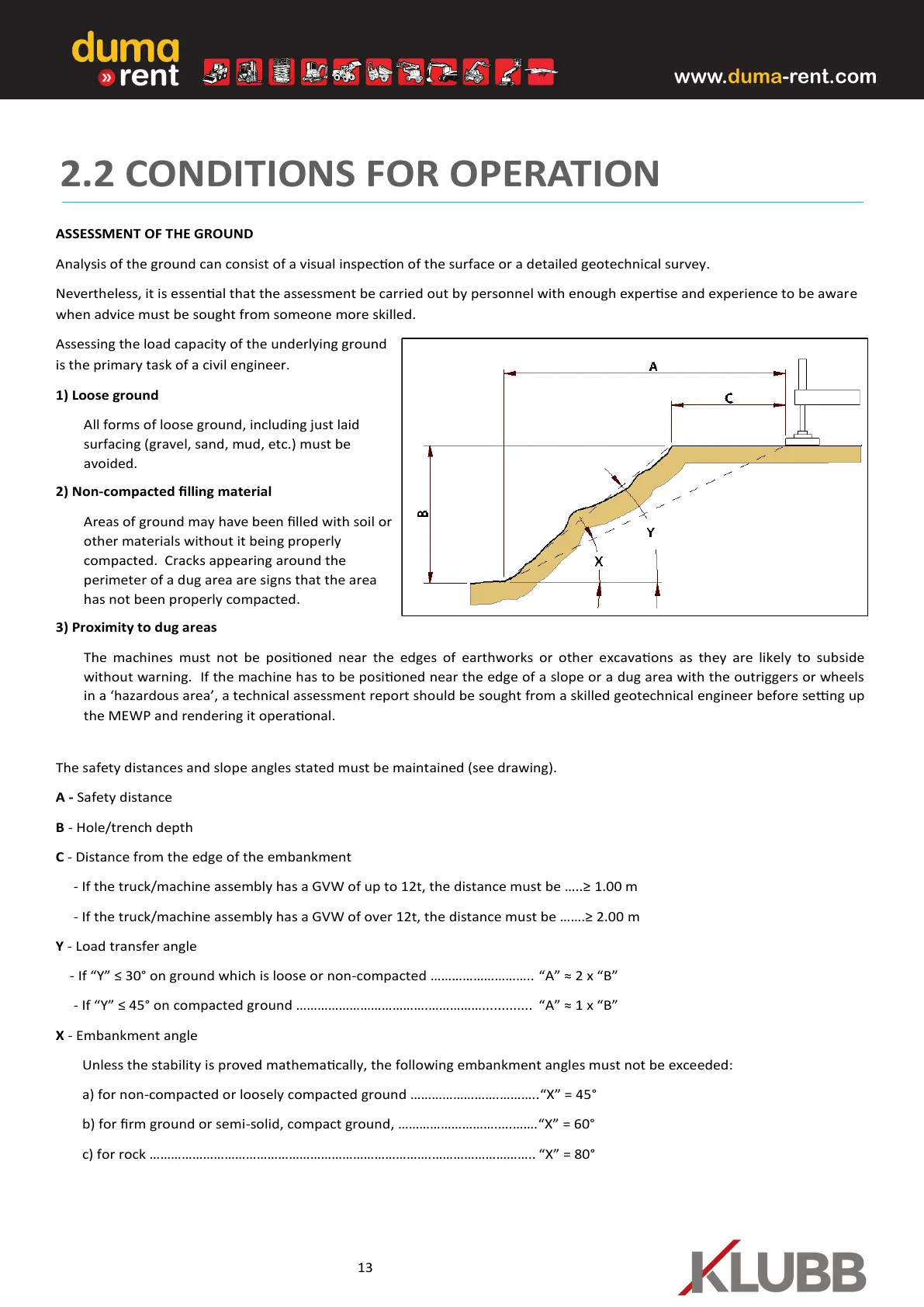
The safety distances and slope angles stated must be maintained (see drawing).
A - Safety distance
B - Hole/trench depth
C - Distance from the edge of the embankment
- If the truck/machine assembly has a GVW of up to 12t, the distance must be …..≥ 1.00 m
- If the truck/machine assembly has a GVW of over 12t, the distance must be …….≥ 2.00 m
Y - Load transfer angle
- If “Y” ≤ 30° on ground which is loose or non-compacted ……………………….. “A” ≈ 2 x “B”
- If “Y” ≤ 45° on compacted ground ……………………………….……………............. “A” ≈ 1 x “B”
X - Embankment angle
Unless the stability is proved mathemacally, the following embankment angles must not be exceeded:
a) for non-compacted or loosely compacted ground …………………….………..“X” = 45°
b) for rm ground or semi-solid, compact ground, ……………………….….…….“X” = 60°
c) for rock …………………………………………………………………….……………………….. “X” = 80°


 To Next Page