14
2.2 CONDITIONS FOR OPERATION
ASSESSMENT OF THE GROUND (connued…)
4) Paved areas, basements, and semi-basements
Many paved areas, basements, and semi-basements are unable to withstand the load of a plaorm and could collapse
without warning. The suitability of the ooring and the locaon of the basements and semi-basements must be taken into
account.
5) Areas paved with slabs
Paving slabs can appear strong while hiding a weak oor underneath. Cauon must always be taken with pavements as
they could have been made from poor quality materials or might hide work that has been carried out underneath the
surface. If a road is subject to constant heavy goods trac and does not show any signs of wear, then it may be less
hazardous than a car park or a less-used country road.
6) Underground works
All underground cavies, such as sewerage, drainage canals, wells, manholes, pipelines for gas, water, power cables, and
other pipelines, tunnels, abandoned cemeteries, old water holding tanks, sepc tanks, etc. could be damaged by the weight
of the machine or could even cave in, either leaving the machine unstable or causing it to overturn.
7) Weather condions
Heavy rain or extended rainy periods could alter the condions of the ground, causing outriggers and wheels to sink. If you
suspect subsidence in the ground where the MEWP needs to stand, check the level of the machine regularly and make the
appropriate adjustments to the outriggers, ground shoring, etc. Regular checks must also be made when icy
ground begins to thaw, as it could look much stronger than it actually is.
Spreader Plates
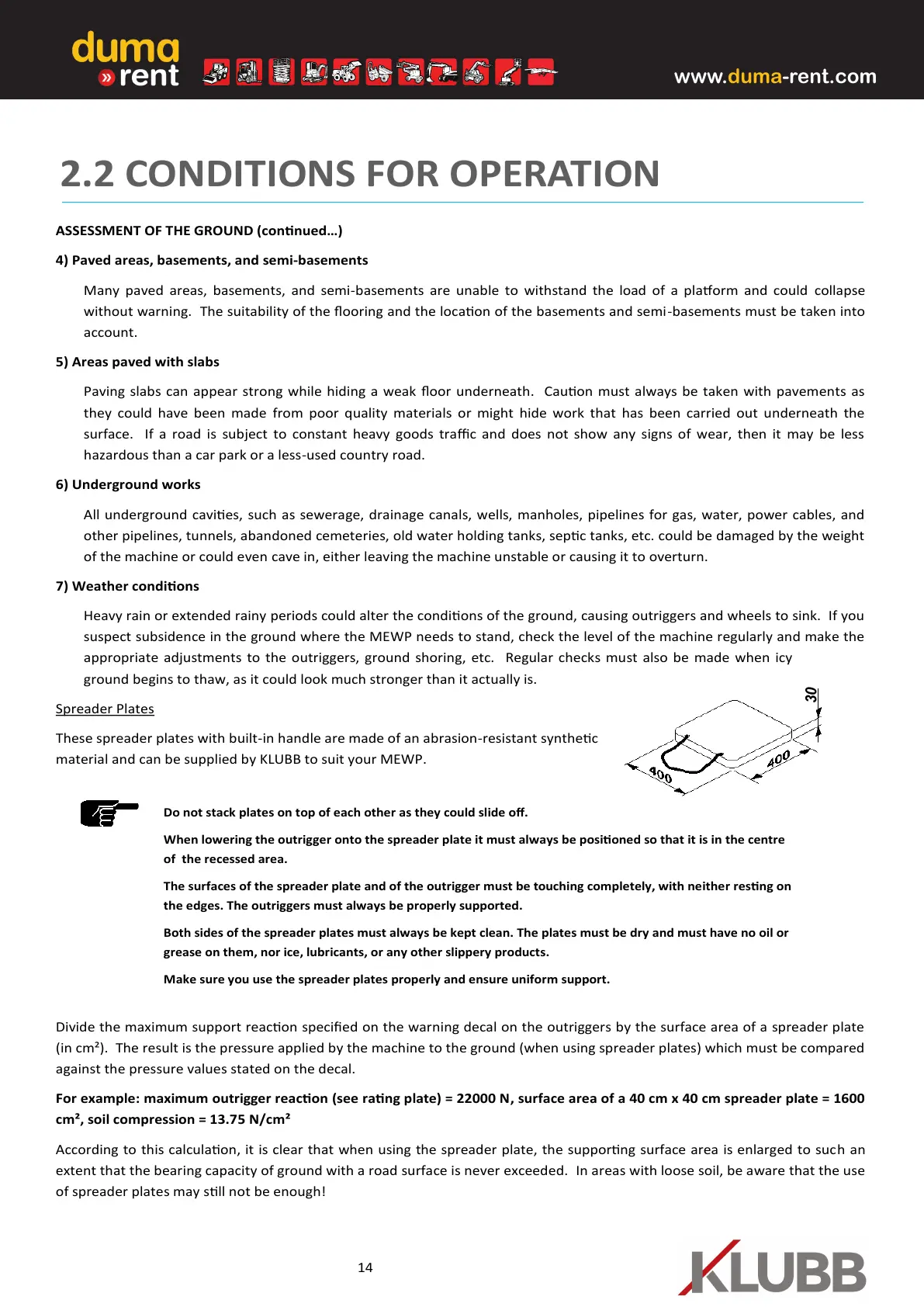
These spreader plates with built-in handle are made of an abrasion-resistant synthec
material and can be supplied by KLUBB to suit your MEWP.
Divide the maximum support reacon specied on the warning decal on the outriggers by the surface area of a spreader plate
(in cm²). The result is the pressure applied by the machine to the ground (when using spreader plates) which must be compared
against the pressure values stated on the decal.
For example: maximum outrigger reacon (see rang plate) = 22000 N, surface area of a 40 cm x 40 cm spreader plate = 1600
cm², soil compression = 13.75 N/cm²
According to this calculaon, it is clear that when using the spreader plate, the supporng surface area is enlarged to such an
extent that the bearing capacity of ground with a road surface is never exceeded. In areas with loose soil, be aware that the use
of spreader plates may sll not be enough!
30
Do not stack plates on top of each other as they could slide o.
When lowering the outrigger onto the spreader plate it must always be posioned so that it is in the centre
of the recessed area.
The surfaces of the spreader plate and of the outrigger must be touching completely, with neither resng on
the edges. The outriggers must always be properly supported.
Both sides of the spreader plates must always be kept clean. The plates must be dry and must have no oil or
grease on them, nor ice, lubricants, or any other slippery products.
Make sure you use the spreader plates properly and ensure uniform support.



 To Next Page