Need help?
Do you have a question about the Leb Electronics CTR50 and is the answer not in the manual?
Explains the function of START and Pedestrian START controls for gate operation.
Details safety devices like Stop buttons, photocells, and edge sensors for gate protection.
Defines inputs for stroke end signals and the integrated amperometric sensor for obstacle detection.
Details the outputs for blinkers, motors, electric locks, and open gate indicators.
Specifies the power supply inputs for the electronic card, motors, and accessories.
Describes the input for connecting a radio receiver aerial.
Explains the function of various LEDs indicating operational status and errors.
Details the RV1 trimmer for regulating the amperometric sensor sensitivity.
Describes the dip switches for selecting working logic, phase displacement, and extra-push.
Explains the function of jumpers JP1 (LED feeding) and JP2 (Battery charger).
Details the programming keys for remote control management and parameter setting.
Describes the protection fuses for the battery and electronic card.
Highlights technical features like soft stop function and power supply options.
Details the integrated 2-channel radio receiver for remote controls.
Explains the extra-push function for electric lock release in adverse conditions.
Describes setting dip switch 5 for synchronized opening/closing of wings.
Defines different working logic modes like Step-by-Step, Automatic, and Condominium.
Explains how the unit behaves after temporary power interruptions.
Notes the requirement for Condominium logic when opening is timer-controlled.
Details configuration for single wing gate operation.
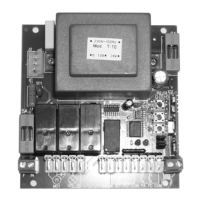
Lists the electrical and mechanical specifications of the CTR50 control board.
Details the electric connections and terminal boards on the control board.
Describes connections for controls, safety devices, and indicators on terminal board J2.
Details connections for power supply, motors, and electric locks on terminal board J1.
Explains connections for stroke ends and safety sides on terminal board J3.
Details buffer battery connections (FS1, FS2) and the importance of Jumper JP2.
Describes scheduled ordinary maintenance and procedures for extraordinary repairs.
Provides the declaration of conformity with European directives and applied standards.
Details procedures for learning and cancelling remote control codes.
Explains an alternative method for learning Rolling Code remote controls.
Guides on programming work times and pause times for gate wings.
Step-by-step guide for programming gate wings with different opening angles.
Instructions for programming gates with identical or single wing strokes.
Details the procedure for setting the pause time between gate opening and closing.
Explains how to set the opening delay for motor M1.
Details how to set the closing delay for motor M2.
Describes how the DL1 LED signals different error types and their meanings.
Provides a sequential guide for wiring and initial installation steps.
Details the connection procedure for an optional buffer battery with warnings.
Presents a schematic diagram of all electrical connections for the control board.
 General
| Brand | Leb Electronics |
|---|---|
| Model | CTR50 |
| Category | Controller |
| Language | English |


 To Next Page