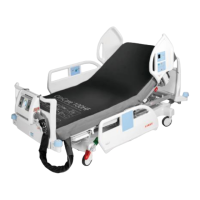
The power cable must not be connected through an extension cord and it must not be connected
to common multisocket inlets (trhree-way hub etc.).
No input cable of other devices can lead over the surfaces of the bed or over the patient. When
moving the bed, avoid pinching/kinking of any objects.
Pay attention to proper fixing of the approved accessories listed in the manual.
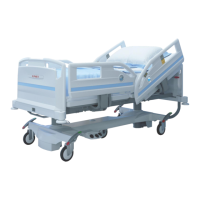
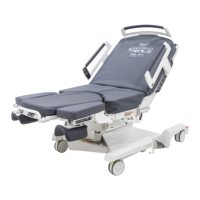
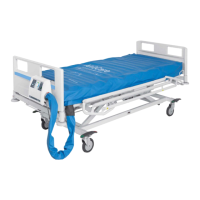
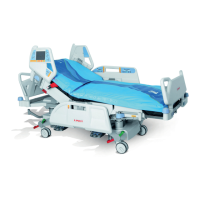
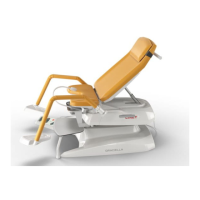
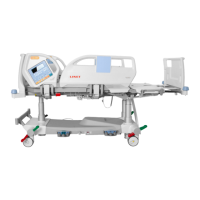
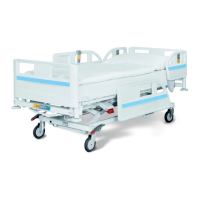
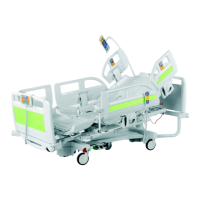
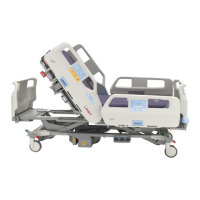
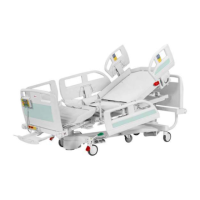
The birthing bed is installed by trained person. It can be operated in ordinary way by trained personnel
only. Trained personnel must be also educated on appropriate height of infusion stand setting.
The training is provided by LINET (manufacturer) representative or its authorized dealership.
The birthing bed includes fully charged and flawless battery that enables the bed to function for three
minutes. The battery is automatically charged from the control unit and does not require special
maintenance except the case when the bed is disconnected from the power supply more than 1 week.
In such case, it is necessary to disconnect the battery connector from the CB (Control Box).
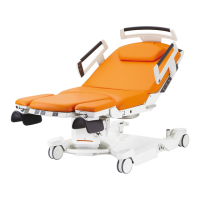
We recomend to set up the bed in to Welcome position:
Straight "horizontal" position at the lowest possible height of the bed.
The foot section and legrests is extended and set in the highest position, where it serves as a
lying area.
The bed is covered with government-issue sheets / disposable drapes.
The side rails are in the active position, and they serve as a safety feature.
The hand grips are hidden away so they do not get in the way when the mother enters the bed.
When the room is made dim in order to create a more pleasing atmosphere, the backlight of the
bed is switched on.
The wheels are braked with a central brake.
The staff always briefly instruct the mother on how to use the bed (control the basic functions, the
bed's adjustment) and showing the warning labels.
4.4.1 Transport, braking
The birthing bed also allows for the transport of a patient. This is, however, subject to the following
conditions:
The birthing bed allows for the transport of a patient by pushing forward using the handle on the back
section. Before transporting the patient, disconnect and store the power supply cables and equipotential
and other connections properly, to prevent their tearing off. Use the handle on the back section only to
transport the bed. Do not transport the patient if the bed is set in the chair position. If you do so, you
can cause injury to persons or damage to the device. Before transporting the patient, the central brake
must be released.
When transporting the patient, the locking pedal must be used to secure the front directional castor in a
straight direction. Otherwise the patient has to be transported by two persons.
When transporting the bed w i t h in hospital premises, make sure that the patient as well as all
equipment, such as cables (including the power supply cable), hoses, tubes, etc., are safely placed in the
area bounded by the circumference of the bed. Otherwise you can cause injury to persons or damage to
the device.
During transport, check the stability of the infusion stand - it can hit doors or ceiling lights. Before
transporting the patient, set the stands to the lowest position. Otherwise you can cause injury to
persons or damage to the device.
After the transport, reconnect the power supply cable and secure the bed with the central brake.
Otherwise you can cause injury to persons or damage to the device.
Do not expose the bed to prolonged extreme effects of external environment (snow, frost, rain, etc.). It
could damage the device.
Transport the bed in its lowest position and make sure that it is not transported over areas with
lateral inclination exceeding 5°. In case of interrupting the transport (stopping the movement of the


 To Next Page