G4 Wiring and Installation Manual36
© 2009 Link
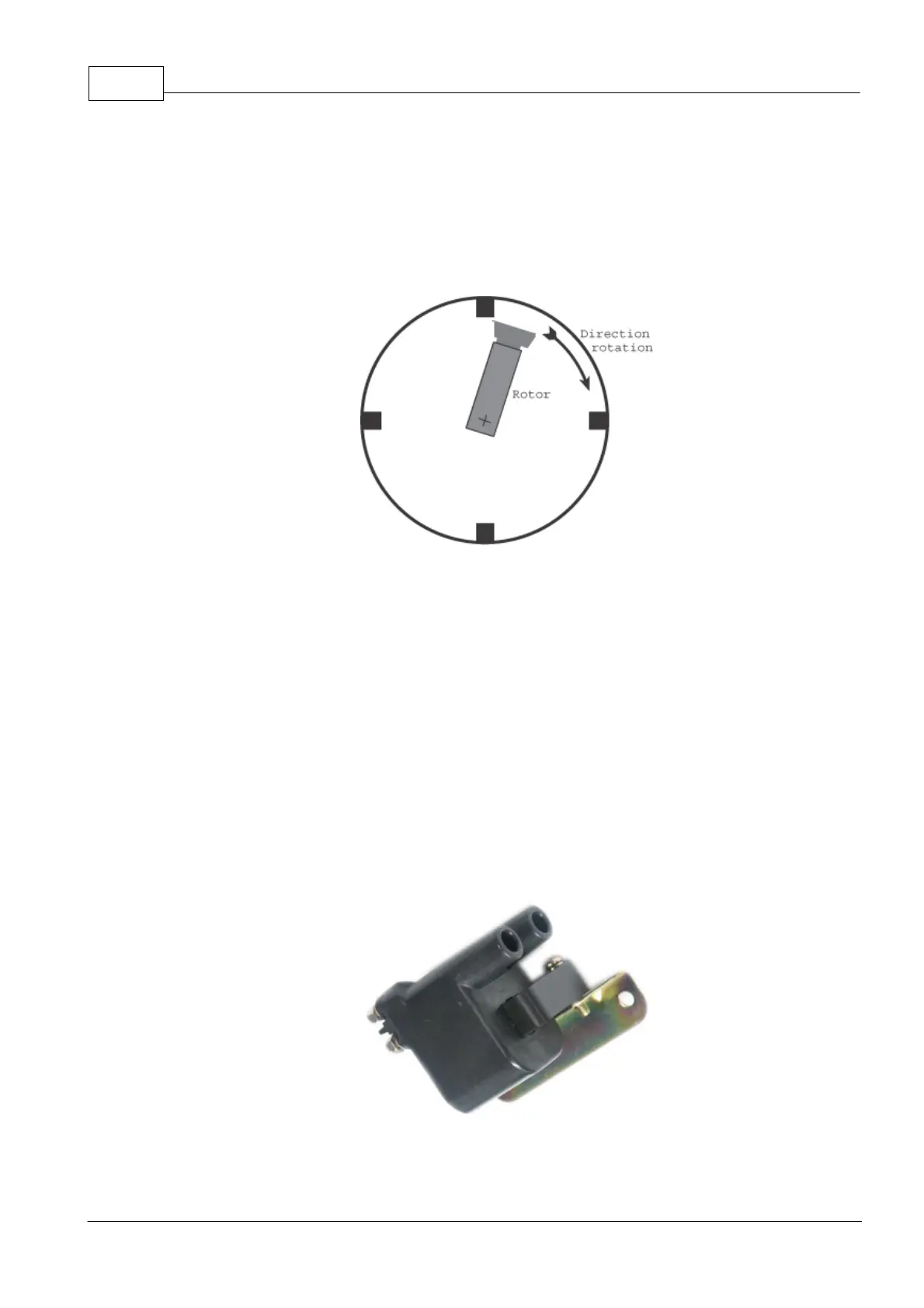
time, the rotor timing dictates the range of ignition advance angles that may be used without
misfiring or unnecessarily losing spark energy. A wider tip on the rotor will also allow a wider
range of timing values to be used. The tip of rotor should be just leaving the post when the
crankshaft is positioned at the minimum timing that will be used (typically at about 10
degrees BTDC). The point where the leading tip of the rotor arrives at the post is the most
advanced timing that should be used.
Correct Rotor Timing
8.2.5 Multi-Coil Wasted Spark Ignition
Wasted spark will fire two cylinders simultaneously, using a common dual post coil. When a
dual post coil is fired, two cylinders receive a spark. One cylinder is fired conventionally on
the compression stroke while the other cylinder has its piston in the same position but on the
exhaust stroke. One crankshaft rotation later, these two cylinders are two working stokes
further ahead and the spark plugs fire again, but now with reversed roles. The result is that
each coil will be fired twice per engine cycle hence the term “wasted spark”. This set-up can
ONLY be used on engines with an even number of cylinders.
Dual Post Coils
One dual post coil (with a primary resistance between 0.4 and 1.0 ohms) is required per 2
cylinders. Figure 8.8 shows a typical coil. The coils should be positioned so they minimise
the length of the HT Leads. This will help reduce the electrical noise generated when the
spark plugs are fired.
Dual Post Coil
The main concern when using dual post coils is the generation of electrical interference.
This can interfere with ECU operation and cause unwanted static on car radios. The ignition


 To Next Page