LeadCare
®
II User's Guide 4-9
The analyzer displays “Low” when it detects a
blood lead level below 3.3 µg/dL. “Low” results should
be recorded as “<3.3 µg/dL”. It is not uncommon to
obtain patient results that read “Low”.
If you do not run another test within 60 minutes (15 minutes when using
batteries), the analyzer will automatically go into “sleep” mode. If you have not
recorded your test result, it will be lost. You will have to repeat the analysis.
Interpreting Patient Test Results
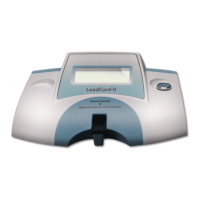
The analyzer’s display window shows the blood lead result. The result is in
micrograms (µg) of lead per deciliter (dL) of whole blood. No calculation is
needed. Results are displayed to one decimal place. The reportable range of the
LeadCare II system is 3.3 to 65 µg/dL.
“Low” in the display window indicates a blood lead test result less than
3.3 µg/dL. When this occurs, report the blood lead result as less than (<)
3.3 µg/dL.
“High” in the display windows indicates a blood lead test result greater than
65 µg/dL. When this occurs, report the blood lead result as greater than (>)
65 µg/dL. “High” results on LeadCare II should be followed up immediately
as an emergency laboratory test.
Follow-up Testing
Blood lead test results should be shared with the patient’s physician for
interpretation and to determine when retesting and follow-up care are necessary.
For the most current information regarding blood lead testing guidelines, please
refer to the CDC’s website
3
and your state specific regulations.
Please refer to Appendix C for Blood Lead Retesting Guidelines for Pediatric
Patients.
A capillary blood sample that generates an elevated lead level should be
confirmed with a venous sample. The venous sample should be run at a
reference laboratory on a high complexity testing method.
In cases where the capillary specimen demonstrates an elevated lead level but
the confirmation venous sample does not, it is important to recognize that the
child may live in a lead-contaminated environment that resulted in contamination
of the fingertip. Efforts should be made to identify and eliminate the source of
lead in these cases.
3
www.cdc.gov/nceh/lead/ACCLPP/blood_lead_levels.htm.


 To Next Page