Folio 972-3
BATTERY MAINTENANCE
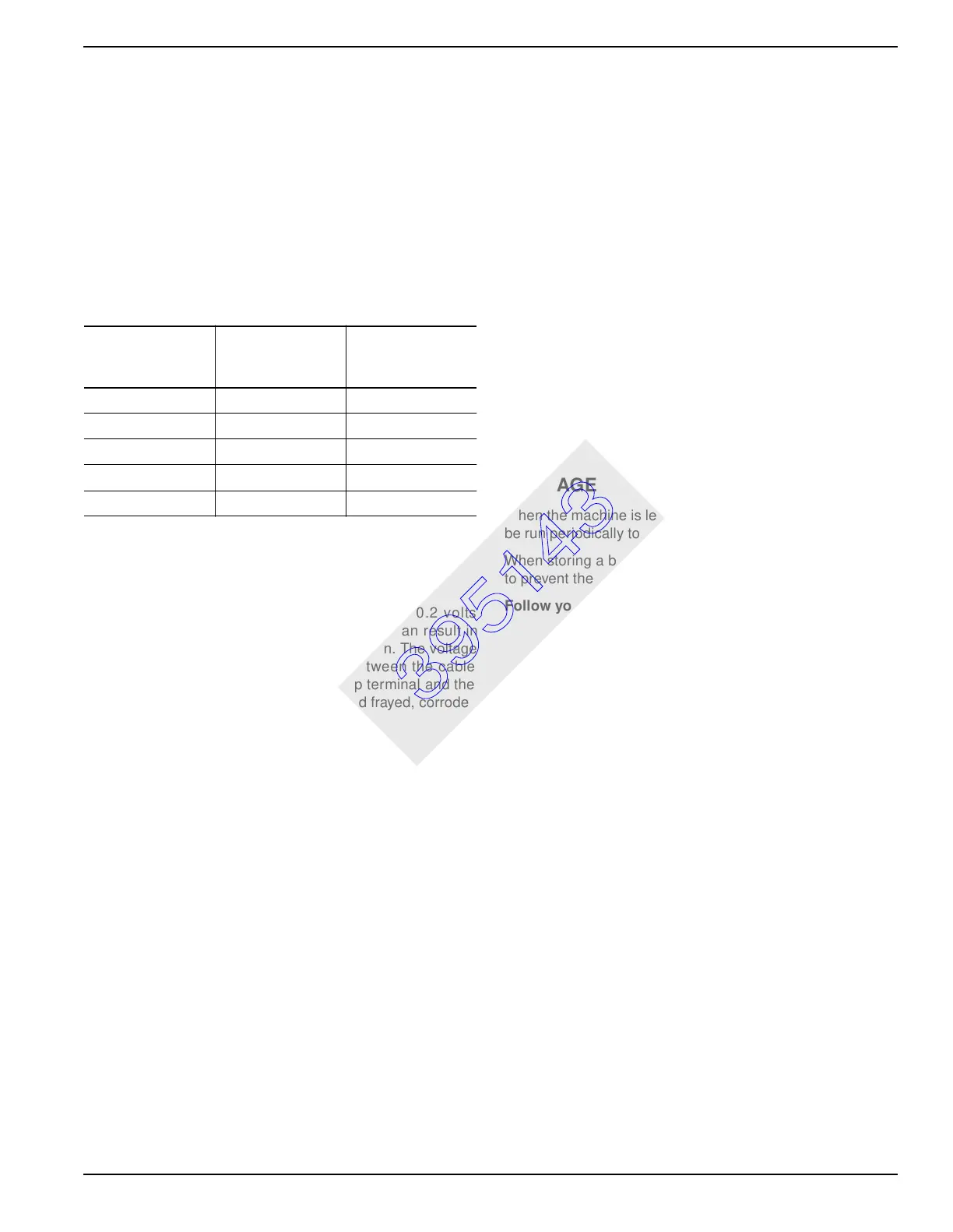
Open-Circuit Voltage Test
A sensitive voltmeter can be used to determine a battery’s
state-of-charge as depicted in Table 3.
The open circuit test is not as reliable in determining a
battery’s condition as the hydrometer test. This test is
acceptable for stored batteries, but not ones in use.
This test must not be performed on batteries being charge or
delivering power; charging causes an increase in voltage
which may persist for an extended period.
Table 3
Open Circuit Cell Voltage
NOTE:
Detailed test information is provided by the meter
manufacturer.
High Resistance Test
A voltage drop (while cranking) of more than 0.2 volts
between the starting motor cable and ground can result in
hard starting regardless of a battery’s condition. The voltage
drop can be caused by a poor contact between the cable
terminal and ground or between the clamp terminal and the
battery post. Poor start-switch contacts and frayed, corroded
or broken cables can also be the cause.
Quarterly
1.
Thoroughly clean the batteries and the holder with
baking soda.
2.
If provided, make sure the drain holes are open in the
holder. If water collects in the holder, drill drain holes.
3.
Clean the posts and terminals. The posts can be tightly
coated with grease to prevent corrosion.
4.
Make sure the hold-downs are in good condition; replace
faulty parts.
5.
Replace frayed, broken or corroded cables.
6.
Replace the batteries if their containers are cracked or
worn to the point they leak.
7.
Ensure good contact (tight) between the clamp terminals
and battery posts.
Make sure the hold-downs are tight enough to prevent
battery movement but not so tight to cause distortion.
CHARGING
If at all possible, the battery should be at room temperature
when recharging. Before a battery is recharged, it must be
thoroughly cleaned. Take care not to allow dirt to enter the
cells.
A battery should be recharged in the way it was discharged.
If it was discharged over a long period of time, it should be
recharged slowly at 6 to 10 amps for up to 10 hours. A rule-
of-thumb value for a slow rate is a current equal to about
one-half the number of plates per cell in the battery. A battery
with 13 plates per cell, should, therefore be charged at 7
amps.
If a battery was discharged rapidly (cranking until dead), it
can be recharged on a fast charger with an output of up to 40
amps for a maximum of 2 hours. If the electrolyte
temperature reaches 125°F or if it gases violently, the
charging current must be reduced or halted to avoid battery
damage.
For optimum charging results, adhere to the charger
manufacturer’s instructions.
STORAGE
When the machine is left idle for prolonged periods, it should
be run periodically to charge the batteries.
When storing a battery, make sure it is at least 75% charged
to prevent the possibility of freezing.
Follow your battery dealer’s recommendations.
% Charge Specific Gravity
Approx. Open
Circuit Cell
Voltage
100 1.260 2.10
75 1.230 2.07
50 1.200 2.04
25 1.170 2.01
Discharged 1.110 1.95
395143









 To Next Page