Folio 931-3
WIRE ROPE INSTALLATION AND MAINTENANCE
Winding Wire Rope onto Drum
Refer to Figure 5.
Refer to “Load Line Specification Drawing” in Service or
Operator’s Manual for correct type, size, and amount of wire
rope to be installed on load drums.
Refer to “Boom Rigging Drawing” in Service or Operator’s
Manual for correct type, size, and amount of wire rope to be
installed on boom hoist drums.
Refer to “Drum and Lagging Chart” in Service or Operator’s
Manual for correct size of drum laggings, if used.
1. Carefully inspect drums and all rope guides, rollers, and
sheaves for damage that can cause wire rope to wear or
be cut. If damage cannot be fixed, replace faulty parts.
2. Apply tension to wire rope as it is wound slowly onto
drum. First wrap must be tight against drum flange for
approximately three-fourths of drum diameter. Tap
adjacent wraps against each other with a soft metal or
wooden mallet.
Use extreme care not to put twists or turns in wire rope;
allow rope to assume its natural lay.
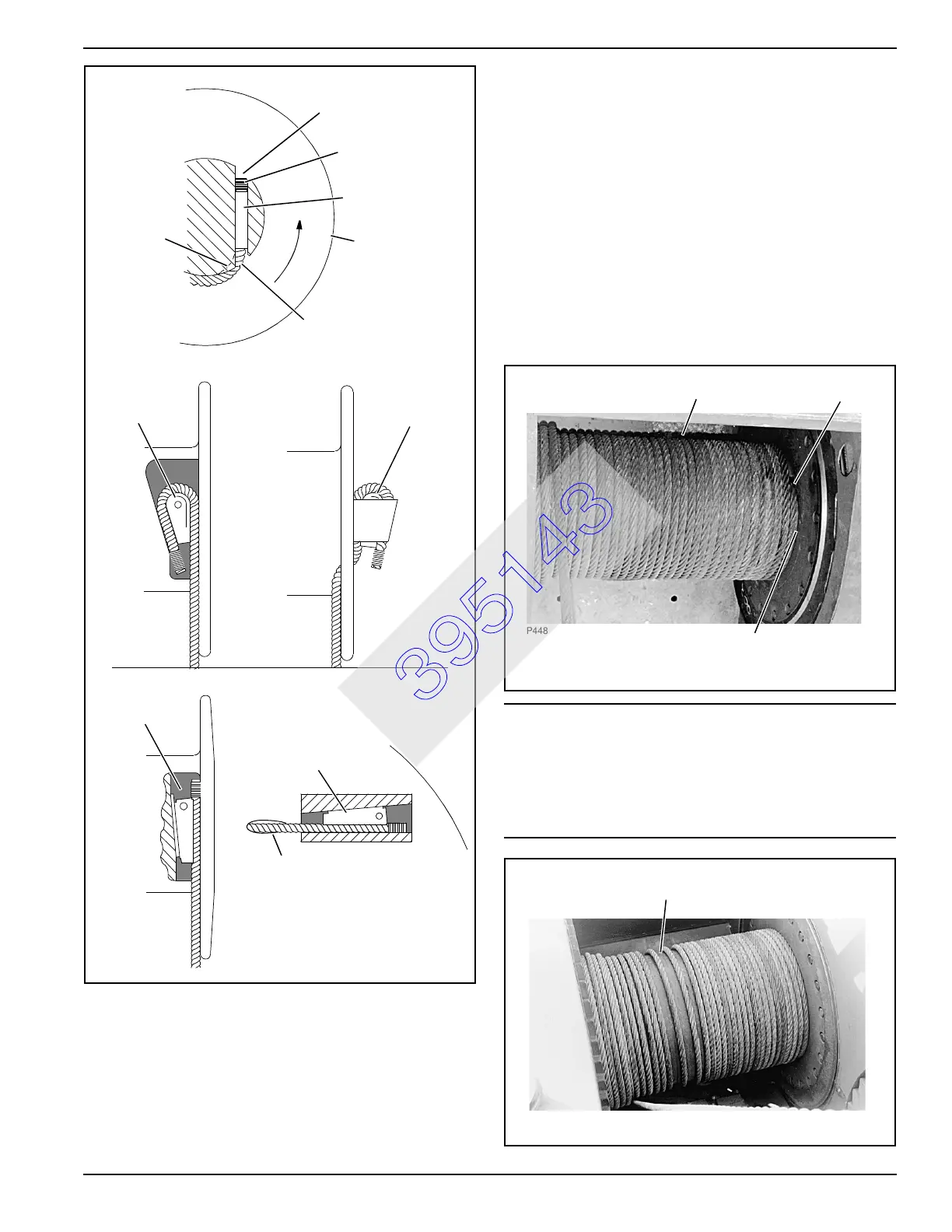
FIGURE 4
Hole in
Drum Flange.
Straight Wedge
Inside drum.
Wrap-Around
Wedge Inside
Drum.
Wrap-Around
Wedge Outside
Drum.
Drum
Groove
Seizing
Wedge
Wire
Rope
Drum
Don’t Allow Dead End to
Extend Out of Socket
Opening.
Straight Wedge
Outside drum.
CAUTION!
Wire Rope Damage!
Voids or spaced wraps in first layer (see Figure 6) will
permit movement and a wedging action with subsequent
layers. Wedging action will cause crushing and abrasion
of wire rope. Never allow wire rope to “cross wind”.
FIGURE 5
P448
First Wrap Tight Against
Flange for 3/4 of Diameter.
Wraps of First Layer Tight Against
Drum and Against Each Other.
Wedge
FIGURE 6
P449
Voids and Loose Wraps in First Layer
Cause Severe Wear of Wire Rope.
395143







 To Next Page