© 2002 Manitowoc Cranes, Inc.
Rev. 04-08-2002 Folio 997-1
LOAD BLOCK AND HOOK-AND-WEIGHT BALL
Maintenance and Inspection
The operating condition of the load block and the hook-and-
weight ball can change daily with use; therefore, they must
be inspected daily (at start of each shift) and observed
during operation for any defects which could affect their safe
operation. Correct all defects before using the load block or
the hook-and-weight ball.
Daily inspection and maintenance will include the following
points (see Figures 2 and 3):
1.
Clean the load block or the hook-and-weight ball.
2.
Lubricate the sheaves (if fittings provided), the hook
trunnion, the hook swivel, and any other part equipped
with a grease fitting at the intervals specified in the
“Lubrication Guide.”
3.
Tighten loose tie-bolts, capscrews, and setscrews.
Check that all cotter keys are installed and opened.
4.
Check the sheaves for uneven wear in the grooves and
on the flanges. Check for loose or wobbly sheaves.
These conditions indicate faulty bearings or bushings.
5.
Check the fit of the wire rope in the groove of each
sheave. An oversize wire rope can crack the lip of the
sheave flange causing rapid wear of the wire rope and
sheave. The groove must be larger than the wire rope,
and the groove must be free of rough edges and burrs.
6.
Check that the hook, the trunnion, and the swivel rotate
freely without excessive play. Faulty operation indicates
faulty bushings or bearings or inadequate lubrication.
7.
Check the swivel of the hook-and-weight ball for the
following conditions:
•
Overloading: Spin the swivel by hand; if the motion
is rough or has a ratchet-like effect, the swivel
bearings are damaged.
•
Side loading: The swivel will turn freely in one spot
and lock-up in another. This condition can also be
checked by looking at the gap (see Figur e2)
between the barrel and shank (swivel must be
removed from weight ball to check); if the gap is
wide on the side and closed on the other, damage is
present.
NOTE:
The gap between the barrel and the shank is
normally 0.020 to 0.050 inches. If the gap
increases, swivel-bearing failure is indicated.
8.
Check the load block for signs of overloading: spread
side plates, elongated holes, bent or elongated tie-bolts,
and cracks.
9.
Check the wire rope for wear and broken wires at the
point the wire rope enters the dead-end socket. Check
the socket for cracks. Tighten the wire-rope clips at the
dead end of the wire rope.
10.
Check that each hook is equipped with a hook latch and
that the hook latch operates properly.
The latch must not
be wired open or removed.
11.
Inspect each hook and shackle for damage as shown in
Figure 4.
WARNING
Falling Load Hazard!
To prevent load from dropping due to structural failure of
load block or hook-and-weight ball:
• Only use a load block or a hook-and-weight ball which
has a capacity equal to or greater than load to be
handled.
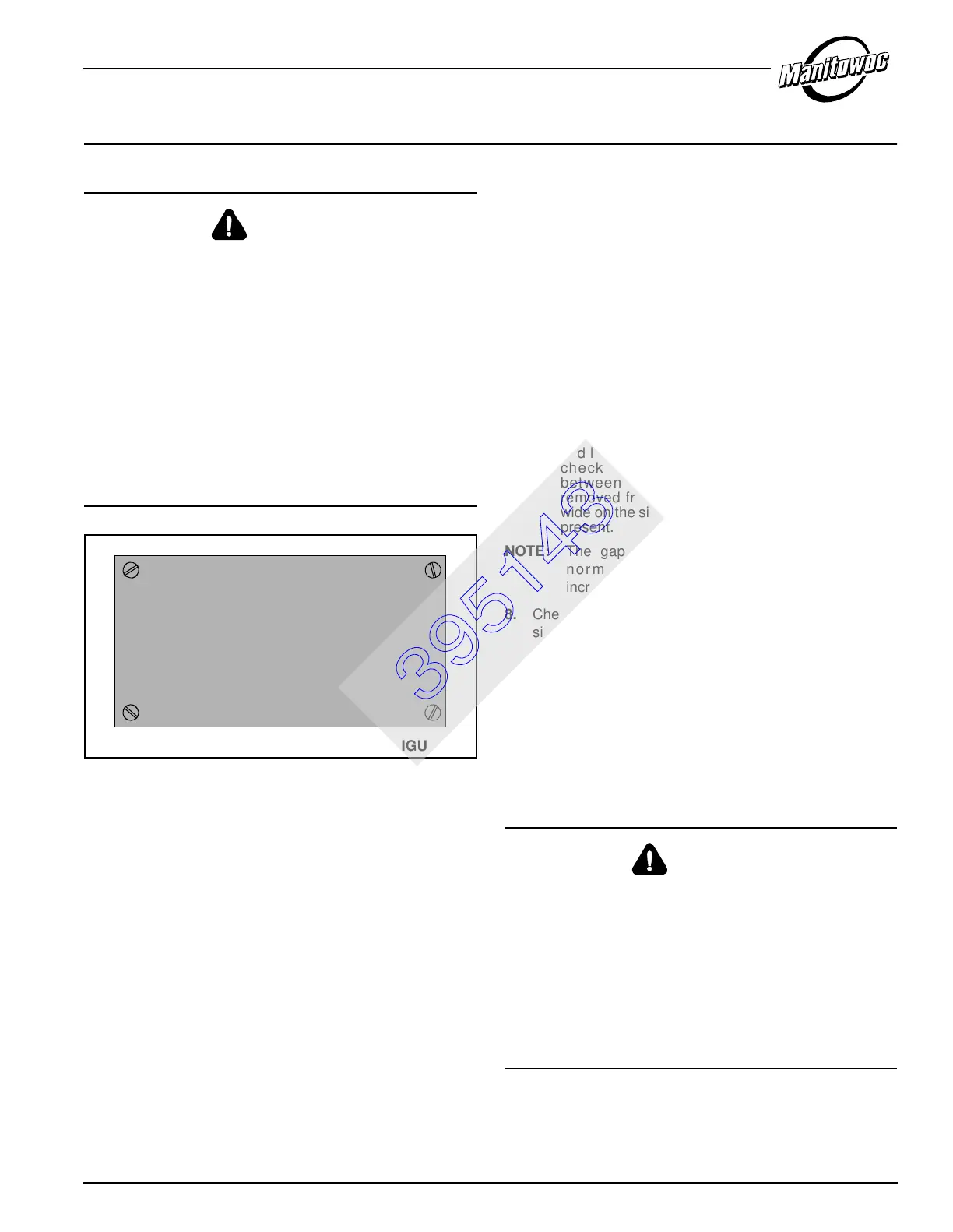
• Do not remove or deface nameplate (Figure 1)
attached to load blocks and hook-and-weight balls.
• See “Load-Block Data” in CAPACITIES Section of
Service Manual for recommended sling angles and
capacity restrictions when load block has duplex or
quadruplex hook.
FIGURE 1
CAP.
WT
.
MANITOWOC
U.S. TON
LB’S.
NO.
SERIAL NO.
Maximum
Capacity
Weight
of Unit
M.E.C. Part Number
of Unit
WARNING
Falling Load Hazard!
To prevent load from dropping:
• Hook latch must retain slings or other rigging in hook
under slack conditions. Hook latch is not intended as
anti-fouling device, and caution must be taken to
prevent hook latch from supporting any part of load.
Slings or other rigging must be seated in hook when
handling load; they must never be in position to foul
hook latch.
395143




 To Next Page