2B-2 90-13645--2 495ELECTRICAL AND IGNITION
Specific Gravity Readings
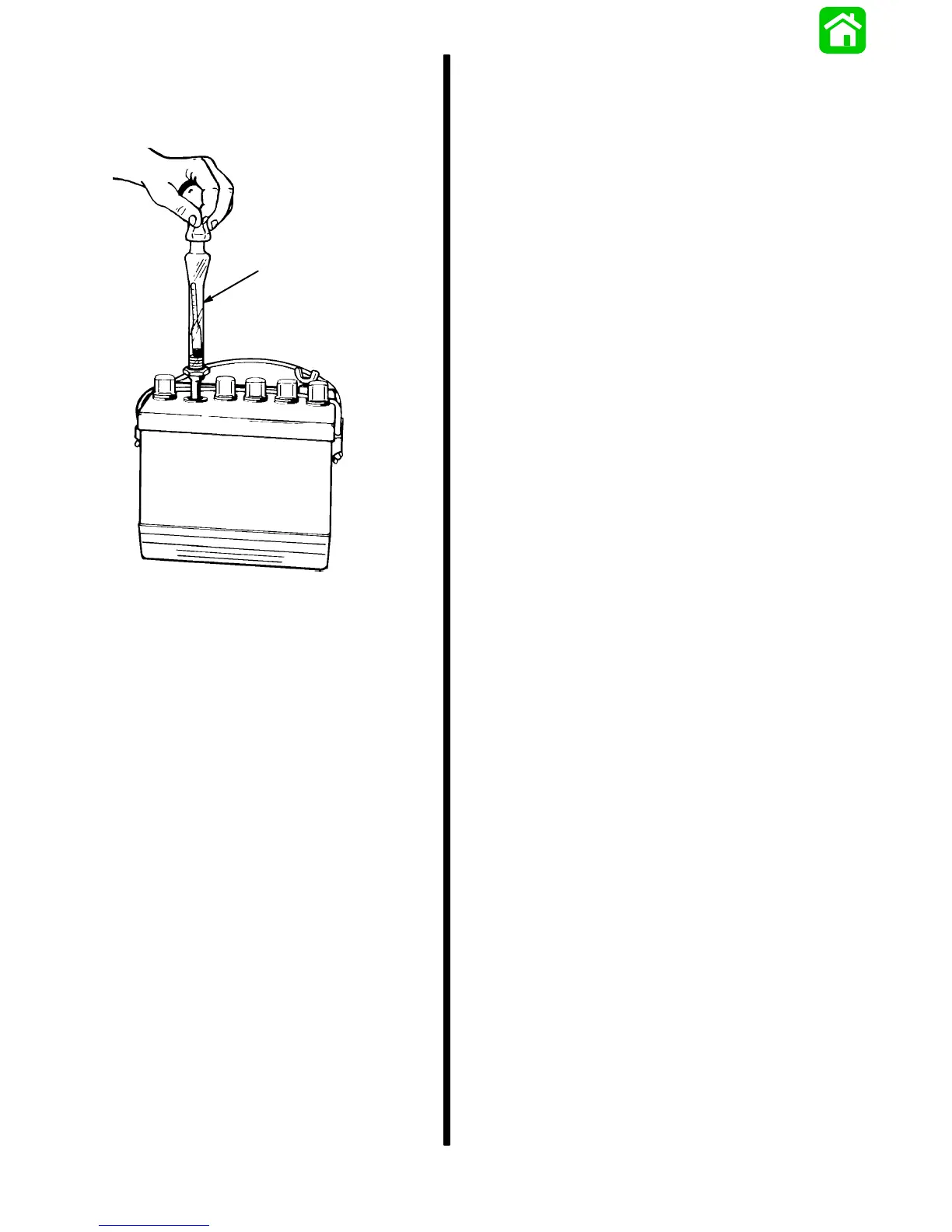
Use a hydrometer to measure specific gravity of elec-
trolyte in each cell.
22532
a
a - Hydrometer
Hydrometer measures percentage of sulphuric acid
in battery electrolyte in terms of specific gravity. As a
battery drops from a charged to a discharged condi-
tion, acid leaves the solution and chemically com-
bines with the plates, causing a decrease in specific
gravity of electrolyte. An indication of concentration of
electrolyte is obtained with a hydrometer.
When using a hydrometer, observe the following
points:
1. Hydrometer must be clean (inside and out) to in-
sure an accurate reading.
2. Never take hydrometer readings immediately af-
ter water has been added. Water must be thor-
oughly mixed with electrolyte by charging for at
least 15 minutes at a rate high enough to cause
vigorous gassing.
3. If hydrometer has built-in thermometer, draw liq-
uid in several times to ensure correct temperature
before taking reading.
4. Hold hydrometer vertically and draw in just
enough liquid from battery cell so that float is free-
floating. Hold hydrometer at eye level so that float
is vertical and free of outer tube, then take reading
at surface of liquid. Disregard curvature where liq-
uid rises against float stem due to capillary action.
5. Avoid dropping electrolyte on boat or clothing, as
it is extremely corrosive. Wash off immediately
with baking soda solution.
Specific gravity of electrolyte varies not only with per-
centage of acid in liquid but also with temperature. As
temperature drops, electrolyte contracts, so that spe-
cific gravity increases. Unless these variations in spe-
cific gravity are taken into account, specific gravity ob-
tained by hydrometer may not give a true indication
of concentration of acid in electrolyte.
A fully charged battery will have a specific gravity
reading of approximately 1.270 at an electrolyte
temperature of 80 F (27 C). If electrolyte tempera-
ture is above or below 80 F, additions or subtractions
must be made in order to obtain a hydrometer reading
corrected to 80 F standard. For every 10 F (3.3 C)
above 80 F, add 4 specific gravity points (.004) to
hydrometer reading. Example: A hydrometer reading
of 1.260 at 110 F (43 C) would be 1.272 corrected
to 80 F, indicating a fully charged battery.
For every 10 below 80 F, subtract 4 points (.004)
from the reading. Example: A hydrometer reading of
1.272 at 0 F (–18 C) would be 1.240 corrected to
80 F, indicating a partially charged battery.
SPECIFIC GRAVITY CELL COMPARISON TEST
This test may be used when an instrumental tester is
not available. To perform this test, measure specific
gravity of each cell, regardless of state of charge, and
interpret results as follows: If specific gravity readings
show a difference between highest and lowest cell of
.050 (50 points) or more, battery is defective and
should be replaced.
Electrolyte Level
Check electrolyte level in battery regularly. A battery
in use in hot weather should be checked more fre-
quently because of more rapid loss of water. If electro-
lyte level is found to be low, then distilled water should
be added to each cell until liquid level rises approxi-
mately 3/16″ (4.8mm) over plate. DO NOT OVER-
FILL, because this will cause loss of electrolyte and
result in poor performance, short life and excessive
corrosion.



 To Next Page