4-8
Rad-57 Signal Extraction Pulse CO-Oximeter Operator’s Manual
4
Operation
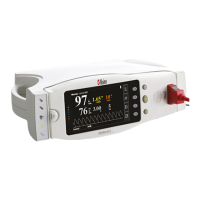
Numeric Display - PI
The Perfusion Index (PI) display provides a relative numeric indication of the pulse strength at the
monitoring site. It is a calculated percentage between the pulsatile signal and nonpulsatile signal of
arterial blood moving through the site. PI may be used to find the best perfused site and to monitor
physiological changes in the patient. It displays a range of < .1% to > 5% on the bar graph display
and a numerical range of 0.03% to 20.0% on the display screen. A percentage greater than 1.00%
is desired. Extreme changes in the display number are due to changes in physiology and blood flow.
Pleth Variability Index - PVI (upgraded Instrument)
The Pleth Variability Index (PVI) is a measure of the dynamic changes in the perfusion index (PI)
that occur during the respiratory cycle. The calculation is accomplished by measuring changes in PI
over a time interval where one or more complete respiratory cycles have occurred. PVI is displayed
as a percentage (0-100%).
Low Signal IQ (Low SIQ)
The Rad-57 display provides a visual indicator Signal IQ and an alert when the displayed values are not
based on adequate Signal IQ. The Low SIQ indicator flashes when the may be compromised. When
the Low SIQ indicator is flashing, proceed with caution and do the following:
■ Assess the patient.
■ Check the sensor and ensure proper sensor application. The sensor must be well secured to the
site for the Rad-57 to maintain accurate readings. Also, misalignment of the sensor’s emitter and
detector can result in smaller signals.
■ Determine if an extreme change in the patient’s physiology and blood flow at the monitoring site
occurred, (e.g. an inflated blood pressure cuff, a squeezing motion, sampling of an arterial blood
specimen from the hand containing the pulse oximetry sensor, severe hypotension, peripheral
vasoconstriction in response to hypothermia, medications, or a spell of Raynaud’s syndrome.)
■ With neonates or infants, check that the peripheral blood flow to the sensor site has not been
interrupted. For example, as may occur while lifting or crossing their legs during a diaper change.
After performing the above, if the “Low SIQ” indication occurs frequently or continuously, obtaining an
arterial blood specimen for CO-Oximetry analysis may be considered to verify the oxygen saturation
value.
Low Perfusion
Low Perfusion is indicated when the arterial pulsations are very low (weak perfusion). Low Perfusion
is shown when the PI LED indicator bar does not exceed 0.25 on the Rad-57.
CAUTION: IF LOW PERFUSION INDICATION IS FREQUENTLY DISPLAYED, FIND A BETTER
PERFUSED MONITORING SITE. IN THE INTERIM, ASSESS THE PATIENT AND, IF INDICATED, VERIFY
OXYGENATION STATUS THROUGH OTHER MEANS.


 To Next Page