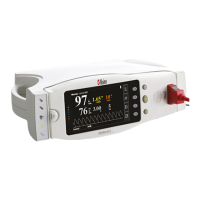
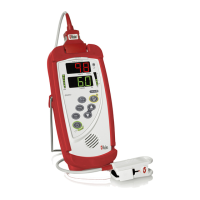
Rad-57 Signal Extraction Pulse CO-Oximeter Operator’s Manual
6-1
6
Troubleshooting
Section 6 - Troubleshooting
Troubleshooting
The following chart describes what to do if the Rad-57 system does not operate properly or fails.
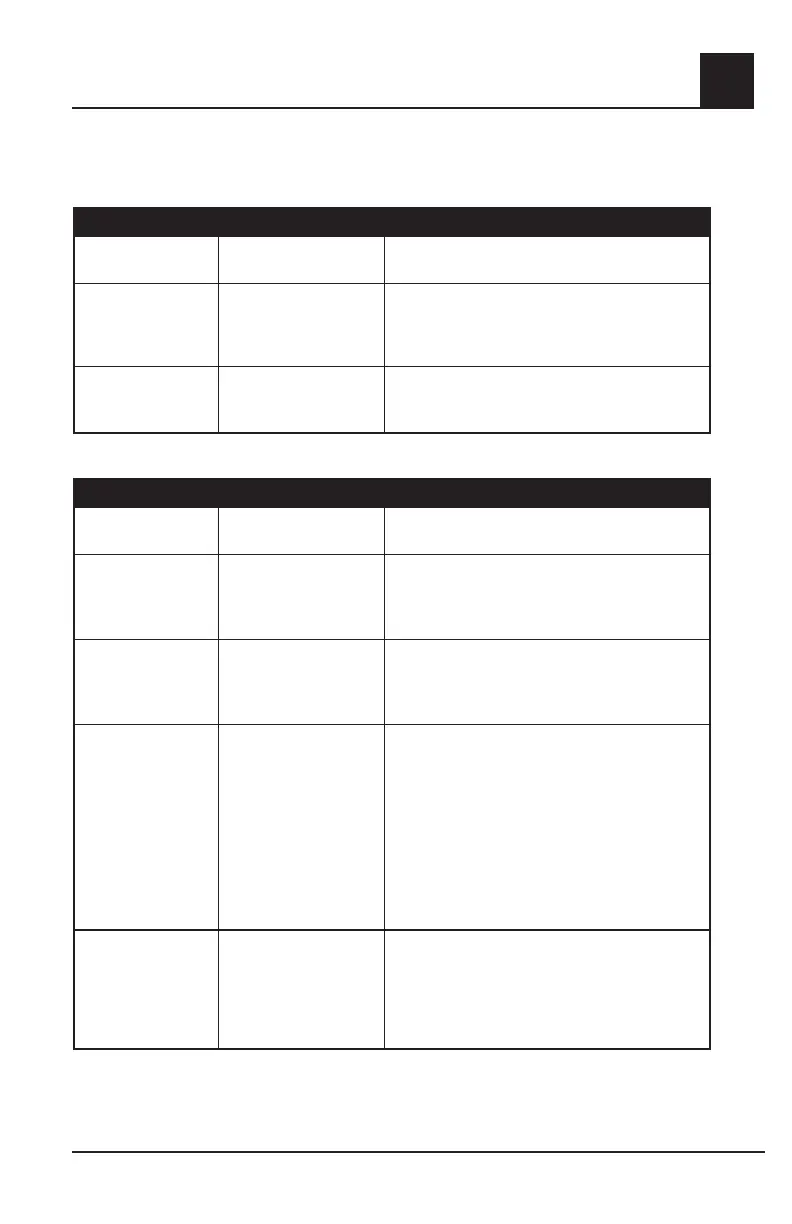
PROBLEM POSSIBLE CAUSE(S) RECOMMENDATION
INSTRUMENT DOES
NOT POWER ON
Depleted battery Check and/or replace the batteries.
CONTINUOUS
SPEAKER TONE
Internal Failure
Instrument requires service. Press the Alarm Silence
button to silence the alarm. If alarm continues to
sound, power down Instrument and remove Handheld
battery if necessary.
BUTTONS DON’T
WORK WHEN
PRESSED
Internal failure Instrument requires service.
The following chart describes what to do when encountering common problems:
PROBLEM POSSIBLE CAUSE(S) RECOMMENDATION
NUMERIC VALUE
FLASHES
Saturation alarm limit
exceeded.
Assess/address patient condition
Re-set alarm limits if indicated.
SENSOR OFF
MESSAGE
Sensor not connected to
patient properly.
Sensor is damaged.
Properly reapply the sensor on the patient and
reconnect the sensor to the Instrument or patient
cable.
If the sensor is damaged, replace the sensor.
NO SENSOR
MESSAGE
Sensor is disconnected
from patient cable.
Sensor connected upside
down into patient cable.
Check to see if the sensor LED is flashing. Disconnect
and reconnect the sensor. If the LED fails to operate,
replace the sensor.
LOW PERFUSION
Improper sensor type.
Poorly perfused site.
Sensor is too tight.
A disorder such
as hypothermia,
vasoconstriction,
hypovolemia, peripheral
vascular disease or
anemia.
Sensor is damaged.
Verify proper sensor and sensor size for the patient.
Check and see if blood flow to the site is restricted.
Be sure that the sensor is not on too tight.
Set Instrument to MAX sensitivity.
Warm the patient or sensor site.
Move sensor to better perfused site.
LOW SIGNAL
QUALITY
Improper sensor type or
application.
Excessive motion relative
to perfusion.
Sensor is damaged or not
functioning
Check and see if blood flow to the site is restricted.
Check the placement of the sensor.
Re-apply sensor or move to a different site.


 To Next Page