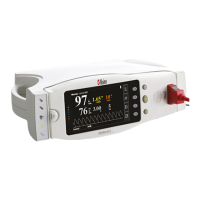
Rad-57 Signal Extraction Pulse CO-Oximeter Operator’s Manual
ii
Safety Information, Warnings and Cautions, continued
■ Do not place the Rad-57 where the controls can be changed by the patient.
■ Do not place the Rad-57 on electrical equipment that may affect the instrument, preventing it from
working properly.
■ Do not expose the Rad-57 to excessive moisture such as direct exposure to rain. Excessive moisture
can cause the instrument to perform inaccurately or fail.
■ Do not place containers containing liquids on or near the Rad-57. Liquids spilled on the instrument
may cause it to perform inaccurately or fail.
■ Changes or modifications not expressly approved by the party responsible for compliance could
void the user's authority to operate the equipment
■ SpO
2
is empirically calibrated to functional arterial oxygen saturation in healthy adult
volunteers with normal levels of carboxyhemoglobin (COHb) and methemoglobin (MetHb).
The Rad-57 cannot measure elevated levels of COHb or MetHb. Increases in either COHb or
MetHb will affect the accuracy of the SpO
2
measurement.
■ Inaccurate SpO
2
readings can be caused by:
z Improper sensor placement
z Elevated levels of COHb and MetHb
z For increased COHb: COHb levels above normal tend to increase the level of SpO2. The
level of increase is approximately equal to the amount of COHb that is present.
z NOTE: High levels of COHb may occur with a seemingly normal SpO2. When elevated
levels of COHb are suspected, laboratory analysis (CO-Oximetry) of a blood sample
should be performed.
■ For increased MetHb: the SpO
2
may be decreased by levels of MetHb of up to approximately
10% to 15%. At higher levels of MetHb, the SpO
2
may tend to read in the low to mid 80s.
When elevated levels of MetHb are suspected, laboratory analysis (CO-Oximetry) of a
blood sample should be performed.
■ Inaccurate SpCO and SpMet readings can be caused by:
z Improper sensor application
z Intravascular dyes such as indocyanine green or methylene blue
z Abnormal hemoglobin levels
z Low arterial perfusion
z Low arterial oxygen saturation levels including altitude induced hypoxemia
z Elevated total bilirubin levels
z Motion artifact
z SpCO readings may not be provided if SpO2 readings are less than 90%
z SpCO readings may not be provided if SpMet readings are greater than 2%
z Intravascular dyes such as indocyanine green or methylene blue


 To Next Page