Reel Disk from McFarlane Mfg. 16 800-627-8569
SAFETY
INSTRUCTIONS
• Never use independent braking with unit in tow as
loss of control and/or upset of unit may result.
• Always drive at a safe speed relative to local
conditions and ensure that your speed is low enough
for an emergency stop to be safe and secure. Keep
speed to a minimum.
• Reduce speed prior to turns to avoid the risk of
overturning.
• Avoid sudden uphill turns on steep slopes.
• Always keep the tractor or towing vehicle in gear to
provide engine braking when going downhill. Do not
coast.
• Use approved accessory lighting or fl ags and
necessary warning devices to protect operators of
other vehicles on the highway during daylight and
nighttime transport. Various safety lights and devices
are available from your dealer.
• The use of fl ashing amber lights is acceptable in
most localities. However, some localities prohibit their
use. Local laws should be checked for all highway
lighting and marking requirements.
• When driving the tractor and equipment on the road
or highway, use fl ashing amber warning lights and a
slow moving vehicle (SMV) identifi cation emblem.
• Be a safe and courteous driver. Always yield to
oncoming traffi c in all situations, including narrow
bridges, intersections, etc. Plan your route to avoid
heavy traffi c.
• Be observant of bridge loading ratings. Do not cross
bridges rated lower than the gross weight at which
you are operating.
• Watch for obstructions overhead and to the side while
transporting.
• Always operate equipment in a position to provide
maximum visibility at all times. Make allowances for
increased length and weight of the equipment when
making turns, stopping, etc.
Pre-towing Checklist
1. Before towing, make sure the maintenance on the
tractor and the unit are current. This is very important
because towing puts additional stress on the tow
vehicle.
2. Check and correct the tire pressures on the tow
vehicle and the unit. Refer to the Tire and Lug Torque
specifi cation chart in the manual.
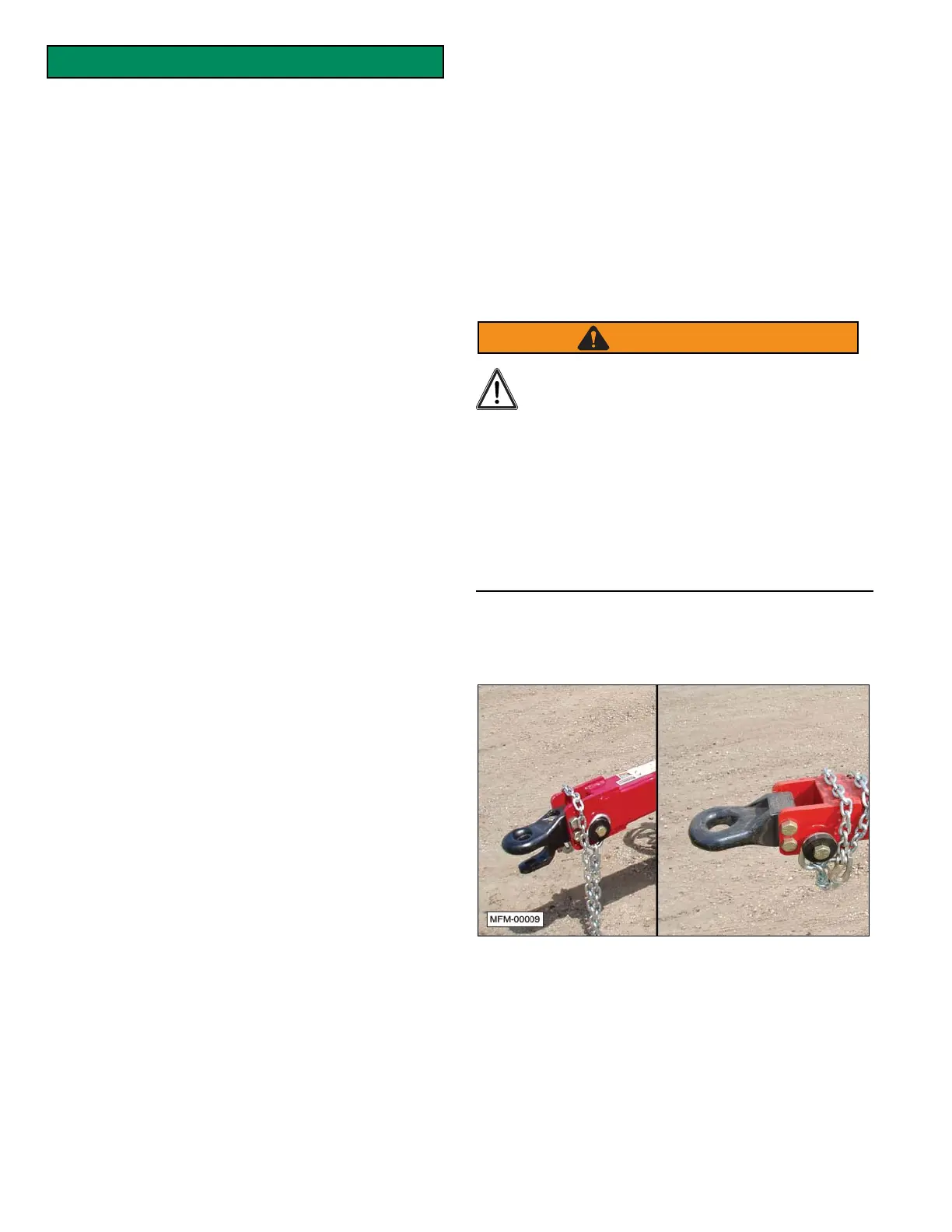
3. Make sure the hitch, coupler, and any other equipment
that connects the unit and the tow vehicle are properly
secured and adjusted. Always inspect the hitch and
tongue for cracks when hooking up.
WARNING
Substandard Parts Hazard
If towing the unit with a draw bar, use only an
OEM certifi ed, hardened drawbar pin with a
retainer clip. Do not use homemade pins, bolts, or
any other type of retaining device. Always install the
retainer clip, making sure the hitch and unit are
securely fastened to the tow vehicle.
Using a pin not intended for this type of towing, can
result in unexpected separation of the unit from the
tow vehicle resulting in equipment damage and
personal injury.
4. Verify the appropriate Category 3 or Category 4 hitch
is securely installed.




 To Next Page